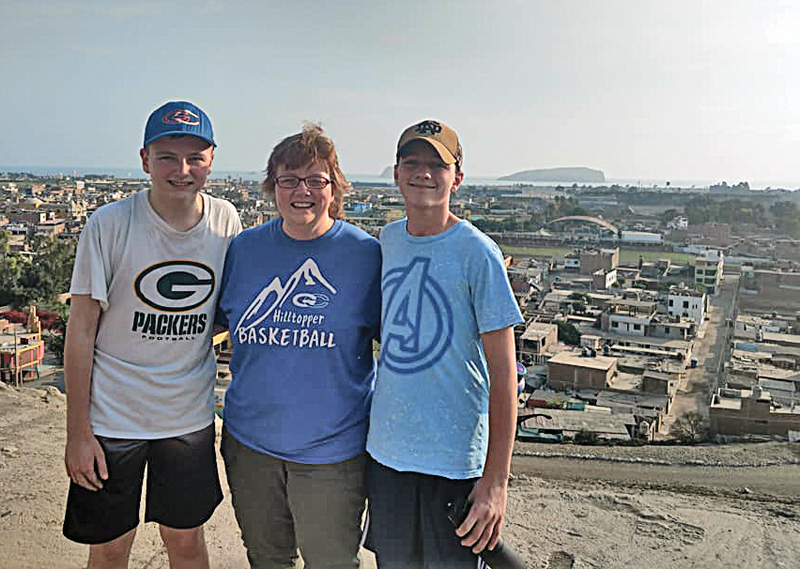
VIEW FROM ABOVE — Brendan, Crystal and Steven Booth stand above Casa Hogar in Lurin, Peru during a mission trip in 2019. The Pacific Ocean is in background. —photo submitted
By Crystal L. Booth
Last spring break, there were no quarantines, no battles with Coronavirus, just some worries about the possibility of malaria, upset stomachs, and the less likely yellow fever, as my sons Brendan, Steven, and I headed for Peru. With 17 other souls, mainly from the Diocese of La Crosse and St. Joseph Catholic Church in Menomonie, we embarked to Minneapolis, caught a flight down to Houston, then Lima, Peru, traveling over 4,000 miles, but still in the Central Time-Zone.
What was our destination? An eight day mission, beginning March 23, 2019, to a place once thought impossible to build, and founded by an unlikely priest who had been thought too “foolish” as he had difficulty with Latin and other subjects. We traveled to Casa Hogar Juan Pablo II, in Lurin – Lima, Peru, an orphanage where 64 youth, ages 5 to 17, live within families of 8 children and two parents or teachers, heading up each “family”. Modeled after Boys Town methods, Casa Hogar is a mission of the Diocese of La Crosse.
Some background from it’s website at https://www.homeajpm.org/home, Casa Hogar was founded on March 22, 1986, and first opened its doors to homeless and abandoned children in 1985. Fr. Joe Walijewski, a missionary priest from the Diocese of La Crosse, went to Peru in 1971 and spent almost 20 years in a nearby village, Villa El Salvador, where he founded the first parish there, Christ the Savior Parish. At the time, the area was a place for those with little to no money, those who were displaced and lost, in essence a shanty town. Pope John Paul II, now St. John Paul II, went to Lima in 1985, after Fr. Walijewski visited the pontiff in 1978, inviting him to come to Peru to witness first hand the needs there. Fr. Walijewski shared his dream of building a home for the abandoned children of Peru. He was first inspired to create such a home after one day noticing a pile of newspapers on the ground that began to move. Out popped the head of a little girl and boy. These homeless and abandoned children had spent nights on the street, with only old newspapers to protect them. St. John Paul was so moved by the people and poverty in Peru that he donated the first $50,000 toward the building of Casa Hogar, in nearby Lurin.
Our Wisconsin group did not go empty handed. Donations of clothing and medical supplies that had poured in from throughout the Diocese were brought along. Each missionary carried one bag for themselves, and two filled to the brim with donations. We arrived at the orphanage about 11 p.m., a gated and walled property, with plenty of space for a soccer game. Our ride there was harrowing, full speed ahead as our group was divided into three vehicles, with little regard by the Peruvian driver for traffic signs or lights.
The first image we saw upon entering the main building was a large statue of St. John Paul II. The next morning revealed the large foothills around Casa Hogar, and a winding path leading up to Fr. Walijewski’s burial tomb and the hills beyond. The group would later shovel and sweep off the collected mounds of shifting sand that had piled up on this winding path, in preparation for Easter. The path was really a life-size Stations of the Cross, or a replica of the final walk of Jesus to his crucifiction place, as remembered during the season of Lent. The group, some of whom were accountants and contractors, estimated they cleared out about 20 tons of sand, rocks, and debris.
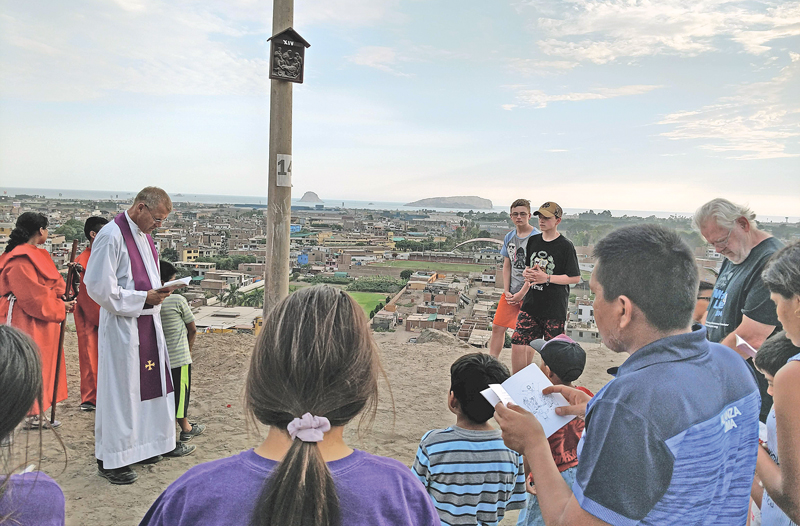
Participating in the Stations of the Cross on grounds of Casa Hogar in Lurin, Peru. Brendan and Steven Booth are shown standing in the back. The Pacific Ocean is in background. The two brothers from Glenwood City along with their mother Crystal Booth were in Lurin, Peru during a mission trip in 2019. —photo submitted
In addition to providing needed donations, our mission was to spend time with the families at Casa Hogar, learn with and from them, eat, share, work, and worship. The time spent with each other and the families was deeply moving. In addition to the families, much of the group’s time was spent with Casa Hogar’s current priest, Fr. Joe Hirsch, who grew up on a farm near Thorp, and the staff at Casa Hogar. On our first day there, we entered Lurin and celebrated an outdoor Mass with many local people, who shared what food they had, a combination of hot-cross-buns and fruit cake, along with punch. Most days of this journey began with a 5:00 a.m. car horn blare and church bell call to children, teachers, staff and visitors, followed by a 6:00 a.m. Mass. Children, teachers, and visitors aren’t required to attend Mass, but it is strongly encouraged to begin their day.
Children were just beginning their school year there, as we head into spring, they are heading into their fall. After Mass and a good breakfast, usually of eggs, breads, and jams, children would travel and walk their separate ways to school. There are several schools around Lurin, and children had their choice from Catholic, Protestant, and Public schools. There are many brick or block walls along main streets, in front of businesses and schools, so when you walk down some of the streets, often you cannot see what is really there. The last day our mission group was in Lurin, we walked the students to their schools, and only caught a glimpse of what was inside as we dropped them off at the gated doors. These walls are due to past oppression and the need of protection from former terrorist attacks, many home-grown due to differing political beliefs. Our group was warned not to talk about politics in any way while there. Students were off to school by 8:30 a.m., and returned anywhere from 1:30 to 3:30, depending on their age. The younger children had a shorter day, and the older middle school/high schoolers had the longest day.
When children came back from school, they would study, practice instruments such as guitar and sing, as well as do crafts. They also had several chores to do, and were never left with idle hands. There was time for sports, as Casa Hogar has an area for a soccer field, basketball court, and playground. The children and our group had soccer and basketball games, with almost everyone participating. A groundskeeper, who appeared older than I, watched the soccer one day from afar, and soon showed us how it is really done, with spectacular kicks and skills that were amazing to us.
After terrific suppers, usually of chicken or beef, rice or potatoes, and various vegetables, students would continue their studies, the older children often until 11 p.m., with the younger children going to bed by 8 p.m.
Two nights we were able to eat with families in their homes, which are apartments on the Casa Hogar grounds. Casa Hogar has an excellent kitchen staff, who prepare all the food for families and visitors, three meals a day during the week, and are off on weekends. On the weekends, families take turns cooking for everyone, and they do a spectacular job. No one became ill from our group, as we learned their water supply has greatly improved over the years, as well as their cooking methods to cut down on bacteria. The first family Brendan and Steven visited were a group of teenage boys, like themselves. Brendan’s Spanish classes at GCHS came in handy, and they shared what their lives were like with each other. That night I went with two other women to visit a family of younger boys, ages five to about eight, again a group of 8, with “parents” or teachers there to help support and guide. These teachers or parents can have their own children also, but are not always a couple in a relationship. For the following family visit, Brendan, Steven, and I went to a family of teenage girls, and played a few rounds of Uno after supper.
While the children were in school, if we weren’t working on our projects, we were able to visit Christ the Savior Parish in Villa El Salvador, visit a soup kitchen there and meet some people escaping Venezuela at the time. We went into Lima and visited the Basilica of Our Lady of the Rosary, where two Peruvian saints are buried, Saint Rose of Lima and Saint Martin de Porres, and where Spanish born Saint Juan Marcias is venerated.
Our group visited the Pacific Ocean one day, able to play among the waves, and hiked the foothills and surrounding area many times. We drove past ancient Inca ruins while on our way to a soup kitchen. We visited a local market area, including food, groceries, and other supplies. The meat left something to be desired in our American view, but the pastries were phenomenal. Our favorite, we soon learned, was Inca Cola, produced by the Coca Cola Company, and not available in the U.S. unless, we found out later with the GCHS Band, you are at Disney World.
We were able to visit not only with families, but also the teachers and other staff. We had one afternoon of discussion where we could ask them about Casa Hogar, what their lives and the lives of the children were like, about Peru, Lurin and Lima, almost anything we could think of.
A final question I asked the group, was what do you want us to tell the people back where we live, in our home area, about Casa Hogar? They agreed that we should take the message back home of service.
From the start, what our group was seeing in Peru were glimpses that reminded us of home. The crazy traffic, the poverty, while driving down the streets my memory was jogged of a time when I visited southern California and Los Angeles, and it did not seem much different to me. Glimpses of the homeless in Peru, we have near us, right in our own community, and more easily recognizable in the Twin Cities or Milwaukee. The concerns of kids getting involved with drugs, of human trafficking, of broken families, abandoned children, the struggle to do better for themselves, we all have around us.
The teachers, staff, and pastor stressed that, although they loved to see us, we do not need to go back to Casa Hogar. They asked us to take a message of service, of living for others, of helping others, and of tackling problems right where we are. They wanted us to learn from them, to see how they work together to create a better tomorrow for themselves and others in Peru, especially for the children.
The final weekend we were at Casa Hogar, children who still had some family that they knew of, which may have been parents who had been clean from drugs, aunts, uncles, grandparents, etc., were allowed to go “home” for the weekend. It is often emotionally difficult for the children to go visit and come back, and it is difficult for those who have no one at all and need to stay. That weekend another orphanage group, this time a home for girls, came to visit us and those left behind that weekend at Casa Hogar. It was just as moving, and showed there is no lack of need.
Children leave Casa Hogar at age 17, but they are not alone. Casa Hogar follows up with them, and helps them more if they need support, through other agencies. We met a young man one night, who had been one of the first children to live at Casa Hogar. He is now a successful father and husband, was able to go to college for engineering, and is currently a successful engineer. There were many stories of hope out of the sadness.
May we keep that in mind as we face today’s challenges, and be of service to others in any way we can.


