
Northwoods Quilts of Valor awards 12 quilts to Vietnam War veterans
PROTECTED CONTENT
If you’re a current subscriber, log in below. If you would like to subscribe, please click the subscribe tab above.
Username and Password Help
Please enter your email and we will send you a password reset link.


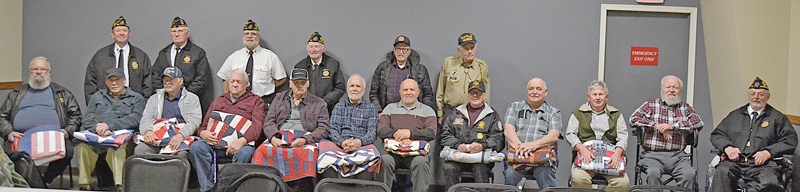
QUILTS OF VALOR — The Northwoods Quilts of Valor Sewists presented Quilts of Valor to Vietnam Era veterans at the Viking Bowl on March 29. First row from left: Larry Edwards, Ingman Ralph, David (Buck) Knutson, Rance Anderson, Roger Hanson, Leo Schindler, Duane Schindler, Ronnie Larson, Mike Tandberg. Tom Dunbar (Russell-Toycen American Legion Post 131 of Colfax), Al Johnson (American Legion). Second row from left: American Legion — Jim Irwin, Derald Tuschl, Chris Larson, Mike Smith, Gust Fehr and Herb Tallman. Jack Seehaver and Rick Sundby also were awarded Quilts of Valor but were not present at the Viking Bowl. —photo by LeAnn R. Ralph
By LeAnn R. Ralph
COLFAX — Members of the Northwoods Quilts of Valor awarded 12 quilts at the Viking Bowl the evening of March 29 to area veterans who served during the Vietnam War era from 1955 to 1975.
Northwoods Quilts of Valor began stitching quilts in 2022.
Quilts of Valor was started in 2003 by Katherine Roberts, whose son was deployed in Iraq, and the quilts are a civilian award for the service of veterans.
A Quilt of Valor can never be bought or sold, and it is not a gift. The quilt consists of three layers. The top of the quilt, with many shapes and colors, represents the various communities and individuals. Each stitch represents the love, gratitude and sometimes the tears of the maker.
The batting is for warmth and represents the hope for warmth, comfort and healing to the individual who receives it. The backing and the stitching are the strength that holds the many pieces together and represents the strength of the recipient and his or her family, community and the nation,
The biographies included here are based on the comments the veterans submitted after they learned they had been nominated for a Quilt of Valor.
Some of the veterans did not include any comments.
Anderson
Rance Anderson of Wheeler served in the United States Navy from March of 1965 until March of 1969 and was honorably discharged as an E-4.
In March of 1965, he entered basic training at the United States Navy’s Recruit Training Command in Great Lakes, Illinois.
Anderson completed Parachute Rigger A school at Lakehurst Naval Air Station in New Jersey, now part of Joint Base McGuire-Dix-Lakehurst.
He served two years of shore duty at Naval Air Station Barbers Point, located on Oahu.
Anderson served 14 months of duty with SEAL (Sea, Air and Land) Team One at the Naval Amphibious Base in Coronado, California.
SEALs are the United States Navy’s primary special operations force, and SEAL Team One was one of the first two SEAL Teams established on January 1, 1962.
Edwards
Larry Edwards of Colfax served in the United States Army from April 11, 1968, to November 12, 1969, and was honorably discharged as an E-5.
Edwards served in Cuchi, Vietnam, and Tay Ninh, Vietnam.
He was a combat infantry squadron leader, jumping on and off helicopters, “keeping the guys in line (search and destroy).”
Edwards earned the National Defense Service Medal; Vietnam Campaign Medal; Bronze Star Medal; Vietnam Service Medal; and the Combat Infantryman Badge.
Larry “met three Colfax guys either coming or leaving Vietnam. Pete Johnson, Jim Irwin and Duane Schindler. It was good to visit with them, if only for a few hours,” Edwards wrote.
[Please see the article from the November 20, 1969, Colfax Messenger published elsewhere in this issue.]
Hanson
Roger Hanson of Menomonie served in the United States Army from 1970 to 1972.
Knutson
David (Buck) Knutson of Colfax served in the United States Navy from June of 1965 to June of 1969.
He was honorably discharged as an E3.
Larson
Ronnie Larson of Hudson served in the United States Army from 1966 to 1968 and was honorably discharged as an E-1.
Larson served with the 9th Division Army out of Fort Riley, Kansas.
He was deployed to the Mekong Delta in Vietnam as part of the Army infantry in the Mobile Riverine Force.
The Mobile Riverine Force was a joint United States Army-Navy unit deployed during the Vietnam War in the Mekong Delta to conduct amphibious operations that targeted the Viet Cong.
Larson was wounded while serving in Vietnam and received the Purple Heart.
In addition to the Purple Heart, Ronnie Larson earned the Combat Infantry Badge and the standard Vietnam Campaign meals.
Ralph
Ingman Ralph of Colfax served in the United States Army National Guard from 1959 to 1964 and was honorably discharged as an E5.
“I joined the National Guard in June of 1959 and took basic training from September 19, 1959, until November 20, 1959, in Fort Leonard Wood, Missouri. I was shipped to Fort Dix, New Jersey, the week of November 20, 1959. This was for advanced basic training,” Ralph wrote in his biography.
“I was discharged back home to the local guard unit the week of March 20, 1960. Our guard unit was called into active duty in the fall of 1961. My local guard unit was out of Menomonie, Wisconsin. I was in the first platoon, 4th squad, which was a light-duty weapons squad,” he said.
“My rank in Fort Lewis was Specialist 4th Class. When we came home, I had less than two years left to go. When I got discharged, my rank was Sergeant E5,” Ralph said.
In the fall of 1961, during the Berlin Crisis, the Wisconsin National Guard’s 32nd Infantry Division, known as the “Red Arrow Division,” was mobilized for a year of active duty at Fort Lewis, Washington, starting on October 15, 1961.
The mobilization of the Red Arrow Division was in response to Soviet Premier Nikita Khrushchev and his threats to cut off access to West Berlin.
The 32nd Infantry Division was called to federal service for one year, and this marked the first time the National Guard was mobilized to advance American foreign policy intended to prevent a third world war.
The mobilization in 1961 was the largest mobilization of the Wisconsin National Guard since World War II.
Schindler
Duane Schindler of Elk Mound served in the United States Army from 1969 to 1971 and was honorably discharged as an E-4.
Schindler entered basic training at Fort Knox, Kentucky.
He received Army Advanced Infantry Training at Fort Polk, Louisiana, which prepared soldiers for combat.
Schindler was then shipped to Vietnam where he was assigned to the 2/27th Wolfhounds Infantry Unit (2nd Battalion, 27th Infantry Regiment — 2-27 INF).
Schindler
Leo Schindler of Menomonie entered the United States Army in 1970 and was honorably discharged as an E-5 in 1971.
He received basic training at Fort Bragg, North Carolina.
Schindler received advanced training at Aberdeen Proving Ground in Maryland and graduated as an aircraft armament subsystem mechanic.
He was shipped to Vietnam in August of 1970 where he performed the duties of maintaining and repairing helicopter machine guns and rocket systems and flew in Huey helicopters as a door gunner.
“Our company was an assault helicopter company. We were loaded with weapons and ammunition. We did not transport troops. Our missions were to support heavy ground assaults or to attack known enemy targets,” Schindler wrote.
“After my 12-month tour, I extended my stay in Vietnam for 16 additional days, which qualified me for the ‘early out’ program which means I could be discharged the same day I arrived back in the States,” he said.
“This program just started in mid-1971 to help reduce overall troop levels in the Army,” Schindler said.
“My brother Duane was serving his Vietnam tour at the same time, along with my two cousins, Ralph and Steve Schindler,” he said.
Leo Schindler notes that he had two other cousins, Jack and Tony Bresina, who also served in Vietnam.
Leo Schindler earned the National Defense Service Medal, the Vietnam Service Medal w/60 Device, the Vietnam Campaign Medal with 2 Stars, the Aircraft Crewman’s Medal and the Air Medal.
Schindler
Steven Schindler of Bloomer served in the United States Army from July 25, 1968, to May 3, 1971, and was honorably discharged as E-5.
Schindler served two tours in Vietnam.
Seehaver
Jack Seehaver served in the United States Marine Corps from September 26, 1966, to September 25, 1968, and was honorably discharged as an E3/Lance Corporal.
“I was sent to Vietnam and was stationed with the 7th Engineer Battalion. We built roads and maintained them. I also hauled explosives to (the Army of the Republic of Vietnam). Most of our work was on Route 5. On Hill 55 there were a lot of land mines. I ran over one while hauling gravel on Route 5,” Seehaver wrote.
“After about 12 months, I was pulled off the roads. The 13th month I [went] back to Camp Pendleton, California. I was there for the rest of my enlistment … before my discharge, I was awarded the Navy Achievement Medal with Combat V,” he said.
The “V” device (Combat Distinguishing Device) was authorized for the Navy and Marine Corps Achievement Medal from 1946 until 2016, and it signified an awardee’s experiences of personal hazard while directly participating in combat operations.
Sundby
Richard (Rick) Sundby of New Richmond served in the United States Navy from 1969 to 1973 and was honorably discharged as a Seaman E3.
Sundby earned the Full Service Medal Vietnam (combat action medal); Vietnam HMC Service Medal Ribbon (lapel pin); National Defense Ribbon Vietnam (lapel pin); 2 Campaign Stars (two tours); and the Combat Action Ribbon.
Sundby notes in his biography that he is missing three medals.
His service location was north of the DMZ in the Gulf of Tonkin.
Tandberg
Michael Tandberg of Elk Mound served in the United States Army from May of 1970 to November of 1971 and was honorably discharged as an E-4.
“After doing my basic training at Fort Bragg, North Carolina, and more training at Fort Leonard Wood, Missouri, I was assigned to a unit in the Central Highlands region of South Vietnam,” Tandberg wrote.
“My platoon spent most of our time providing armed escort for truck convoys delivering supplies to military bases and remote military outposts in the Central Highlands region, and we would sometimes be tasked with checking out an area for land mines and other duties as needed,” he said.
“With all of the miles traveled and experiences, many friendships were made, some of which continue to this day,” Tandberg said.
