
Finding the fox with amateur radio


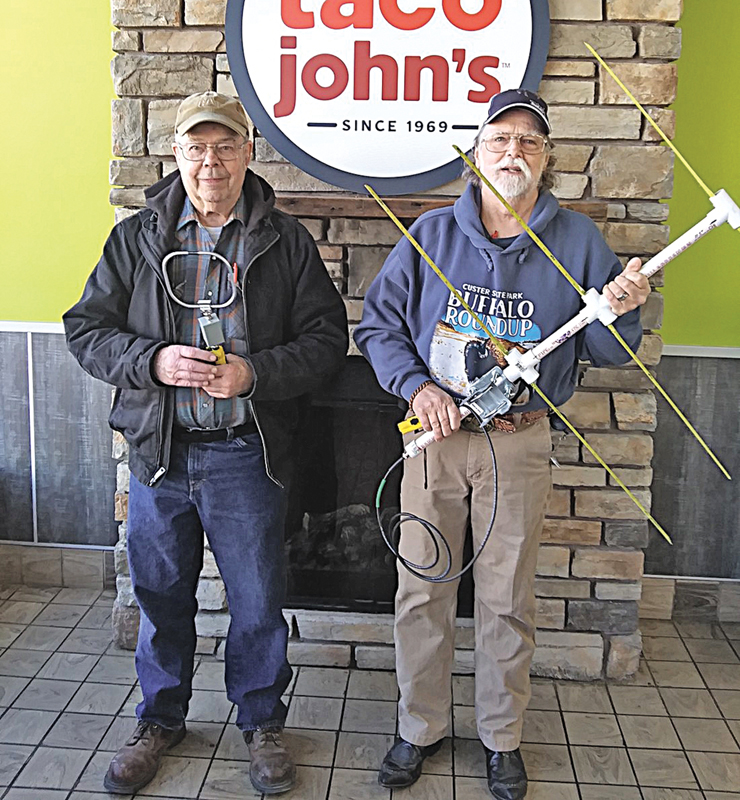
JIM Ley (left) and Kenny Dicks (right), fox hunt winners, at a recent Saturday morning “ham breakfast”. —photo by Joyce Uhlir
By Joyce Uhlir
MENOMONIE — Ten amateur (ham) radio operators raced to locate a transmitted signal, “the fox,” hidden somewhere in Menomonie on February 15.
“Fox hunts are a way to bring the amateur radio community together while improving skill set,” stated Bryan Moris, Dunn County ARES/RACES Emergency Coordinator.
According to Moris, DCARES is a nonprofit organization that helps the community by providing emergency and non-emergency communications. Other DCARES activities include storm spotting and providing support communications for local events such as fun runs.
The first to find the fox in the February contest were Menomonie resident Jim Ley, and Kenny Dicks from Colfax. They competed as “Team 45.” Dicks said they chose the name for a specific reason. “We wanted to hurry up and find the fox so we could eat at Exit 45,” he said.
The two found the fox 30 minutes into the two-hour challenge after only three triangulating sound checks on their radios. Mary Purvis of Knapp was transmitting the fox signal from Elmwood Park.
“It was part luck and part skill.” – Jim Ley
“Finally we are not in last place!” – Kenny Dicks
This was the second recent fox hunt sponsored by DCARES. In October, a county-wide search was simulated for a radio transmission from a downed airplane. The February “fox” was hidden within Menomonie city limits. Because radio signals bounce off buildings, it can be harder to find their source in a city.
Highly directional antennas are used to find the transmitter’s location. Strategies include (1) listening for the strongest signal while rotating the antenna in a circle, (2) using a map to triangulate direction from several different locations, and (3) decreasing the radio’s receiving ability because too much signal is not helpful.
Dicks says it is sometimes necessary to find the source of radio signals that are interfering with ham frequencies, intentionally or unintentionally. For example, a radio operator may not know their microphone is stuck in transmit mode. There can be interference from electronic equipment that needs to be identified. Dicks recalled a time when local hams had to locate a downed airplane transmission in the Chippewa Valley.
Moris stated, “Even highly skilled amateur radio operators will find the fox hunt exercise challenging but rewarding. It is a fun time to play amateur radio.”
To learn more about amateur radio, visit ARRL.org, dunnares.org, or stop by Taco John’s in Menomonie any Saturday between 9 and 10 a.m. to meet the local “ham” community.
Joyce Uhlir has been a licensed ham radio operator for three years and wrote this article for a UW Stout Citizen Journalism class.
