
Colfax’s new administrator: Carrie Johnson
PROTECTED CONTENT
If you’re a current subscriber, log in below. If you would like to subscribe, please click the subscribe tab above.
Username and Password Help
Please enter your email and we will send you a password reset link.


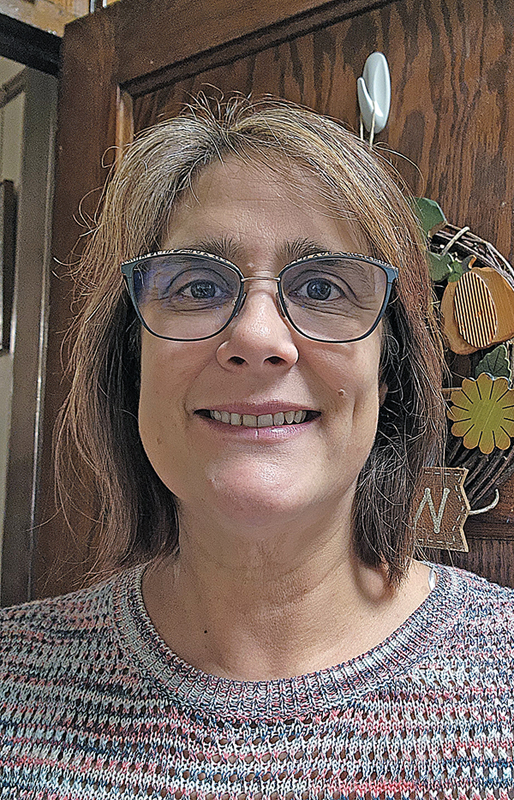
CARRIE JOHNSON
By LeAnn R. Ralph
COLFAX — Carrie Johnson, the new administrator-clerk-treasurer in Colfax, has a vision for the village.
Colfax, she says, should be a place where people want to live and work.
The village also should be a destination to enjoy what the area has to offer, such as fishing, kayaking and canoeing on the Red Cedar River, trout fishing in Eighteen Mile Creek, touring the railroad museum, browsing the downtown shops, and enjoying lunch at one of the establishments in town that offer a variety of menu options.
Johnson started as the administrator-clerk-treasurer at the beginning of June following the resignation of Lynn Niggemann.
Niggemann was officially appointed as the Dunn County treasurer at the county board’s April meeting and is running for election to the position in November. Her last day of working in Colfax was May 28.
Johnson, who lives in Chippewa Falls, earned a Bachelor of Arts from UW-La Crosse in English/Writing with “a bunch of minors.”
“I thought at first that I would be a college professor, but life threw me a curveball, and I never did finish my Masters at U of M,” she said.
“But I love those not-so-little curveballs, and the grandkids they’ve started producing — so that’s okay,” Johnson said.
She describes herself as a single parent and has three children. Her oldest son is a mechanic and has two children of his own younger than two years of age. Her daughter and her daughter’s boyfriend are in the process of buying a house in Chippewa Falls. Her youngest son is a student at UW-Stout who bought a duplex so he can rent out one side and live in the other side.
Accounting
Johnson also earned a Bachelor of Science in accounting from Globe University.
She has worked for the Chippewa County highway department and has worked at selling real estate.
Johnson describes her background as “chaotic.”
“If I hadn’t work for the highway department, I wouldn’t know who to call for information about roads. If I didn’t have a background in real estate, I wouldn’t know about (certain aspects of ) working on the subdivision. I have a patchwork background, and it’s a patchwork job,” she said, adding, “I am not afraid to ask questions.”
The patchwork nature of the administrator-clerk-treasurer’s job involves a variety of tasks: renewing liquor licenses for local establishments; issuing permits and licenses for chickens and dogs; researching, writing and interpreting ordinances; paying invoices; consulting with attorneys; writing and posting agendas for committee meetings and village board meetings; working on the annual budget; finding the best rates for health insurance for village employees; dealing with zoning issues; responding to questions from village board members and from residents — and just about anything else you can think of.
Small town
Johnson grew up in the small town of Edgar and says that’s why working for the Village of Colfax was so appealing to her.
Edgar has a population of about 1,400, so it is bit larger than Colfax.
“My dad had a drugstore there. It had a 30-foot chrome soda fountain. That was my after school job from the time I was 12 until I was just about 20. That was a lot of fun, making sodas and floats,” she said.
“I remember getting up at 4:30 in the morning on really snowy days and walking a mile and a half to the drugstore so we could open up for the farmers who would drive their tractors into town and then complain about how hard it was to get there for coffee,” Johnson recalled with a smile.
“Those are memories that I have. Really good memories. It was a good childhood to have,” she said.
Colfax
At least twice a week, Johnson says she tries to walk around to different parts of Colfax to talk to people and to see “what is going on.”
She has heard complaints about Railroad Avenue, so she went to see for herself, and to know that, yes, Railroad Avenue could use a rebuild. The road has reached the end of its useful life, so the road surface is rough and crumbling.
The estimate is that repaving Railroad Avenue would cost around $1 million to $1.5 million, so that is another task Johnson will have, to find ways to finance Railroad as well as to find financing for other road projects.
Johnson met recently with the new director of economic development in Dunn County, Adam Accola.
“We went around and talked to some of the businesses and talked a little about retaining the community. How do we get into the school and have them come out and see what those trades are like and maybe interest (the students) in those kinds of things. To keep them here in town. Encourage them to not move two towns over or to not work in Menomonie or the Twin Cities. Encourage industry here so we can keep the youth here and promote growth here,” she said.
“I know I would be happier if my grandchildren lived across the street from me than the two hours away that they live,” Johnson said, noting that where grandchildren live depends upon where their parents can find work that pays a living wage and allows the support of a home and a family.
“It’s a slow process to address (retaining graduating seniors). It’s not a one or two year process or a five year process. It’s at least a 10 year process,” she said.
Community planning
Johnson also is interested in community planning and how that could apply to Colfax.
“We have to have enough things going on for Main Street to help keep (residents) here. We need to do some smart community planning. Adam (Accola) has a good background in that,” Johnson said.
After the first of the year, once the budget for 2025 has been finished and adopted, Johnson plans to talk with other communities to find out what those communities have done to revitalize the downtowns, such as La Crosse, Superior and Hudson.
“I want to look at those communities and find out how they developed those strategies for housing, jobs and entertainment,” she said.
“The 18 to 20 crowd doesn’t have something to do here, so why would they stay in town? It’s not just growing business, it’s the whole aspect of growing the community. There are many parts and facets to that,” Johnson said.
Once Johnson gathers information about how other communities revitalized their downtowns, then she must work on buy-in from the village board and the residents who live in the area.
If people want the village to grow, then the residents are going to have to work with others who share that desire for growth, not only business growth, but growth in other aspects of the community that make it a place where people want to live and work, Johnson said.
The Wisconsin Department of Natural Resources is working on setting up this area of Wisconsin as a recreation destination, she said.
“I am excited to work with the DNR to bring our community out into the forefront. We have great recreation areas out here. They are not being used the way they could be. They are not bringing in the people that could support our local businesses,” Johnson said.
“Part of it is putting signs out. When people are biking (on the Dunn County bike trail, for example) to know what the options are for lunch. The Blind Tiger. Little Italy. Mark’s shop (Mark Johnson, Cafe II Coffee Shop and Bakery). Mom’s. Show them how to get to those options,” she said.
The Dunn County bicycle trail comes into town on county Highway BB, goes east on Railroad Avenue and connects with county Highway M.
