
Dunn Energy holds ribbon cutting for solar projects in Towns of Hay River and Tainter
PROTECTED CONTENT
If you’re a current subscriber, log in below. If you would like to subscribe, please click the subscribe tab above.
Username and Password Help
Please enter your email and we will send you a password reset link.


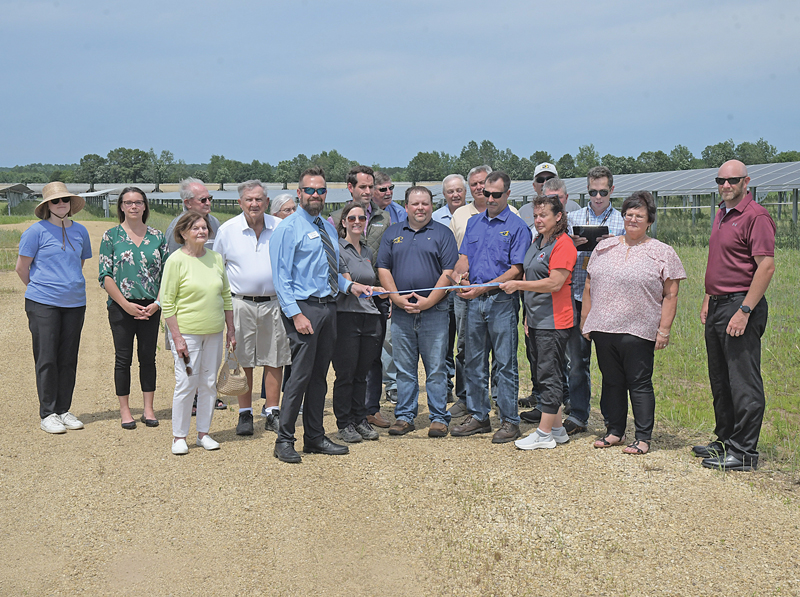
DEDICATION AND RIBBON CUTTING HELD — Dunn Energy Cooperative held a dedication and ribbon-cutting ceremony for its two new solar arrays, one located in the Town of Hay River and the other the Town of Tainter, on Monday, June 24. The solar arrays, developed in partnership with OneEnergy, Dairyland Power Cooperative, and the Albricht and Daly families, were the second and third utility-scale solar installations on Dunn Energy lines that power local homes and businesses. Pictured above, in no particular order, are some of the individuals that participated in the dedication and ribbon-cutting ceremony at the Town of Hay River location. Jeff Jaeger Menomonie Chamber Ambassador; Jolene Fisher, Director of Member & Employee Engagement, Dunn Energy Cooperative; Shellee Pechmiller, Menomonie Chamber Ambassador; Joe Hebert, Dairyland Power Cooperative; Dennis Dvoracek, Dunn Energy board member; Brian Johnson, Dunn Energy board member; Jesse Singerhouse, Dunn Energy CEO; Ed Hartung, Dunn Energy Board Member; Jeff Gasteyer, Dunn Energy Board president; Jeff Wildner, Dunn Energy Board member Kris Korpela, Dunn County Manager; Dan Dunbar, Dunn County Assistant Manager; Joe Martin, Menomonie Chamber Ambassador; and members of the the Albricht and Daly families, land owners.
—photo by Shawn DeWitt
By LeAnn R. Ralph
COLFAX — Dunn Energy Cooperative has completed two solar projects in the Town of Hay River and the Town of Tainter that will generate enough electricity to power approximately 800 homes.
Members of the Dunn Energy Cooperative Board of Directors and representatives for the Menomonie Chamber of Commerce, Dairyland Power Cooperative and Dunn County held a ribbon cutting ceremony Monday, June 24, at both sites.
One of the solar arrays is located near the Big River Resources Boyceville LLC ethanol plant on state Highway 170 between Boyceville and Wheeler, and the other site is located south of Colfax on county Highway B a few miles west of state Highway 40.
The solar arrays were built in partnership with OneEnergy, Dairyland Power Cooperative, Daly Brothers LLC and the Greg and Wendy Albricht family. Both sites have been planted with a mix of 30 different native species that make a pollinator-friendly environment, according to a news release from Dunn Energy.
The solar panels are expected to have a useful life of 40 years.
“It’s our mission to safely provide affordable, reliable, and environmentally responsible energy,” said Jesse Singerhouse, General Manager/CEO of Dunn Energy Cooperative, according to the news release.
“With these installations, we’re doing just that,” Singerhouse said.
Special exceptions
The Dunn County Zoning Board of Adjustment approved a variance and a special exception permit for each project in May of 2022.
The variance was required because under current Dunn County zoning, up to five acres and under 500 kilowatts is allowed by special exception.
Each site produces 1.5 megawatts (or 1,500 kilowatts) of local, renewal energy, according to the news release from Dunn Energy.
A staff analysis from the BOA meeting notes that renewable energy facilities are permitted in General Agriculture zoning as a special exception.
The solar photovoltaic panels are mounted on steel I-beams driven in the ground. With the panels attached, the height is about 7.5 feet, or the height of a mature corn plant, according to information in the BOA packet.
The approximately 10-acre site in the Town of Hay River is adjacent to three-phase electric distribution lines and is within two to three miles of a substation. The location of the project allows the rest of the 70-acre property to remain easily accessible to farm equipment, according to information provided to the BOA.
The approximately 10-acre site in the Town of Tainter is part of a 38-acre parcel and also is situated to allow the remainder of the parcel to be easily accessible to farm equipment.
According to information in the BOA packet, the solar project near the ethanol plant produces enough electricity annually to power all of the houses in Boyceville, and the project on county Highway B produces enough electricity annually to power all of the houses in Colfax.
Ag markets
The two solar projects provide benefits to farmers and local residents as well as to the Dunn Energy Cooperative.
According to information in the Board of Adjustment packet, Dunn County “seeks new and diversified agriculture markets and businesses while also protecting natural resources. Solar projects can help farmers diversify their revenue sources, providing a fixed payment that does not vary with commodity price fluctuations or weather. Farmers can continue to farm traditional agricultural products alongside the solar project … In addition, the land within the solar project is planted with perennial pollinator mix or grazing pasture mix, restoring nutrients to the soil and benefitting adjacent crops that depend on pollinators.”
The solar projects also conform with future land use plans to keep the area reserved for agricultural use, according to the information presented to the Board of Adjustment.
OneEnergy maintains a commitment to preserving farmland and keeping it in production even while the solar panels are operating and producing electricity.
According to the application for a special exception permit, “The zoning ordinance states renewable energy facilities sized 501kW to 1500kW are a permitted use in Light and Heavy Industrial zoned parcels. We are asking for a special exception in Agriculture zoning for 1500kW solar project … OneEnergy has 15 projects in Wisconsin of a similar nature and all of these projects have remained zoned as agriculture with conditional use permits granted as applicable.
“These solar projects have remained zoned as agriculture due to the fact that our lease with the landowner requires OneEnergy to return the land to a farmable condition once the project is no longer producing energy.
“In addition, while the project is producing energy, we plant the area around and between the panels with a deep-rooted pollinator mix or a pasture mix.
“If we plant the pollinator mix, we partner with a local beekeeper to keep bees on the site, which produces honey and pollinates area crops. If we plant the pasture mix, we partner with a local farmer to graze sheep within the project or cut and bale haylage. This practice of co-locating agriculture and solar photovoltaics is called agrivoltaics, and is fundamental to both our design and operation plan,” according to the application for a special exception.
