
Boyceville Ambulance celebrates 50th anniversary with open house on May 18 and 19
PROTECTED CONTENT
If you’re a current subscriber, log in below. If you would like to subscribe, please click the subscribe tab above.
Username and Password Help
Please enter your email and we will send you a password reset link.


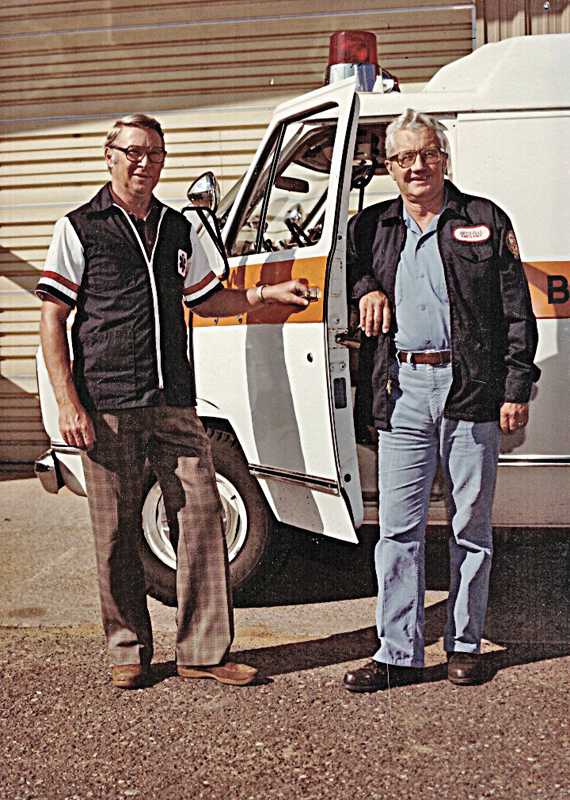
50 YEARS — The Boyceville Community Ambulance District is celebrating 50 years of service with an open house May 18 and 19. This photograph of the first two EMTs in Boyceville, Charlie Sutliff and Herb Dow, is on display at the Boyceville ambulance station on Race Street. — Photo submitted.
By LeAnn R. Ralph
BOYCEVILLE — To celebrate the 50th anniversary, the Boyceville Community Ambulance District is holding an open house on May 18 and 19.
“We have had so many people say, ‘I’ve never been in that building,’ so we want to invite the public,” said Wayne Dow, director of the Boyceville ambulance service.
The ambulance station is located at 504 Race Street in Boyceville, and people are welcome to drop in anytime between 9 a.m. and 5 p.m. on Saturday and Sunday.
Dow noted that people will be able to see demonstrations involving older equipment and new equipment.
The first two Emergency Medical Technicians in Boyceville were Herb Dow and Charlie Bartlett, and Boyceville purchased the first ambulance in 1974.
“We have not quite figured out who was the first transport. It might have been Lil Donahue. She fell outside the bank when it was on Main Street. Someone else got hurt over by the feed mill. Doug McIntyre said in 1974, when they finished the year, they had 72 calls. They were amazed they had that many calls,” Dow said.
The Boyceville ambulance service had 72 calls this year by sometime in April, he noted.
“EMS has changed so much in that time period. What we carry. What we do. How we communicate,” Dow said.
In addition to Bartlett and Herb Dow, early EMTs also included Clarence Tape, Eldie Sutliff, John Yamriska, Jack Harvey, Merle Robinson, Bobbie Marlette, and Morris and Sharon Evenson.
“Staffing was different then. You could go out with one EMT. Dad and Charlie did a lot of the calls,” Dow said.
Dow said one of his goals is to put up a “Hall of Fame” in the ambulance station for the EMTs who served early in the history of the Boyceville ambulance service.
The Hall of Fame will add to the existing wall of photographs and other memorabilia associated with the ambulance service.
“Bobbie Marlette remembers driving the old station wagon before the new ambulance was purchased in 1974. He was right out of high school then,” Dow said.
First ambulance
The original ambulance that was purchased in 1974 had a door that opened on the side.
“The original ambulance was so tiny and so small. There are a few who still remember it. I rode in the ‘catcher’s crouch’ one night from Connorsville to Menomonie, and I couldn’t move (when I stood up). That would have been about 1989,” Dow recalled.
“They used the fire phone back then. Usually they said on the telephone who was going to go. If there were not enough people, they would blow the fire siren three times to see if they could get someone else to come and help,” he said.
The fire phones were first installed for the fire department, and then when the ambulance service began, the fire phones also were used to alert the EMTs when they were needed. Many of the early EMTs were both firefighters and EMTs.
When a call for a fire would come in, the siren would be blown five times. Blowing the siren three times was for the ambulance after Boyceville got the ambulance in 1974, Dow said.
“Charlie did a lot of the driving because he lived two houses away. Dad liked it when I became an EMT because then he could drive more often. He spent a lot of time in back over the years,” he said.
“The training and the equipment have changed so much,” Dow said.
In the beginning, the goal was to get someone to the hospital.
“We did the basics. Back-boarding was important. Back-boards are not used much now … Splinting started to be much different. They started getting better splints for us, and not the board splints … and we did not carry any medicines back then. It was a haul. And you did the basics,” Dow said.
Hearses and station wagons
Prior to the ambulance acquisition in 1974, the alternative for transporting someone to the hospital was the Olson Funeral Home hearse or Dr. Limberg’s station wagon from Glenwood City.
Dow said he was not aware of any particular event that caused Boyceville to pursue obtaining an ambulance in 1974.
“They were probably getting tired of waiting for Olson’s or relying on Doc Limberg. (At the time) Glenwood was probably getting an ambulance, and Colfax was probably getting an ambulance … they came out with the white paper in 1965 that said ‘we are killing people without doing some kind of treatment.’ A lot of it back then was control the bleeding, give them oxygen and get them transported,” he said.
The hearses and the station wagons used to transport people to the hospital did not allow much room for anyone in the back to work with the patient or do any kind of treatment.
But even though the hearses were not meant to transport people to the hospital, “they were a much better ride (in terms of suspension) than the ambulance — even today,” Dow said a bit ruefully.
“The 1974 ambulance had metal hooks that you could hook to the ceiling and you could transport four people. One on the bench seat, one on the cot, and two hanging over the other two,” he said.
“To my knowledge, we never used it, but it had that capability (to transport four people). And I can tell you that having two patients in there was plenty,” Dow said.
The fire department bought a resuscitator and had it for a fire in 1958. The firefighters used to run the station wagon with the resuscitator so they could give oxygen if someone needed it, he said.
Clocking your speed
The older ambulances had a unique way of keeping track of how fast they were traveling on the way to hospital.
“The 1974 ambulance had a little clock in it that you put a piece of paper in. When you closed it and locked it, it would track your speed. So when you got done, you had your mileage and how fast you were driving, and you could attach that to your ambulance report,” Dow said.
“If you didn’t want anyone to know how fast you were driving, you started down the road, and then you pushed the button, so it started at zero, and you could be 20 mph over what it seemed like you were going,” he said.
The radios in the early ambulances were very different, too.
The 1974 ambulance “had a radio in it with a PL [private line] system that was like dialing a telephone. If you had the scanner on, you heard, ‘ditt-it, ditt-it-ditt-it, ditt-it-ditt-it-ditt-it-ditt-it, ditt-it-ditt-it’ — and that was people doing the dialing. There was a certain number for each hospital,” Dow said.
“I remember helping to convince the board in about 1990 to get rid of that. It helped that we had just transported the son of one of the board members. I asked him what he thought of it, and he said, ‘that was dangerous.’ And then we got our radio,” he said.
Sometimes board members have a difficult time understanding why new equipment is needed and why the equipment costs are so high.
A power cot now is about $30,000, and the ambulance itself is over $300,000.
The power cots are safer for patients, and they greatly reduce or eliminate the chance of injuring EMTs when they are trying to lift patients.
“It is unreal what the price of (equipment) has gotten to be,” Dow said.
Orange stripe
The reason the original ambulance had an orange stripe was because of the Triple KKK standard that said the ambulance had to have an orange stripe, Dow said.
In order to refine the purchasing process for ambulances, the KKK-A-1822, better known as the Triple K specifications, was the first ambulance specifications document that was published by the U.S. General Services Administration in the 1970s, according to the Braun Ambulance website.
The color was called “Omaha orange” and was included in the federal regulations for ambulances and selected because it did not conflict with colors used for fire apparatus, according to www.professionalcarsociety.org.
“Boyceville kept the orange and white for a long time until they finally switched over to the blue, Dow said, noting that he was not sure where the first ambulance was purchased and whether it came through the Keyes Chevrolet dealership.
The second ambulance in Boyceville was a GMC purchased at a Bloomer dealership, he said.
Eventually the regulations mandated that all ambulance services needed a second ambulance. When ambulance services are fully staffed, then the second ambulance can be taken out if there is more than one patient to transport.
As is true of most ambulance services, especially in rural areas, it is difficult to have enough EMTs on the roster to make sure a second ambulance can be staffed to go out on a run, Dow said.
Working together
In view of the shortage of EMTs, especially in rural areas, ambulance services now try to work together, so that EMTs can be credentialed with more than one service and can then work at neighboring ambulance services.
“Most of us are pretty easily (cross credentialed with another ambulance service). We can help each other. If we both show up at the scene, then we can hop in the other (ambulance service’s) rig. Or we can provide a driver. We can always sort it out later and get the EMTs back where they need to be,” Dow said.
“How different times were back then when people could leave a business (where they worked) and go out on a call. Now you cannot hardly do that,” Dow said.
Many people in small towns today commute somewhere else to work.
There also are fewer businesses in small towns that have employees who can volunteer with the ambulance service, or with the fire department for that matter.
“Dad worked for the village. Charlie had his own little feed mill. Jack Harvey was independent doing the candy truck. Eldie was always independent. Johnny Yamriska would walk away from his body shop and gas station and jump on the call. They were all free to do that. Merle would leave the restaurant,” Dow said.
“The lumberyard was always good to let someone out of work to go on a run. Hedlunds was always good about letting their people go on fire and ambulance calls. It was a different era back then,” he said.
New EMTs
Fortunately, the Boyceville ambulance service is now starting to bring younger EMTs on board.
“We are starting to see a trend of younger EMS providers. If we can get them into that volunteer mentality of helping out the community, (then) we have a good base for that,” Dow said.
Some of the younger EMTs have decided they want to be paramedics, and with the voluntary downgrade of the Boyceville ambulance to a basic service, so that more EMTs would be available to go out on a call, the paramedics have gone off to another service where they can have a career.
“We now have a good age group going on of late teens and early 20s. Dad always said the stuff they taught (the younger EMTs) was so different,” Dow said.
“In his case, they learned how to do trachs (tracheotomy) of cutting open the throat. He was always afraid someone was actually going to do it. It is absolutely taboo now. It is a paramedic skill now,” he said.
“Today, they teach a lot more anatomy and physiology, and they teach you why to do things and not just how to do things,” Dow explained.
“As we progressed, we’ve learned that things they did back then, did not work. At the time, we thought it was the right thing to do, but now through studies, we know it’s not,” he said.
During the early years of ambulance services, “there was not a lot of science behind what we did. The backboard was the perfect example. Did we actually help anyone with spinal immobilization? Now we find out that people get pressure sores, and that (EMTs) were causing more problems by keeping them on backboards,” Dow said.
“In the beginning, almost everyone got oxygen. If you called (for the ambulance), well, ‘here is your celebratory nasal cannula’ kind of thing. We gave every diabetic, every stroke, every chest pain, every person with difficulty breathing, you name it, they almost always got oxygen,” he said.
“Now we know that if we keep their oxygen levels too high for too long, it actually causes problems. Even though you are short of breath, unless you really need the oxygen, we don’t give you the oxygen any more,” Dow said.
“The chest pain. Now I did see some chest pain go away with oxygen. But now we know that it is messing things up internally for them … when someone was in shock, as a paramedic, we could not give them enough fluids, so we would start two large IVs and run them wide open. Guess what we did? We got their pressure up so high that they bled out of everything, and we made kool-aid. We thinned out the blood. Now we do what is called permissive hypotension,” he said.
“Back then we had pneumatic shock trousers. We would inflate them to squeeze the blood out of their lower extremities and abdomen (to keep it higher in the body). Again. It didn’t work. It sounded good. It worked for pilots, so it should work on shock, right? For years, we were taught how to use those things,” Dow said.
“I was taught in 1989. We have a 20-year gap of using that equipment. Now we don’t use those things anymore. They did not actually do what we thought they were going to do,” he said.
Open house
During the open house from 9 a.m. to 5 p.m. Saturday and Sunday, May 18 and 19, people can stop in whenever they want to say “hello,” learn how to do some CPR and can ask questions and look at the equipment.
“People can see what we carry and see what we do,” Dow said.
When the ambulance service holds the chili feed at the Spirit of Christmas Celebration, quite a few people say they have never been in the ambulance station, he said.
“They look at the map, and they say, ‘I didn’t know you covered that much area.’ When we are out, we make a big hole in Dunn County. And if more than one service is down (for any reason, such as being out on another call), that makes an even bigger hole,” Dow said.
The Boyceville Community Ambulance District includes the Village of Boyceville and the Towns of Hay River, New Haven, Sherman, Sheridan, Stanton and Tiffany.
Dow noted that there are still some items around the ambulance station that have something written on them in his dad’s handwriting.
“EMS has come a long way … even when I started in the late 1980s and early 1990s, we did not carry any medicines. That came later,” Dow said.
The Boyceville ambulance service obtained the first defibrillator in the 1990s, he noted.
