
Short season, good trees, hard work are core elements of local sapping businesses
PROTECTED CONTENT
If you’re a current subscriber, log in below. If you would like to subscribe, please click the subscribe tab above.
Username and Password Help
Please enter your email and we will send you a password reset link.


Birch syrup and maple syrup from Horner’s Corner. —photo by Renee Bettendorf
By Renee Bettendorf
CONNORSVILLE/DOWNING — For the last two years, Wisconsin has ranked fourth in the nation for maple syrup production according to the USDA’s National Agricultural Statistics Service. About 400,000 gallons of everybody’s favorite pancake condiment is produced annually in the state. Last week the Tribune looked in on three local maple operations and learned that this sap season is coming along nicely.
“It’s an early year,” said Steve Horner, a rural Connorsville sap producer.
He’s already made more syrup this year than he did last year. And he’s not done yet. Last year’s season only lasted about three weeks because of deep snow and cold weather in March followed by a week of 70 degree days that occurred in April.
Horner, owner and operator of Horner’s Corner, a maple syrup farm, said this year he tapped his trees at the end of January and hauled his first load of sap on February 2. Which was two weeks earlier than any other season and six weeks earlier than an average season.
“And an average season usually only lasts about six weeks!” he pointed out.
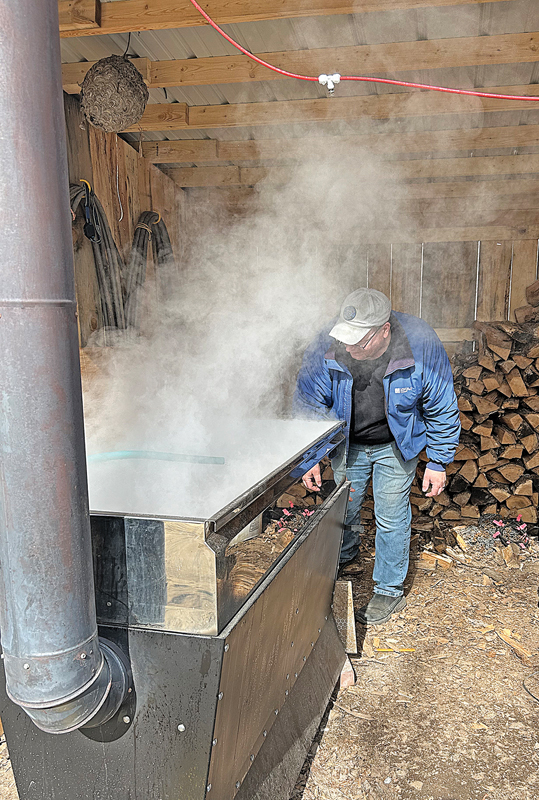
STOKING THE FIRE — Brian Japuntich loads wood into his evaporator. —photo by Renee Bettendorf
Eric Klatt of Double E Valley Maples LLC, located south of Downing had similar thoughts. He said they also got started early and as of March 6 they have produced twenty-two 55 gallon barrels of syrup. It’s looking like they will have a normal crop this year from their 5,500 taps or maybe even a substantially better crop, depending on how long the season goes.
“By the weather forecast it looks like an extra long season at this point,” said Klatt.
Brian and Anne Japuntich, who also live near Connorsville said they started their sap season about one month earlier than usual this year. Generally they tap the first week in March but this year they tapped right around Groundhog’s Day.
In a typical year the Japuntichs produce between 20 and 25 gallons of syrup. Brian thinks they will probably get something close to that this year which was surprising to him since he didn’t know what to expect due to the very warm winter.
“I wasn’t expecting that,” said Brian of his growing syrup stores.
This year they tapped 99 trees on their property and as of last week they had made 18 gallons of maple syrup. They use plastic bags specifically designed for sap collection. As the bags fill they gather the sap by hand using a 35 gallon tank and a four wheeler.
They used to use buckets to collect sap up until a couple years ago. But plastic buckets degrade in the sun, get brittle and shatter, usually when they have several gallons of sap in them. The bags have advantages and disadvantages. One advantage is that they are better at keeping debris out. A disadvantage is that squirrels chew on them.
“Disadvantage is squirrels,” said Brian of his bag collection system.
Brian first got interested in making maple syrup as a kid. He had relatives and neighbors that made syrup and his mom would tap a few trees in their yard. When he was in college at UW-Stout he had a sap collecting system using wal-mart bags hanging on some yard trees.
“It actually worked,” he said of his former bag system.
When the Japuntichs moved to rural Connorsville in the late 1990’s they started tapping five or ten trees and after a while ramped up the operation to 40 trees and did that for many years. At first they cooked their syrup on a gas grill and eventually upgraded to a stainless steel pan on a fire pit made of cinder blocks.
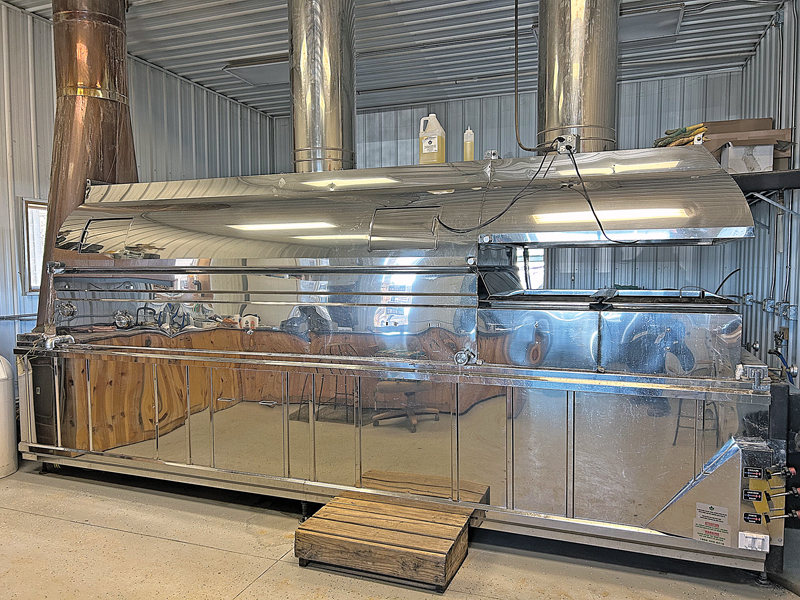
THE 4 x 14 foot evaporator at Double E Valley Maples. —photo by Renee Bettendorf
This year they built a shed so now they are cooking out of the elements. Last year they bought an evaporator, which is a piece of equipment made especially for boiling maple sap into syrup.
“It’s been so nice with the evaporator,” said Anne.
Not every sap producer uses an evaporator, some hire that part of the process out, which is the case for Horner who tapped 600 trees this year. He takes his sap to a nearby farm for evaporation, which many sap producers do.
“There’s lots of collaboration. People rent and tap in various places. They haul sap to other people’s evaporators,” said Horner.
As it turns out, people have been collaborating with maple syrup production in Wisconsin for thousands of years, starting with the Native Americans. They were producing maple syrup and maple sugar long before European settlers arrived and used the syrup and sugar for culinary uses as well as for trade, according to Smithsonian’s National Museum of the American Indian website.
Native Americans probably taught early American settlers how to farm maples since Europe’s climate is not conducive to maple farming. Although some Europeans may have been familiar with tapping trees since birch sap has been used as a flavoring for mead and wine since the middle ages in parts of Europe. By the time immigrants from New England, New York, and the Southeast started showing up in Wisconsin, maple farming was an established tradition.
But boiling sap into syrup was not always the main goal. While some syrup was produced by early Wisconsinites, capturing the sugar in that syrup was what they were really after. Making maple sugar is made by boiling sap from maple trees down until most of the liquid is gone and only granules remain. Since maple sap is about 98% water and two percent sugar, making maple sugar and syrup is labor intensive.
Reverse Osmosis is Magic
Sap needs a whole lot of evaporation before it becomes syrup. According to Horner, on average it takes 40 gallons of maple sap to make one gallon of maple syrup. The high water content in maple sap was a time consuming problem for syrup producers for many years, until reverse osmosis (RO) came along. RO is a type of filtering system that separates water from fluids since water is the only thing that goes through a RO filter.
Last year Horner was processing about 2,000 gallons of sap per day by himself and would reduce that to less than 200 gallons through RO. RO takes out only pure water and all the minerals and microbiome that is in the sap stays there, he said.
Horner said a sap producer can collect sap, run it through an RO filter and get rid of 75% of the water before transferring it to an evaporator. Some boiling is still required to remove water but not nearly as much.
“Reverse osmosis is the way to go,” he said.
Other producers are in agreement with Horner about RO. It allows a producer to save a lot of time and fuel.
The Japuntichs were having a hard time keeping up, so they installed an RO system three years ago. It removed much of the water from the sap and they can run about 25 gallons of sap per hour through it.
“It’s a pretty cool thing,” said Anne of RO.
Klatt said he and his syrup partner, Eric Stoll, used to haul their sap to another producer for RO and then bring the concentrated sap back to their sugar shack to cook it on their evaporator. During a particularly busy sap season, they cooked for three days straight before using RO. In 2010 they bought their own RO.
“Otherwise we were cooking around the clock,” said Klatt, who got into making his own syrup about 30 years ago.
He got started in 1994 when he tapped 50 trees at a neighbor’s place. He made his own evaporator in welding school and used it to cook up 13 gallons of syrup which he gave away as presents to family and friends.
In 1998 he partnered up with Stoll and they started growing a sap operation together. They set up their equipment at Stoll’s parents place near Knapp and produced 40 or 50 gallons in 1999. Right around 2008 Stoll moved to a place near Knapp and built a shed there with a lean-to and they bought a brand new 3X12 foot evaporator.
In 2012 they moved their operation to Klatt’s parent’s farm. They bought a new 4X14 foot evaporator and a bigger RO in 2014. At that time they had about 35,000 taps they were cooking for. Between 2014 and 2019 they evaporated for a number of smaller producers. Many of whom have since gone off on their own and now Double E Valley Maples just has a few other producers that they cook for.
Horner also used to evaporate for other producers. At his peak he had about a dozen local producers bringing sap to him for processing. At one point he had up to 2,500 taps and produced about 20 barrels a year. He’s been downsizing to fit what he can do on his own. Last year he produced six barrels.
Horner and his wife Sandy bottle their syrup and sell it at the Mill City Farmers Market in Minneapolis. In addition to maple syrup they also make and sell fruit flavored maple syrups, maple sugar, maple chocolate and maple cream.
They got started with making different products from maple syrup when they decided to make their own grenadine and then just kept experimenting with fruit syrups from there.
“Every batch is a little different. I almost never do the same one twice,” he said.
The Japuntichs make maple sugar candies. They brought some of them on a trip to Croatia to give to relatives as presents.
“They are world famous now,” said Brian of their maple sugar candy.
Klatt sells about 200 gallons of his syrup right out of his sugar shack. The rest, which on average amounts to between 40 and 50 barrels, is sold in bulk to other large producers.
The Beginning and the End
Horner, who has been making syrup for over 40 years, said that he starts getting ready for sap season whenever daytime temperatures get up to about 30 degrees. Since his system involves tubing and a vacuum pump, getting that all up to snuff is the first step in the season. Then when he’s sure the season is just about ready to start, that’s when he taps. He watches several signs, one is receding snow cover.
“Usually the best sap run happens with the final recession of the snow cover,” he said. “So you gotta be ready before that”.
According to Horner, you can continue collecting sap long after the snow cover recedes as long as there is a freeze-thaw cycle happening. The freeze-thaw cycle is the key to the best sap flow. Sugar is produced in the trees only between 40 and 45 degrees. There’s an enzyme that becomes active in the wood between those temperatures. If it gets much above 45 degrees the trees stop turning starch into sugar. When it drops below 40 it will also stop producing sugar. The trees will still produce sap at higher and lower temperatures, it just won’t have the sugar content.
According to Horner, one or even two days of 70 degree weather is not a problem but any more than that and the enzymes in the sap changes and there is less sugar. Also the microbiome in the sap starts to grow and forms a film in the system.
Klatt said he keeps a close eye on the weather forecast and looks for freeze-thaw cycles to know when to get ready for the season. It takes about a week for Double E Valley Maples to get ready and involves setting tanks in the woods, getting sap extractors and vacuum pumps set up and tapping trees.
“The longer it’s frozen, the better run you get the following day,” advised Klatt.
According to Klatt, the sap season is done when there is no freeze-thaw cycle. At that point the sap will get cloudy or sour and the sugar content goes down. Also the trees will start to bud, which is another telltale sign that sap season is over.
“If they bud, you’re done,” said Anne of the trees.
The Japuntichs use a sap app on their phones to give them a heads up on what to expect with how the sap is running, but of course every season is different.
“It’s an adventure,” said Anne.
A few years back Klatt remembers a season that lasted just two days and they only made about 40 gallons of syrup. The longest season they ever had started on March 5 and ended on April 27.
“And it was still running on April 27! But we shut it off, the sugar content was going down, I think that was in 2017 or 2018,” he said.
It’s the Trees
According to the Japuntichs, you can tap pretty much any type of maple tree and you can also tap box elders because they are in the maple family. They don’t have any box elders, and they avoid tapping silver maples because they tend to bud out earlier. They mostly tap sugar maples and a few red maples.
They can get as much as 200 to 300 gallons of sap on a good day. Some taps don’t do much and some will fill a couple bags a day, it all depends on the tree. Through word of mouth, they sell about half of what they make and the rest they give out as gifts. Last year they produced 24 gallons of syrup.
Besides pancakes, the Japuntichs like to put their maple syrup on ice cream, or use it as a glaze on certain kinds of veggies like carrots, or use it in baking or in brandy old fashions.
“There’s nothing commercial here, it’s strictly a hobby,” said Brian. “It’s just out of enjoyment, it’s nice to be outside.”
From time to time Horner also taps birch trees and has tapped butternut and black walnut trees. The nut trees produce a syrup that has a nutty flavor. While birch syrup has a flavor similar to wintergreen.
“It’s really a unique flavor. It’s not for pancakes, it’s a culinary ingredient,” he said of birch syrup.
Birch sap is much lower in sugar content compared to maple sap. As a result, it takes about 180 gallons of birch sap to make one gallon of birch syrup. Horner’s RO system really helps him with birch syrup production.
“It really takes a lot of sap,” he said.
Another challenge of making birch syrup happens because it’s almost all fructose which has a smoke point of 230 degrees. The sugar in maple sap is almost all sucrose which has a smoke point of 330 degrees. Because syrup cooks at 220 degrees, it’s really easy to burn birch syrup and make it unpalatable. But birch syrup is popular at the farmers market, so he’s willing to make it.
Horner got his start making syrup in Forest lake and produced there on seven acres for about six years, the rest of the time he’s been producing near Connersville. He got interested in making maple syrup after seeing a PBS special on backyard maple syruping.
“I watched that and said, boy I think I can do that,” said Horner.
