
Uncommon Conversation: Water, Soil, and Farming
PROTECTED CONTENT
If you’re a current subscriber, log in below. If you would like to subscribe, please click the subscribe tab above.
Username and Password Help
Please enter your email and we will send you a password reset link.


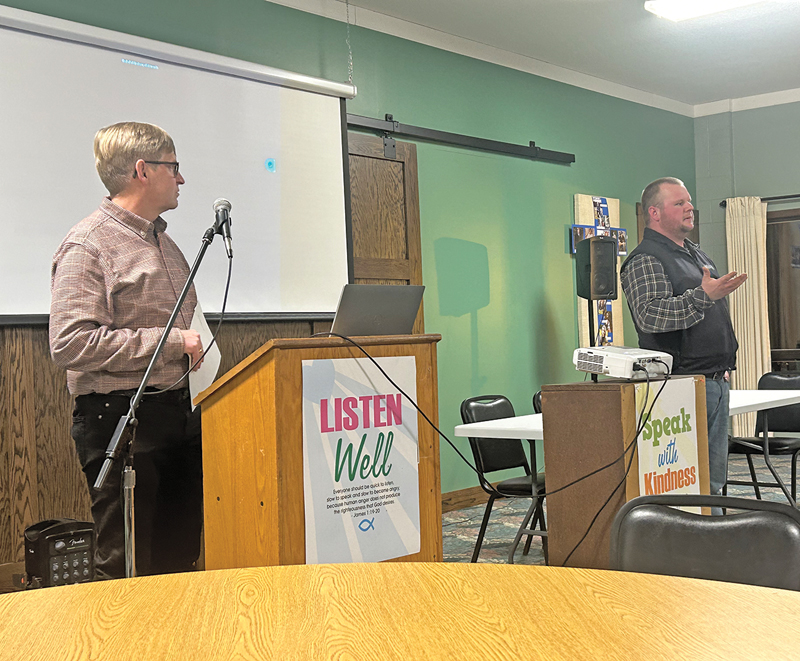
LOCAL BEEF and crop farmer Stewart Bartz (right), spoke about water conservation at Holy Cross Lutheran Church February 5. The event was part of the Uncommon Conversation series organized by Pastor Jonathan Zielske (left). —photo by Renee Bettendorf
by Renee Bettendorf
GLENWOOD CITY — About 30 people attended a presentation about how agriculture affects the local watershed last week at Holy Cross Lutheran Church in Glenwood City. The event was part of the church’s Uncommon Conversation series where community members are invited to learn about and discuss local issues.
Pastor Jonathan Zielske welcomed the audience and introduced the speakers. He introduced Tara Daun, who is the Farmer-Led Watershed Council Coordinator for the Wisconsin Farmers Union. Daun came up with the idea to have an Uncommon Conversation about water, soil and farming.
“We have several VIP’s here tonight,” Zielske said of the water experts speaking at the event.
In addition to Daun, Becky Brathal, Regional Crops Educator for the Pierce County Extension Office, Kasey Yallaly, WI DNR Fisheries Management and local beef and crop farmer, Stewart Bartz spoke at the presentation about the relationship between agriculture and water.
“You can’t have ag without water,” said Brathal.
People who attended the presentation were asked to mark the location of their residence by sticking a push pin into a map of the local watershed. Brathal then talked about the different routes that water takes depending on where someone lives.
“We all experience rain, that’s one thing that can bring us together,” she said.
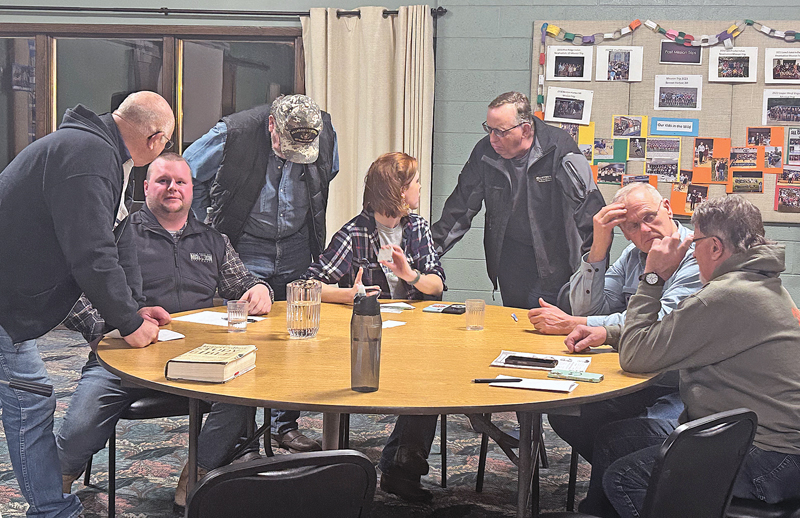
DISCUSSIONS — Stewart Bartz and Tara Daun answered questions from community members after the Uncommon Conversations event held February 5 at Holy Cross Lutheran Church in Glenwood City. —photo by Renee Bettendorf
Brathal pointed out that while all the people in the room live pretty near each other, the water that falls on their properties does not go to the same place. Some people who attended are in the Red Cedar River watershed while others are in the St. Croix River watershed.
She said that there are also many smaller watersheds within the larger Red Cedar River and St. Croix River watersheds and farming can have impacts on both large and small watersheds.
Daun, who has worked in her position with the Farmers Union since 2021, said Bartz has been experimenting with different methods of water and soil conservation and has incorporated several significant water conservation practices on his farm.
“He has been working diligently with our farmer-led council and has really stepped up as a leader,” said Daun.
Bartz took over his parents’ dairy farm, which they started in 1974 near Connorsville, a couple of years ago. His family has been farming in the area for six generations. His farm is located on the banks of Bolen Creek.
“The Bartzs’ have a rich history in this area, we’ve been farming in this watershed for over 100 years,” he said.
Currently his farm has three enterprises; raising beef cattle for the commodity market, growing row and forage crops and selling beef directly to consumers.
The two main practices he does on his farm that help with water conservation are no till planting and cover cropping. According to Bartz, both help to reduce runoff, save fuel and time, require less soil disturbance, filter out sediments and improve soil structure.
“Those are kind of our heavy hitters, they have the most impact,” said Bartz of cover cropping and no till planting.
According to the United States Department of Agriculture [USDA], cover crops are plants that are grown for the purpose of covering the soil rather than for harvest and no till planting is when crops are planted without plowing or tilling the soil.
Bartz said the roots of cover crops allow for soils to act like a
sponge and hold more water, which reduces runoff. Those roots also help keep the soil in place and increase the organic matter, making the soil more fertile.
Normally a cover crop is planted after a main cash crop like corn or soybeans is harvested. Since those crops are harvested late in the growing season, it’s hard to expect much growth from a cover crop. Bartz gets around this challenge by planting his cover crops by air using a drone and hiring an airplane.
He’s able to plant rye as a cover crop from the air into his corn and soybeans. The rye then germinates and starts growing alongside the cash crops. Then after the corn and soybeans are harvested, the rye continues to grow and cover the soil.
He also plants cash crops directly into established rye plantings in the spring. When the corn and soybean seeds start to germinate, he sprays the rye with herbicide to kill it and make way for the cash crops. He’s also doing experiments with different methods of killing off cover crops.
“We try to keep a living root in the soil almost year round,” he said.
As for the cattle on his farm, Bartz keeps water conservation in mind as well. He owns 40 beef cows which are rotationally grazed on 32 paddocks in the summer. During the winter he feeds them using a technique called bale grazing.
During bale grazing, farmers spread bales of hay out on the land rather than placing them in a feeder or a barn. Livestock then spread their own manure and any wasted hay is incorporated back into the soil.
Because of cover cropping and no till planting, Bartz believes that is why any melt or rain water that runs off his fields is free of sediment and mud. Even though the runoff from his farm runs clear, he also maintains a buffer zone along the stretch of Bolen Creek that runs through his farm.
Land owners who have streams that run through their property, especially if they are trout streams, may be eligible for the stream easement program through the WI DNR, said Yallaly.
The program purchases easements directly from landowners. In return for payment, the landowner allows public fishing and DNR management activities along the stream. Yallaly encouraged the audience to get in touch with the DNR if they think they may qualify for the program.
The next Uncommon Conversation event will be held on Monday, April 22 at Holy Cross Lutheran Church. The topic of conversation will be about building relationships across cultural backgrounds.
