
A Report on the Reports: Property condition evaluation and feasibility study for the Colfax Municipal Building


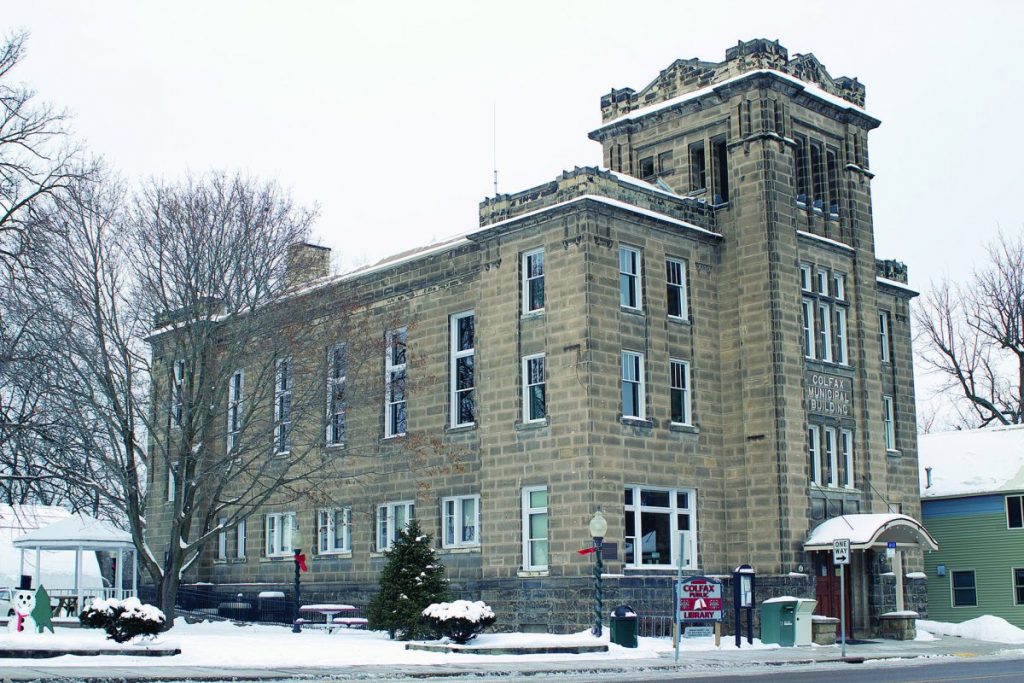 By Lisa Bragg-Hurlburt
COLFAX — In order to understand why the basement of the Colfax Municipal Building has been closed for so long and what must be done to make it usable again, Lisa Bragg-Hurlburt, director of the Colfax Public Library, researched and found information on past studies pertaining to the building.
In addition to serving as the director of the library, Bragg-Hurlburt serves on the Colfax Elevator Commission.
If the basement of the municipal building were remodeled, the library would have extra space to use for library programs, and there would be space available for local organizations and groups to meet or hold events.
The Colfax Village Board’s Property Committee, at a meeting several months ago, asked the question of what needed to be done to make the municipal building basement usable again.
Here is Bragg-Hurlburt’s report:
In 1999, Short Elliott Hendrickson, Inc. (SEH), Apex Engineering, and L.L. Dahl Electric submitted a “Village Hall Feasibility Study” to then Clerk-Treasurer John Jahr.
The report summarized their observations of the architectural, structural, HVAC, plumbing and electrical systems in the Colfax Municipal Building and what it might cost to repair or upgrade any code violations (Sworski, 1999).
The report acknowledged that while the basic structure of the building was sound, significant repairs were needed in the basement and on the first and second floors.
Bob Sworski, SEH Project Architect and main author of the report, concluded that the cost of repairs and updates would be extensive and likely exceed the cost of new construction.
The report advised that there would be cost savings in abandoning the building and constructing a new village hall elsewhere (Sworski, 1999).
As we examine the SEH feasibility study through today’s eyes, it’s obvious that much has changed in regard to the condition and status of the building.
The 1999 report came out five years before the Colfax Municipal Building was placed on the State and National Registers of Historic Places (Joan Scharlau, 2011), so the building now enjoys historic distinction and protections it did not have in 1999.
Also, many of the problems outlined in the report no longer exist because they were addressed later during renovation and restoration.
Thirdly, there is more awareness of possible economic impacts for adjacent businesses should a prominent downtown building be abandoned (Peterson, 2000).
For a more complete understanding of what the report means today, what updates are needed to open the basement to the public again, and for a better understanding of our role in history as we make decisions regarding the Colfax Municipal Building, it’s worthwhile to look at the history of decisions made about the building over the years.
Dilapidated
By 1998, much of the building had fallen into disrepair and had a dilapidated look.
Among other problems, the second floor windows were boarded up, the auditorium was closed off and used for storage, and the electrical system was old (CMBRG, 2015).
When water was discovered in the basement, floor boards and parts of the wall were removed to pinpoint the probable source, a dishwasher leak (CMBRG, Earlier Social Narrative, Approximately 2000).
The Merry Mixers, who served meals to seniors in the basement, relocated their meetings to the bowling alley before eventually buying their own building (CMBRG, Social Narrative, 2015). [The Merry Mixers own the Grapevine Senior Center on Main Street next to Kyle’s Market.]
The basement was officially closed to the public in October 1998 by a state building inspector (CMBRG, Building Data, Approximately 2000).
The only needed corrections for the village hall mentioned in that report involved testing the old furnace insulation and pipe for asbestos, installing an eye wash station and providing protective equipment in the boiler room as well as ensuring that pipes carrying steam are not within seven feet of the floor in the “Kiwanis room” (Commerce, 1998).
At that time, Gail Svee was Village Board President (Scharlau, 2011).
Gail was a retired Colfax Public Library Director whose tenure serving the library was 1971-1980 (plaque in library).
John Jahr, long-time Clerk-Treasurer of Colfax, ran village administration during this time period (John Jahr’s obituary).
Gail, an elected village official, approached Joan Scharlau about forming a restoration group for the building.
In October 1998, the same month a state inspector closed public access to the basement, the Colfax Municipal Building Restoration Group met for the first time (Scharlau, 2011).
SEH
SEH’s “Property Condition Evaluation and Feasibility Study” came out in September of 1999. The entire building was examined, with code violations found on each level. Problems relating to the basement are listed below. Where applicable, I have listed known fixes and the changes made after 1999 in parentheses:
• Moisture (greatly improved in 2016-17 by A Breeze Construction). [A Breeze Construction completed an extensive drainage project in Tower Park and around the perimeter of the building to make sure water coming off the roof of the building drained away and did soak in along the building’s foundation.]
• Floor warpage (flooring removed in 2011). [The floor in the basement was a hardwood floor made of maple.]
• Accessibility (elevator and elevator tower required).
• Secondary stairs must be enclosed as approved smoke enclosure. Also the back stairs are too narrow, rise is too steep, and run is too short (secondary stairs removed).
• Needs smoke detection system.
• “Area of rescue” needed at exits (room for a wheel chair to park and still be able to swing the door out).
• Fire blocking in vertical and horizontal directions needed.
• Old boiler system (was removed and new furnace installed).
• Restrooms (were removed).
• Basement exhaust fans not vented.
• Plumbing in kitchen and bathrooms (plumbing was removed as were all kitchen cabinets, appliances and the front counter).
• No drinking source.
• Need to change wiring material and splicing prohibited.
• Needs to be grounded.
• Needs bushings installed.
• Branch circuits need updating.
• UL listing needs to be displayed.
• Neutral and ground wires must have different lugs.
CMBRG
As village administration grappled with the mounting cost of the Colfax Municipal Building’s needed repairs, the building’s newly formed restoration group worked to have the building’s non-monetary value recognized.
For example, in February 2000, CMBRG member Pat Eggert reached out to architect Tim Peterson of Architectural Design Group Inc. for his thoughts on the SEH study.
Peterson began by listing the building’s positives and negatives, provided his thoughts on the SEH report, offered his own observations, and made recommendations for the village.
Peterson acknowledged that the SEH report “was well written and has validity.”
He noted, however, that the report does not address “the possible importance of the building related to its historical and sentimental value” or the “relationship of and resulting impact to the adjacent downtown area.”
He thoughtfully observed:
“Perhaps the question could be asked by the leadership of the Village of Colfax, ‘what if Menomonie had demolished the Mabel Tainter Theater before it went through its retrofit process approximately thirty years ago?’ This would have been a terrible loss to Menomonie if this had happened, but it was a very real debate at that time. Maybe the argument could be made that this is not in the same category of valuable buildings as the Mabel Tainter. However, I cannot judge that because it is for the local citizens to decide.”
Peterson suggested as a compromise building a new facility for the police and/or administration and renovating the Colfax Municipal Building for other departments, and mentioned the library and community center as examples of village services that might remain (Peterson, 2000).
[According to an article published in the Dunn County News in 2001, the Menomonie City Council first started talking about tearing down the Mabel Tainter Theater in the 1940s. In 1958, the Menomonie City Council wanted to turn the building into municipal offices. The president of the city council cast the tie-breaking vote against converting the building. In the 1960s and 1970s, the Mabel Tainter Memorial Preservation Association worked to raise funds and renovate the building.]
Historic preservation
Twenty-two people came to CMBRG’s first meeting and $26,000 was raised by 2001 (Scharlau, 2011).
In her efforts to establish the historical relevance of the building, Joan Scharlau reached out to preservation architect Brian McCormick. He advised her that the important [historical] interior elements of the Colfax Municipal Building include the library, the entry vestibule, corridor, stairway, and auditorium.
The office areas and basement had already been altered from their original state so could receive extensive remodeling without jeopardizing the historic value of the building (McCormick, 2001) .
A Colfax Messenger article from December 26, 2001, notes that Village Board President Gary Stene signed the application for historic status filled out by Joan Scharlau and the restoration group.
There was not a village board vote on whether to have Gary Stene sign it, but nobody objected, and so permission was given to allow someone from the state Department of Commerce to conduct a historic code inspection on the Colfax Municipal Building (Marlin Raveling, 2001).
True, plumb and level
In 2003, architect William Anderson and structural engineer Daniel Young did a visual inspection of the Colfax Municipal Building.
They also met with the electrical engineer who participated in the 1999 SEH report, Larry Dahl, to discuss his findings.
In a memorandum labeled “Exhibit G” (presumably used as part of CMBRG’s effort to build the case for the building’s historic status), he wrote that the 1999 report is neither “so extensive or costly to seriously impact the renovation/restoration effort” (Anderson, 2003).
He also emphasized that an elevator is part of the building’s restoration plan, so concerns about the exit stairs will be addressed at the time an elevator is installed.
And finally, he praised the soundness of the building’s structural foundation:
“Footings and Foundations for the structure were obviously carefully placed and constructed as the interior and exterior materials that bear on these foundations remain true, plumb and level. The absence of any cracks, fissures or like results from uneven forces or settlement is remarkable for a building of this age.
“This report would be incomplete without further comment on the roof and balcony construction, due to their excellent original design and current condition.
“The roof construction consists of a series of roof trusses built of wood timbers with steel reinforcing rods. The ends of the rods are threaded and have large adjusting nuts and plate washers, so provided as the timbers age over time and some shrinking occurs, they can be adjusted to perfect level.
“Today, as one sights along the auditorium ceiling while standing in the balcony, the very minor amount of deflection seen could be eliminated by adjustment to these components.
“While it is not at all necessary to do this and considering that the adjustments need to be done only a little at a time to prevent plaster cracks and joint separation, the fact that this innovative construction method provides for such an event, makes the uniqueness of the Municipal Building that much more interesting from an historical viewpoint” (Anderson, 2003).
National Register
By 2004, the Colfax Municipal Building was on the State and National Registers of Historic Places.
Restoration of the first floor hallway commenced in 2005, and by September 20, 2011, the village spent $284,000 on asbestos abatement, demolition, concrete, carpentry, roofing work, window installation, painting, plumbing, HVAC, and electrical work in the building (Niggemann, 2023).
The restoration work was was facilitated by a $179,300 Energy Efficiency and Conservation Block Grant and reimbursement of over $100,000 from CMBRG.
At that time, Cory Scheidler of Cedar Corporation recommended replacing the service panels in the basement and providing a new 600 Amp, 240/120 Volt, single phase, three wire main distribution panels, and new feeders.
Scheidler called for the bussing and circuit breakers to be replaced as well as new conduit and wiring and new GFI receptacles.
According to Public Properties Chair Michael Laska, the electrical work in the building could be done in three segments, so the basement could be done at another time.
Water infiltration
No work was done on the basement at that time, but in 2013, another phase of work began.
The Colfax Village Board paid $16,000 to have a company clean up mold in the basement.
“The wooden floor, which was warped and had heaved in certain spots, also was removed” (LeAnn R. Ralph, Colfax Messenger, 2015).
While removing floor and walls in the basement helped with the mold smell, drainage problems around the building became obvious during rainfalls, as water ran down the basement’s interior south wall on the ramp side of the building (video-recorded by retired library director Lisa Ludwig).
[Ludwig described the water infiltration as sounding “like a waterfall” after there had been a heavy rainstorm.]
In 2015, Ayres Associates developed a phased plan for water mitigation (Ralph, Colfax Messenger, 2015).
Engineering firm Ericksen Roed & Associates observed the flow of water on and around the building and made short-term and long-term recommendations (Ralph, “Water from municipal building roof primary source of basement problems,” Colfax Messenger, 2015).
Village staff worked on short-term fixes such as fixing the blacktop and concrete at the back of the building.
But A Breeze Construction was hired to work on the long-term fixes like installing exterior water-proofing and drain board (Ralph, “Water from municipal building roof primary source of basement problems,” Colfax Messenger, 2015).
Altogether, $55,521 was paid to A Breeze in 2016 and 2017 to address the basement problem (Niggemann, Bank Transaction Detail, 2016-17).
Context
This brief narrative of repairs done on the Colfax Municipal Building since the 1999 SEH report leaves out a lot of detail, but should help provide context and point us in the direction of what still needs to be done.
There’s a lot of unmentioned work hiding between the lines of this narrative.
Many events were organized and held these past 25 years, along with money raised.
New village board members were elected, some old village board members are still around. Library directors have changed. There have been collaborations with the school to introduce the next generation of Colfax residents to experiences in the building.
Many quiet, patient helpers have cleaned and decorated.
Historic-minded individuals like Sue Hill (History Room) and Troy Knutson (event organizer and author) have helped build collections, community spirit and memories.
Sadly, many of the original participants involved in saving this building have changed roles, retired, or passed away.
No one asked me to write a six-page paper about the Colfax Municipal Building but I’m doing it because I don’t want it to be said, “no one ever does anything about this building.”
In reality, a lot has been done for this building over the years, and we need to remember that in order to have a proper sense of accomplishment and stay motivated.
We don’t want to miss windows of opportunity as they appear.
For example, changes in the median income level of village residents means we now qualify for the Community Development Block Grant… in a way we did not, 25 years ago.
[With CDBG funds, a $1 million project would provide about $650,000 in grant funding requiring a $350,000 local match. To date, the Colfax Elevator Commission, through fund-raising efforts, donations and pledges, has raised nearly $140,000 that would go toward the local match.]
Also, we have a revitalized library and developing downtown with exciting new additions like The Blind Tiger mural.
Let’s keep building on that.
