
Eight Quilts of Valor presented to area veterans at Veterans’ Day supper
PROTECTED CONTENT
If you’re a current subscriber, log in below. If you would like to subscribe, please click the subscribe tab above.
Username and Password Help
Please enter your email and we will send you a password reset link.


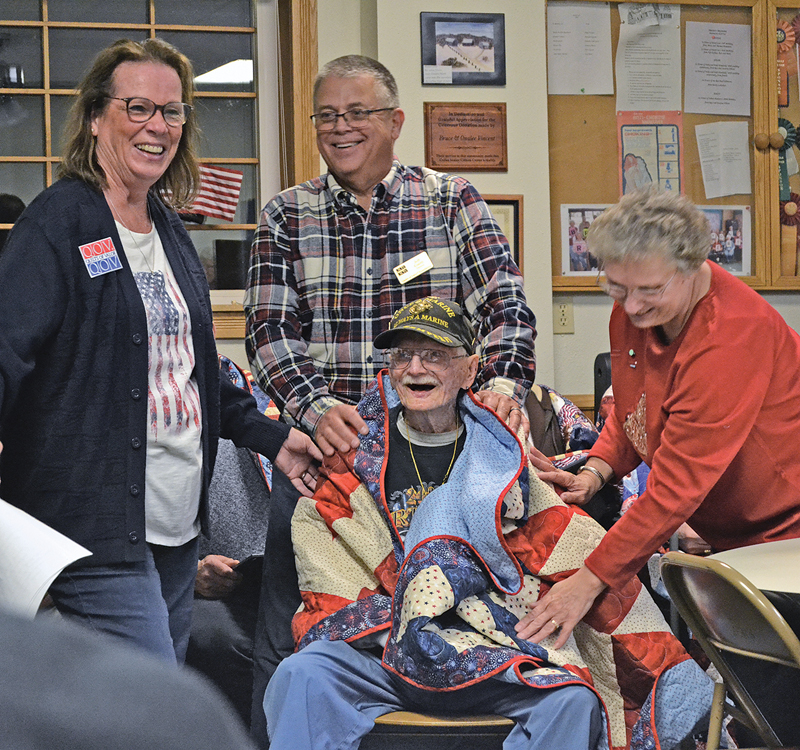
WORLD WAR II VETERAN — Charlie Brady, who served in the United States Army and the United States Marines in World War II, age 99, was presented with a Quilt of Valor at the Veterans’ Day supper at the Grapevine Senior Center November 11. Nancy Hainstock (on left), a member of the Northwoods Quilts of Valor, presented the quilt. Also pictured is Jeff Goettl, who presented Vietnam veteran lapel pins to the Vietnam veterans who were honored with Quilts of Valor. Tammy Steakhouse, a member of the Northwoods Quilts of Valor, is adjusting the quilt. Charlie asked if they had “an electric blanket” version of the quilts. —photo by LeAnn R. Ralph
By LeAnn R. Ralph
COLFAX — Members of the Wisconsin Northwoods Quilts of Valor presented eight quilts to area veterans on Veterans’ Day during the annual Veterans’ Day supper Saturday evening at the Grapevine Senior Center.
Vietnam era veterans Jerry Anderson, Mike Boyd, Tom Dunbar, Stan Knudson, Richard Larson, Jon Scott, Julian (Happy) Silva — and Charles Brady, age 99, a veteran of World War II — were honored with quilts and a “Thank you for your service and welcome home.”
The supper was sponsored by the American Legion Auxiliary of Russell-Toycen Post 131 of Colfax.
“We are very happy to have a full house here tonight!”said Nancy Hainstock, a member of the Wisconsin Northwoods Quilts of Valor and the American Legion Auxiliary.
Hainstock presented the quilts to all of the veterans.
QOV
“The mission of the Quilt of Valor Foundation is to cover service members and veterans touched by war with comfort and healing Quilts of Valor,” said Kristy Goettl, group leader of the Wisconsin Northwoods QOV.
The Quilts of Valor Foundation began in 2003 with a dream experienced by the founder, Catherine Roberts, whose son was deployed in Iraq.
According to the Quilts of Valor Foundation website: “The dream was as vivid as real life. I saw a young man sitting on the side of his bed in the middle of the night, hunched over. The permeating feeling was one of utter despair. I could see his war demons clustered around, dragging him down into an emotional gutter. Then, as if viewing a movie, I saw him in the next scene, wrapped in a quilt. His whole demeanor changed from one of despair to one of hope and well-being. The quilt had made this dramatic change. The message of my dream was: quilts equal healing.”
Originally known as Quilts for Soldiers, the Quilts of Valor Foundation gave out the first quilt at Walter Reed Hospital in October of 2003, Goettl said.
The chaplain at Walter Reed when the first quilt was awarded, Chaplain John Kallerson, noted that a Quilt of Valor is “a lifetime award” and it is “not a blanket.” A blanket is a single layer and quilts are made of the three layers representative of the veterans to whom they are awarded, she said.
The top layer is made of many pieces, colors, shapes and sizes representing the many men and women who have served, Goettl said.
The center of the quilt is the batting that is responsible for the warmth of the quilt and bringing comfort. And the back of the quilt, which holds the three layers together, is representative of the strength of the veterans, their families and their communities, she said.
“The quilt represents the gratitude of all of our citizens for your service and your sacrifice. We offer them as a tangible civilian award to thank you for the protection of our freedom,” Goettl said.
“A Quilt of Valor is priceless. It can never be bought, and it can never be sold. And it is never a gift. Know that when we are stitching, we are remembering the sacrifice you made for us. It is a quilt that comes from the heart, the hands and sometimes the tears of the maker,” she said, adding, “No two are alike but what is the same, though, is the love quilted with each stitch.”
As of October 31, 2023, more than 362,564 Quilts of Valor have been awarded worldwide, Goettl said.
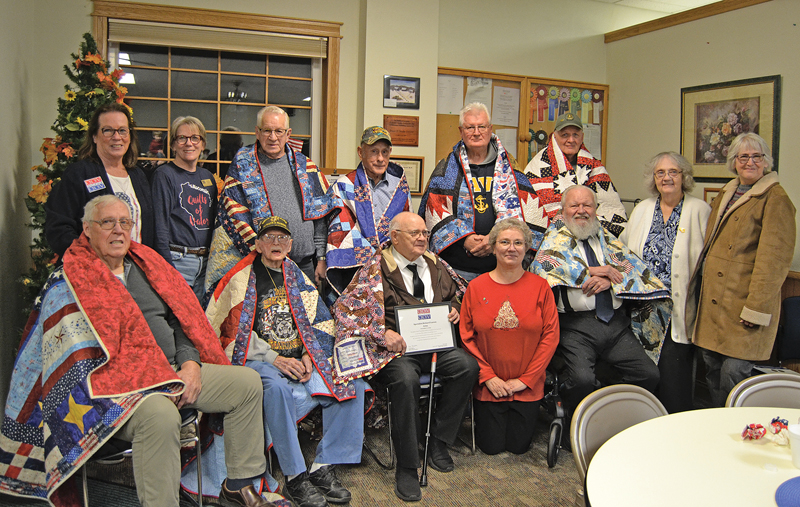
QUILTS OF VALOR — Quilts of Valor were presented to eight area veterans at the Veterans’ Day supper at the Grapevine Senior Center on November 11. First row from left Jerry Anderson (U.S. Army), Charles Brady (U.S. Army and U.S. Marines), Richard Larson (U.S. Army), Tammy Steakhouse (Northwoods Quilts of Valor), Tom Dunbar (U.S. Air Force), Sally Johnson (Northwoods Quilts of Valor) and Cindy Seipel (Northwoods Quilts of Valor). Second row from left: Nancy Hainstock (Northwoods Quilts of Valor and American Legion Auxiliary), Kristy Goettl (Northwoods Quilts of Valor), Stan Knudson (U.S. Army), Julian (Happy) Silva (U.S. Air Force), Jon Scott (U.S. Navy) and Mike Boyd (U.S. Army). —photo by LeAnn R. Ralph
Lapel pin
The Vietnam veterans also received the Vietnam Veteran Lapel Pin, which is presented to veterans who served November 1, 1955, to May 15, 1975, regardless of location of service.
On the front of the pin is the American eagle and six stars, representing the six countries that fought in the Vietnam war.
Embossed on the back is “A grateful nation thanks and honors you.”
According to www.vietnamwar50th.com: “We make no distinction between veterans who served in-country, in-theater, or who were stationed elsewhere during the Vietnam War period. All were called to serve, none could self-determine where they were stationed, and all were seen in the same way by a country that could not separate the war from the warrior, as we do today.”
Anderson
Jerry Anderson served in the United States Army.
He joined the National Guard while in high school and served from 1954 to 1961 and 1976 to 1991.
Anderson retired at the rank of E9 Command Sergeant Major.
He earned the following awards: Good Conduct, Army Achievement, Army Commendation, WCO, Professional Development Ribbon, Korean Service Ribbon, Armed Forces Reserve Ribbon, Army Overseas Ribbon and the Army Service Ribbon.
Over the years, Anderson served in many places, including the 1st Battalion 175th Field Artillery, Dawson, Minnesota; 1st Battalion 76th Field Artillery in Korea; Fifth Army NCO
Academy, Fort Carson, Colorado; 1st Battalion 151st Field Artillery, Duluth, Minnesota; 1st Battalion 125th Field Artillery, New Ulm, Minnesota.
He served at Fort Sill in Oklahoma twice; Fort Carson, Colorado, twice; Fort Ord, California, twice; Camp Roberts, California; Camp Ripley, Minnesota; Fort McCoy, Wisconsin; Camp Saint Barbara, Korea; and Fort Lewis in Washington state.
Boyd
Michael Boyd served in the United States Army from 1968 to 1970.
He was discharged with the rank of Sergeant E5 and served in the Vietnam War.
Mike wrote: “I am proud to have served. I believe all men and women who have been involved with direct combat with the enemy are a changed person when all is said and done. For myself, some changes include not being comfortable around large crowds, nightmares, which are (part of) mild cases of PTSD. Also, I think daily of my comrades who lost their lives in Vietnam and their families having to deal with it. Often I think — was it worth the 58,000 who died to stop the spread of communism, which did not happen, and is ongoing 60 years later.”
Boyd completed basic training at Fort Campbell in Kentucky and advanced training at Fort Lewis.
He served in Vietnam from December 9, 1968, to December 8, 1969.
Boyd earned a Vietnam Campaign Medal, a National Defense Service Medal, an Overseas Service Medal; and a Combat Infantry Badge.
He served more than 25 combat air missions.
He earned Expert Qualifications With Small Arms and Distinguished Service medals.
He carried the company radio for his time in Vietnam.
Letter
Chris Boyd, Mike’s son, had the honor of reading a letter from a fellow Vietnam veteran who served in Vietnam with Mike Boyd.
“Mike’s job, by its very nature, put a target on him for nearly 300 days of combat in the central highlands of Vietnam. He was the radio operator for the commander of our Unit D Company, 1st 14th infantry, 4th Infantry Division.
“We both got there in December 1968 and left in December 1969. Every mission that we went on had a different goal and a different strategy. Mike’s job was to help sort out the traffic on the radio that was coming to Command Post, especially during incoming fire, and the seemingly endless firefights with a well-hidden enemy.
“Mike did his job with ease and calm. Now that I am looking back more carefully, Mike would meet with other soldiers and quickly move to the serious interest of keeping us all alive and safe. He constantly had to sort through communications, under fire from the enemy, and get them to the company commander.
“His job also was to relay the information in a clear and concise manner to three or more infantry platoon officers. He always had to know where all of the soldiers of our unit were situated for the night, and their radio call signs.
“He had to be correct in all things that he reported to the company commanding officer, and all the things he related to the men in the foxholes and firing positions.
“He did this assignment well because he cared. He cared about every person in our infantry for 365 days. He never let down. He never let any personal issues come between him and his massive assignment.
“I am proud to write this for my friend, and I am grateful that during our time in Vietnam, I could walk in his shadow.” — Joe Schlieve, November 2023.
Brady
Charles Brady, age 99, served in the United States Army and the United States Marines from 1939 to 1948.
Brady said when he got out of the hospital, a buddy came home from the Navy, “and then we joined the Marine Corps.”
Brady served on Iwo Jima, was wounded, and said he lost 19 of his buddies.
He was transferred to a hospital in Germany for three months, and then was in Balboa Hospital in San Diego for two and a half years.
“But I’m still here!” Brady exclaimed and noted that he received two Purple Hearts, one of them from his service on Iwo Jima.
Someone in the crowd suggested that Brady talk about how he reached Hawaii.
Brady sailed to Hawaii on the USS Arizona and got off the ship two and a half weeks before it went to Pearl Harbor.
When the USS Arizona was sunk at Pearl Harbor, Brady said he was still listed on the roster.
His wife was a WAVE (United States Naval Women’s Reserve) at Balboa Hospital and received notification that he was buried at sea.
Brady quipped, “I’m Charlie the Tuna!”
Dunbar
Tom Dunbar served in the United States Air Force from July 27, 1966, to July 27, 1970.
He was discharged as a Staff Sergeant E5 from the Vietnam War.
A week after graduating from UW-Eau Claire in 1966, Dunbar enlisted in the Air Force. Within a month, he was on his way to Lackland Air Force Base in Texas for basic training.
He went to Sheppard Air Force Base for accountant training.
Tom and another airman who had accountant training at college were asked to assist others in the class, and none of them failed.
“We must have done a good job!” Dunbar commented.
He received a letter of appreciation from the school commander.
Dunbar was then stationed at Eglin Air Force Base in Florida for three years where he was ordering and receiving medical supplies for the local base hospital in Southeast Asia.
In 1969, he went to the Akatsuki Air Force Base in Japan, which closed shortly after the Vietnam war.
Dunbar was ordering medical supplies for the United States troops in Southeast Asia for the 348th Command Support Group.
When he arrived there, Dunbar learned his predecessor had a little or no accounting or organizational skills.
It took three months of letters, phone calls, and digging through files and desk drawers, until finally, he got everything straightened out.
Two months later, Dunbar received orders to ship out to Vietnam within 48 hours.
The next day he brought everything that he would be shipped out with, and then his commanding officer learned that Tom was being reassigned.
Dunbar’s commanding officer grabbed Tom’s orders and returned after a few hours to announce “Tom was not going anywhere.”
He finished his service in Japan and was honorably discharged from the United States Air Force in California and returned home to work at Peoples State Bank in Colfax.
Knudson
Stanley Knudson served in the Army National Guard from June of 1960 to October of 1961.
He completed his basic training at Fort Leonard Wood in Missouri, and received training in advanced infantry heavy weapons at Fort Jackson in South Carolina.
He was activated to Fort Lewis in Washington state from October of 1961 to August of 1962 and discharged as a Specialist 4 in the Vietnam war.
Larson
Richard Larson served in the United States Army from 1960 to 1963.
He was discharged as a Specialist E4.
Larson served in Chicago, Illinois, at the Fifth Army Headquarters.
He drove “for the high brass.”
“What was that all about?” asked Hainstock.
“I don’t know!” Larson replied. “I drove colonels around.”
Scott
Jon Scott served in the United States Navy from 1963 to 1967.
He was discharged as an E5 Machinists Mate Petty Officer second class.
Scott enlisted in the Navy June 10, 1963, and went to basic training boot camp from June of 1963 to August of 1963 at the U.S. Naval Training Center in Great Lakes, Illinois.
He went to machinists school in August of 1963, and in December of 1963, he was assigned to the destroyer USS Maddox (DD-731) and served on the USS Maddox until December of 1966 in the Tonkin Gulf, South China Sea.
Scott served on the guided missile light cruiser USS Topeka (CL-67) from November of 1966 until his honorable discharge on June 9, 1967.
He received a Good Conduct Medal, a Vietnam Service Medal and an Armed Forces Expeditionary Medal.
Silva
Julian (Happy) Silva served in the United States Air Force from 1961 to 1982.
In 1961, he served at the Air Force Station in Osceola, Wisconsin.
He also served at the Air Force Station in Boron, California; the K55 — Osan —Air Force Base in Korea; the Air Force Station in Chanute, Illinois; the Air Force Base in Antigo, Wisconsin; the Air Force Base in Bakersfield, California; the 366th Combat Support Group in Vietnam; Da Nang Air Base in Vietnam; temporary service in Saigon; and at the Air Force Base in Duluth, Minnesota, and closed the base.
Silva retired in 1982 and was discharged as a Technical Sergeant E5.
He then began his career with the United States Postal Service and retired after 21 years of service in 2005.
