
Concerned citizens allege Emerald Sky Dairy manure spill still not cleaned up 5 years later
PROTECTED CONTENT
If you’re a current subscriber, log in below. If you would like to subscribe, please click the subscribe tab above.
Username and Password Help
Please enter your email and we will send you a password reset link.


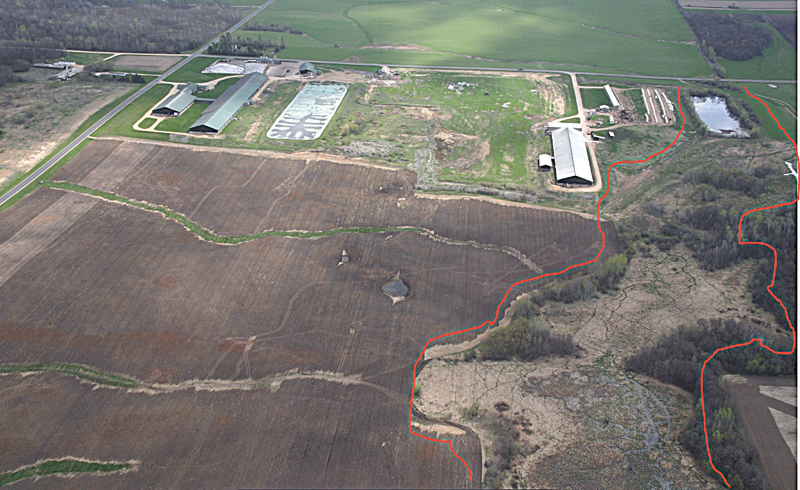
THIS is a DNR aerial photo containing an outline of a manure spill that included a wetland at Emerald Sky Dairy. —photo submitted
By LeAnn R. Ralph
TOWN OF EMERALD — Concerned residents in the Town of Emerald are alleging that the Emerald Sky Dairy manure spill in late 2016 is still not cleaned up completely five years later.
The Town of Emerald residents also are concerned about water quality because of high nitrates and E.coli in their drinking water that they believe are associated with agricultural practices in their township.
Emerald Sky Dairy, classified as a Concentrated Animal Feeding Operation (CAFO), has a conditional use permit from St. Croix County that allows up to 3,400 dairy cows, or 4,760 animal units.
Employees at Emerald Sky Dairy discovered that a clean-out riser pipe had burst earlier in December of 2016 and began repairing the pipe on December 19, 2016, according to the state Department of Natural Resource’s 314-page report on the manure spill.
Emerald Sky Dairy did not report the manure spill to the DNR until three months later on March 30, 2017, after St. Croix County officials and the DNR received an anonymous tip.
The manure transfer line from the Transition Management Facility (TMF) had burst at the clean-out riser pipe closest to the Waste Storage Facility (WSF).
The TMF houses heifers and cows, and the waste storage facility, also sometimes referred to as a manure lagoon, had a capacity of nearly 14.5 million gallons.
At the point of discharge near the waste storage facility, the manure flowed west/southwest and deposited in a wetland area, delineated as Wetlands No. 6 and No. 7, that included an open pond.
Manure continued flowing south, through a ditch around the TMF barn, to the stormwater pond, which overflowed with manure and manure-laden water into Wetland No. 1.
According to the DNR report, a total of 3,455.54 tons of solid manure were removed from the wetlands at Emerald Sky Dairy.
The depth of the manure solids ranged from 12 inches deep to more than three feet deep in places where a fully-submerged yard stick did not reach the bottom of the solids.
The manure scraped up from the wetlands was spread at a rate ranging from 10 tons per acre to 50 tons per acre, depending on the field, according to the DNR report.
The total amount of manure removed from the wetlands was the equivalent of about 7,000 half-ton pickup truck loads or 6.91 million pounds of manure.
All together, Emerald Sky Dairy spent $152,519 on cleanup of the manure spill.
Civil lawsuit
The state of Wisconsin filed a civil lawsuit against Emerald Sky Dairy in St. Croix County Circuit Court.
A judgement issued in May of 2019 by Judge Scott R. Needham fined the dairy $80,000 and ordered the remainder of the wetlands be cleaned up and restored.
The judgement specifically ordered Emerald Sky Dairy to complete the work described for Wetland No. 7 from the February of 2019 report by Tim King of Ecosystems LLC.
The Ecosystems report states that Wetland No. 7 was over-excavated during the clean-up, and because of the disturbed soil, instead of sandbar willow, reed canary grass, stinging nettle and curly dock, the wetland was dominated by pinkweed, lamb’s quarters and giant ragweed.
The Ecosystems report recommended “re-estabilshing pre-discharge elevation … in the central part of the wetland by regrading or filling the central ditch channel that may have been uncovered or enhanced incidental to the initial manure removal and clean-up activities. This would involve placing approximately one foot of salvaged marsh topsoil in the ditch channel within the central part of the wetland using the adjacent spoil piles as the salvaged marsh topsoil material. The disturbed (regraded) wetland area would be seeded with a wetland seed mix consistent with Natural Resources Conservation Service (NRCS) Conservation Practice Standard 327 (Conservation Cover) and Wisconsin Agronomy Technical Note 5.”
Wetland No. 1
Although Wetland No. 1 was not included in the state of Wisconsin’s lawsuit or the orders from Judge Needham, according to a news release from Emerald Clean Water For All, Wetland No. 1, the largest of the wetlands, has yet to be cleaned up and restored.
Wetland No. 1, according to a wetland delineation report completed for Emerald Sky Dairy in August of 2016 by Ecosystems, is 10 acres and contains a wet meadow, shrubs, hardwood swamp and a farmed wetland complex.
Residents in the Town of Emerald, who have been experiencing high rates of nitrate in their well water as well as E.coli contamination, have been working with Steve Oberle, an agro-environmental consultant.
Oberle has talked to, and has had correspondence with, representatives for the DNR, who tell him he must talk to someone with the Department of Justice, who has in turn told him he must talk to the DNR, who then tell him he must talk to the DOJ.
According to a news report published June 2 by the “Wisconsin Examiner,” DNR officials say that while some manure and manure-laden water was discharged from the stormwater pond into Wetland No. 1, there were no recoverable manure solids and the pollutants were all dissolved in water.
In a letter to the Wisconsin Department of Justice in November of 2021, Oberle writes, “The aforementioned stormwater pond, though ‘state of the art’ at the time of construction, is designed and built to only handle clean (runoff) water from this facility and production area. In other words, this stormwater pond was not designed and built with any liner material. Since it has been reported that the stormwater pond was pumped 3 to 4 time following discharges of manure and manure-laden water into it, one can only assume that excessive amounts of plant nutrients (eg. Nitrates, phosphorus) and other agrichemicals and toxics in the manure, process wastewater and production area runoff ended up in the stormwater pond, with some likely to have runoff into surface waters (including wetland 1) and leached into groundwater downstream/down-gradient from this location. It is also quite likely that the integrity of the stormwater pond was comprised and in need of repair following massive amounts of solids being discharged into it, and as a result of cleanup and pumping activities.”
Additional appeals
More recently, Oberle has been in contact with U.S. Senator Tammy Baldwin’s office with the idea that perhaps the U.S. Environmental Protection Agency could be of assistance.
Oberle also has contacted Governor Tony Evers’ office and has talked to a senior policy advisor who works with the state Department of Agriculture.
To date, no one from a state or federal agency has agreed to take a closer look at the wetland, to re-open the case, or has addressed the plight of residents in the Town of Emerald who have high nitrate and E.coli in their well water.
Neil Koch, who worked as a geologist and hydrologist with the U.S. Geological Survey for 32 years and who lives in Dunn County, says ordinances are needed to protect groundwater recharge areas from contamination.
Koch was the featured speaker for a Chippewa Valley Learning in Retirement program at the Rassbach Museum in Menomonie on March 30.
Land spreading of waste from septic systems is the number one polluter of groundwater in the United States, and instead of being spread on land, the waste should be taken to municipal wastewater treatment plants, he said.
Housing developments with wells and septic systems are creating a groundwater crisis, he said.
All together, 60 percent of the recharge of the aquifer in a rural housing development is coming from septic drain field water, Koch said.
High nitrates
While residents in the Town of Emerald are concerned about the Emerald Sky Dairy manure spill and their water quality, their concerns are not only about the 2016 manure spill.
Emerald Sky Day also had run-off into a road ditch from a field application of manure in February of 2017, and more manure run-off into ditch from a broken hose connection in May of 2019, and another manure run-off incident from a field in November of 2019 in which manure ran into Hutton Creek and resulted in a fish kill.
A water sample from the Emerald Town Hall taken in October of 2020 tested at 40.3 mg/L for nitrate, which is four times above the public health recommendation of 10 mg/L.
The water at the Emerald Town Hall, located on county Highway G, is tested regularly amid concerns about Emerald Sky Dairy, which is across the road from the town hall.
According to the report from UW-Stevens Point on the water sample from October of 2020, “water greater than 10mg/L of nitrate should not be consumed by infants less than 6 months of age or pregnant women. The Wisconsin Department of Health Services recommends that all persons should avoid long-term consumption of water with nitrate/nitrogen concentrations greater than 10 mg/L.”
According to the water quality test reports, the nitrate level at the Emerald Town Hall was 6.9 mg/L when the well was drilled in 2007.
Request to reopen
Emerald Clean Water For All is asking the Wisconsin Department of Justice and the Wisconsin DNR to re-open the case against Emerald Sky Dairy and to oversee the clean up and restoration of Wetland No. 1.
The group of concerned citizens also is asking for a thorough investigation of well contamination throughout the township and at the Emerald Town Hall.
No one from the DNR or the DOJ has investigated the causes of the water contamination, and “such neglect of duty is unacceptable,” said former Town of Emerald resident Kim Dupre.
“For those in Madison to turn a blind eye to such egregious violations shows complete disregard for rural families in northwest Wisconsin. Such neglect weighed heavily in my family’s decision to leave our home of 20 years in Emerald,” Dupre said.
