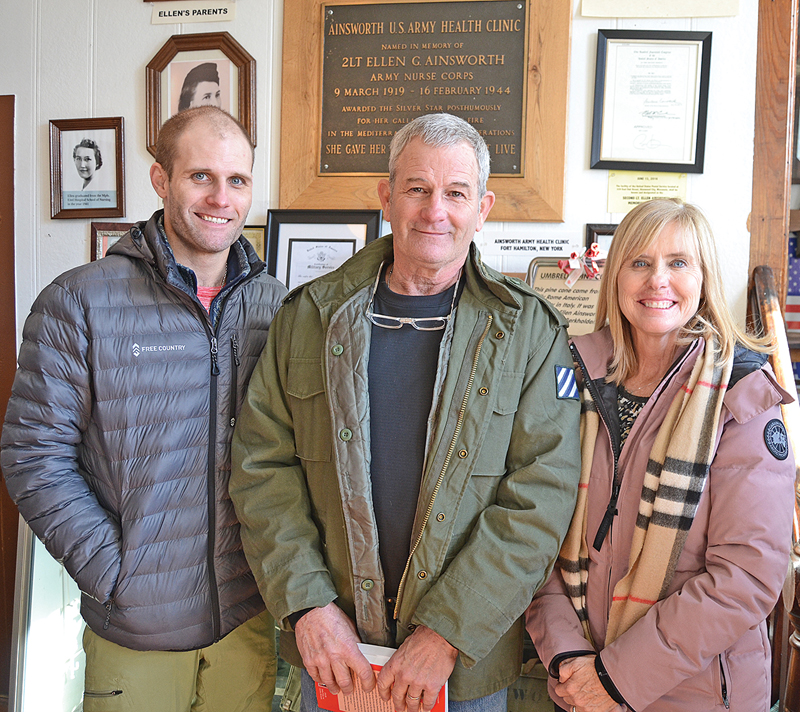
FAMILY VISIT — Keith Giddens, who credits Ellen Ainsworth with saving his father’s life during World War II, visited Glenwood City with his family March 1 to honor Ellen’s memory. From left: Benjamin Giddens, Keith Giddens and Kristi Giddens. —photo by LeAnn R. Ralph
By LeAnn R. Ralph
GLENWOOD CITY — The son of a World War II veteran who credits Ellen Ainsworth with saving his father’s life in 1944 during the Battle of Anzio has visited Glenwood City to honor her memory.
Keith Giddens, the author of “Payne City, A personal account from a lone survivor during WWII, a member of the 3rd Infantry Division, 30th Regiment, 3rd Battalion, Co. K,” visited Glenwood City March 1 and told some of his father’s story at the Glenwood Area Historical Society Museum.
Giddens and his wife, Kristi, live in South Carolina. Their son lives in the Twin Cities, and while visiting their son, Keith Giddens also wanted to visit Glenwood City.
Ellen Ainsworth was born in 1919 in Glenwood City and graduated from nursing school in Minneapolis in 1941. She enlisted in the United States Army Nurse Corps in March of 1942 and served as a Second Lieutenant in Tunisia before going to Anzio, Italy.
Giddens’ book, while not yet available in a print version, is available online through Amazon.
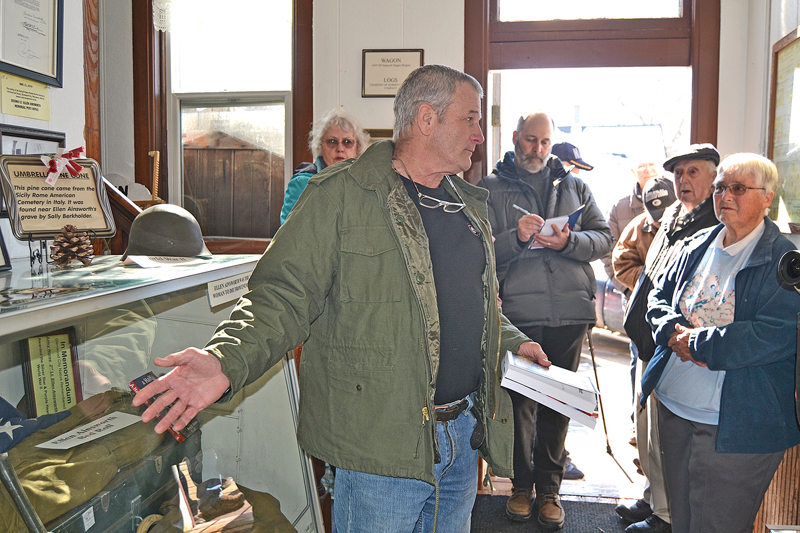
HONORING ELLEN AINSWORTH — Keith Giddens, who credits Ellen Ainsworth with saving his father’s life during World War II, was deeply touched to see the display at the Glenwood Area Historical Society Museum that is devoted to Ellen Ainsworth. Giddens and his family visited Glenwood City March 1 to honor the memory of Ellen Ainsworth. One of the items on display is Ellen’s knapsack. Museum curators do not believe the knapsack has ever been opened since being returned to Glenwood City. —photo by LeAnn R. Ralph
Giddens said his father, Vrozell Broadus Giddens, known as “Dock,” landed in Anzio at 2:30 a.m. January 22, 1944. He had been in North Africa prior to what the soldiers had thought was going to be a beach landing an Anzio.
Instead, they were put out in 10 feet of water.
Dock and the rest of Company K walked in nine miles to Bridge 12, where they started fighting the Germans. They went five days without food and four days without water, because they had outstripped the supply chain, Giddens said.
On January 29, they went back to Bridge 12 and learned there were friends there and not enemies.
Surely, someone must have water, Dock thought.
The Germans saw the movement.
In the movies, Giddens said, you hear the whistling of the mortars, but that does not mean anything. The fins whistle in the distance.
But if the shell is close, you hear “chunk, chunk, chunk” — and as Dock was drinking water, he heard “chunk, chunk, chunk.”
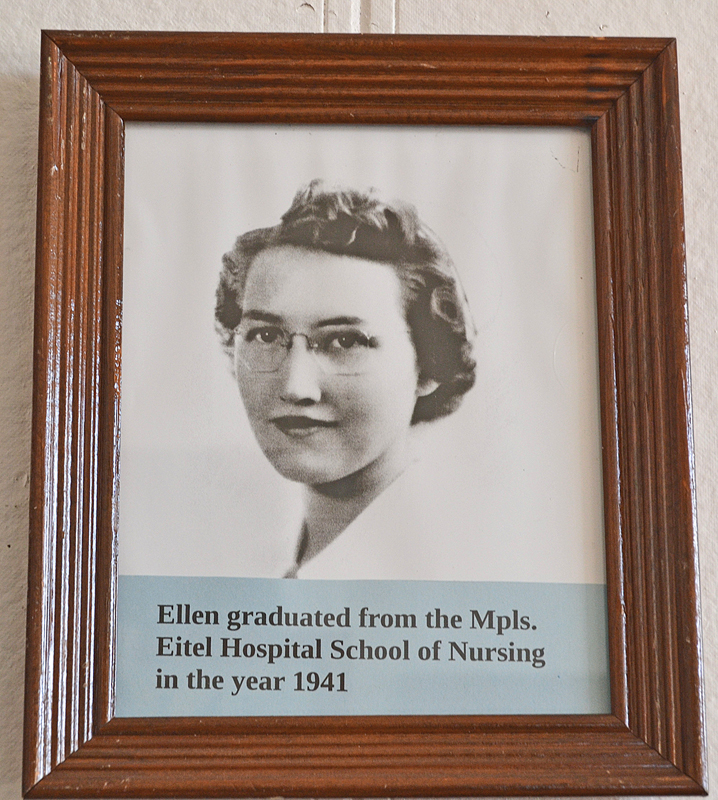
NURSING SCHOOL — One of the photographs on display at the Glenwood Area Historical Society Museum that is part of the Ellen Ainsworth display is of Ellen when she graduated from nursing school in Minneapolis. —photo by LeAnn R. Ralph
Dock Giddens was hit with a 50 millimeter mortar “that took out his left side,” which included his kidney, spleen and part of his lung, Giddens said.
Somehow, the wound cauterized itself — and Dock kept drinking water. He walked the half mile to the rail bed, where he was waiting to be transported.
A Second Lieutenant walked by, and Dock noticed he had a canteen and asked if he could have some water.
The Second Lieutenant noted that water was in short supply but gave Dock the canteen, and “Dad drank the water,” Giddens said.
The Second Lieutenant “left my Dad and said he could walk back the nine miles,” he said.
So, Dock walked the nine miles back to the beachhead. The temperature was never above freezing. His toes, feet and hands were black with frostbite, and he had a hole in his side.
“By the time he arrives, he’s basically knocking on death’s door,” Giddens said.
Evac hospital
Ellen Ainsworth was among the nurses who had set up the 56th Evacuation Hospital.
The full invasion happened on January 31, 1944.
When Dock had landed, there were 36,000 soldiers from the United States Army and only 2,000 Germans, but then the Germans went up to 90,000, Giddens said.
When Dock walked into the evacuation hospital, they said, “You’re going to die.”
Hospital personnel did not give Dock anything for pain or treat his wounds because they said they were saving time, effort and supplies for people who could live, Giddens said.
A nurse named Rita O’Rourke put Dock in a body bag, and he dictated a letter to his mother.
The nurses stayed with Dock throughout the night, as did a chaplain.
“The next morning, my dad was alive,” Giddens said.
“Rita O’Rourke compelled the surgeons to do something for him — and my dad lived,” he said.
The letter to Dock’s mother was not mailed, “but he’s not in good shape,” Giddens said, noting that his father was 19 years old at the time, was five feet, six inches tall and weighed 125 pounds.
Giddens said his father had told the family nothing of his experiences until 1994, when they took him for a 50th anniversary reunion.
Most World War II veterans came back, did not see themselves as heroes, and went about their lives, Giddens said.
Ambulances
At the reunion in 1994, Giddens said he met a major who had been with the 15th Infantry Division and who had been in a mortar division about two miles from where his dad had been.
People are wondering, why are the Germans bombing evacuation hospitals and Red Crosses? he said.
The major said he kept seeing ambulances coming down out of the mountains. He could not figure out why the Germans had so many ambulances, so he said, “We’re going to shoot one,” Giddens said.
On January 24 (or 25), 1944, they shot a two-inch mortar at an ambulance.
“That ambulance went off for about two hours. It was full of munitions,” Giddens said.
The Germans were using the Red Cross and ambulances as a cover to get supplies and munitions to their front-line troops and using them to store weapons so they would not be bombed, he said.
“You know, if you cheat on a test, you know what you think everybody else does. You think they cheat,” Giddens said.
So, the Germans began bombing the beachheads.
Dock Giddens was alive in the Evacuation Hospital on February 2, 1944, and all of the other 542 men in Company K died.
The nurses and doctors could not keep up with the casualties.
Dock Giddens had turned 19 the month before, and he was still in recovery.
Bombs
The Germans began dropping anti-personnel bombs on February 12, 1944, and dropped bombs on the whole beachhead, Giddens said.
The nurses, including Ellen Ainsworth, were moving people out of the hospital as much as they could, but there were a few, like Dock Giddens, who could not be moved because of their fragile condition.
So Ellen Ainsworth decided to stay with Dock Giddens, “to help him, so he would live. They dropped an anti-personnel bomb on the tent and killed her,” Giddens said.
“That’s why we’re here today,” he said.
According to the website, www.womeninwisconsin.org, Ainsworth had been struck in the chest by shrapnel but worked with three other nurses to evacuate 42 patients to safety.
Six days later, Ainsworth died from her injuries and was buried in the Sicily-Rome American Cemetery and Memorial in Nettuno, Italy.
Scholarship
Giddens was accompanied on his trip to Glenwood City by his wife, Kristi, and their son, Benjamin.
While Giddens took a moment to compose himself, Kristi Giddens stepped forward.
“One of the things we wanted to share with her hometown — in her honor — because you don’t hear much about nurses and the Red Cross … we want to start a scholarship foundation in her name for (students to attend nursing school). We want to give a little bit back,” she said.
Enlisted
All together, there were six wounded soldiers who could not be moved out of the Evacuation Hospital where Ellen Ainsworth was working to save their lives.
Dock had enlisted in the Army, but at first, he was not accepted because three of his brothers were already serving.
Earlier in the war, five Sullivan brothers from Iowa died together aboard the USS Juneau, so the “heritage exemption” was implemented to prevent families from losing all of their sons.
Dock had one younger brother and eventually got his mother to sign a waiver.
“Dad chose to go. Ellen chose to go,” Giddens said.
When Dock had been asked why he chose to go, he said, “because it was the thing to do,” Keith Giddens said.
Giddens said he challenges everyone to do one true act of kindness “that will cost you dearly, for someone you don’t know” because that is what creates society, community and a nation.
“She chose to go and chose to stay with people who could not be moved. She did not have to do that,” Giddens said.
“So Ellen — thank you for doing a beautiful act of kindness that cost you deeply,” he said.
Giddens said “it means a lot to me” that there is a display devoted to Ellen Ainsworth at the Glenwood Area Historical Society Museum.
Work also is being done to obtain a Congressional Medal of Honor for Ellen Ainsworth, he said.
Ellen Ainsworth was the only woman from Wisconsin to die in World War II from enemy fire.
Short supply
The medical personnel at the Evacuation Hospital had no rest and no relief, Giddens said.
Supplies were diverted to Normandy, where there were 150,000 United States Army troops, he said.
When Ellen Ainsworth was hit by German artillery, Dock Giddens also got hit again, and on his left side again. This time it took out the lower section of his heart.
Giddens said when he was growing up, his father would take off his shirt to mow the lawn, “and he had one funky looking left side. Scars all over.”
But at that point, Giddens said he knew nothing of his father’s story, only that he had scars.
Dock Giddens died in 2003 at the age of 78.
In 1994, Dock fell out of a deer stand and broke his back, Giddens said.
Dock was paralyzed from the waist down. He crawled to his truck, took a piece of pine stick and used it to push in the clutch and drove himself to the hospital.
The Giddens family motto is — “take one more step,” Keith Giddens said.
Another saying of his dad’s was, “Everything happens for the best,” he said.
According to people who were at the museum March 1 for Giddens’ visit, the knapsack, bedroll and a few other things were the only items belonging to Ellen Ainsworth and her time during World War II that had been saved.
Ellen Ainsworth’s father was said to have never recovered from losing his daughter.
The pictures of Ellen that are at the museum were donated by members of the community.
The Glenwood City Post Office was renamed the 2nd Lt. Ellen Ainsworth Post Office in August of 2016.
The Giddens family also visited the post office while they were in Glenwood City.
Members of the historical society provided refreshments for the Giddens family at the Methodist church next door to the museum.
A photo display devoted to Ellen Ainsworth also was set up in the church basement.
In the beginning
Joan Ludtke, a member of the Glenwood Area Historical Society Board of Directors, said she was “in on the very beginning of Ellen’s story.”
Ellen’s duffle bag and bedroll were found in her father’s house during some remodeling, and the person doing the remodeling did not know what to do with it, so he took the items across the alley and gave them to Helen Best, Ludtke said.
Helen Best, as it turned out, did know what to do with the items and gave them to Wayne Peterson, who was one of Glenwood City’s historians, she said.
Wayne asked Joan if she would take a picture of the items and write a story.
So, Joan Ludtke took pictures of the items and wrote a story about Ellen Ainsworth.
“I was the first one who started all of this,” she said, adding that she felt privileged and guided by divine intervention to be the catalyst for launching the story.
Ellen was known to the older people but not to the younger people of Glenwood City, Ludtke said.
“And now people know we have a hero in town,” she said.
“I was so touched that I was the messenger who could bring this story,” Ludtke said.
Ludtke said she “had a funny feeling” when she touched Ellen’s items “because I knew what they had gone through.”
When Ludtke was finished taking pictures of the items, Wayne Peterson asked her if she had opened the knapsack.
“I could not open it. To me, it was a piece of sacred property. I don’t think anyone has ever opened it,” she said.
Ludtke noted that she and two other women are working on a history book of Glenwood City.
Ludtke joined the Glenwood Area Historical Society in 2004 and said she and Wayne Peterson had worked on setting up the museum on Oak Street.


