
Dr. Ketola takes trip of a life time to Antarctica
PROTECTED CONTENT
If you’re a current subscriber, log in below. If you would like to subscribe, please click the subscribe tab above.
Username and Password Help
Please enter your email and we will send you a password reset link.


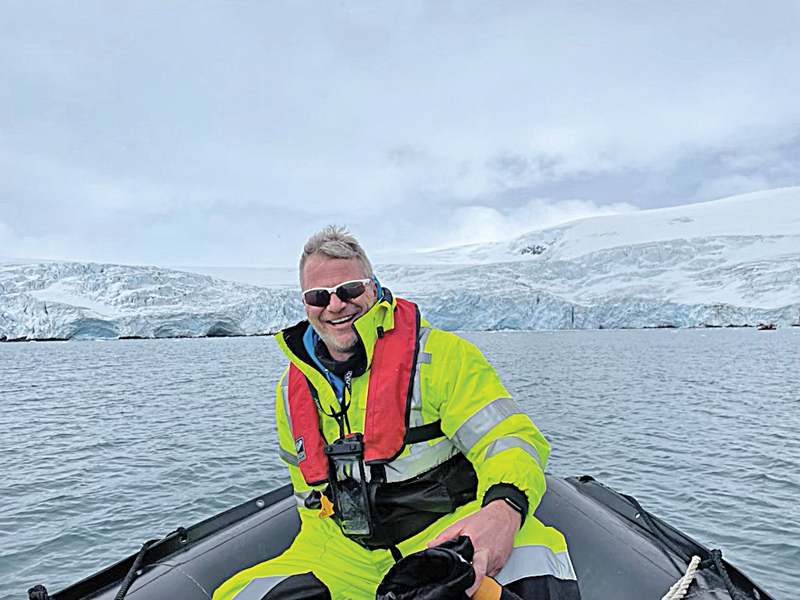
RANDY KETOLA riding a Zodiac float boat as he approaches the shore of Antarctica during his January trip to the seventh Continent.
Editor’s note: Dr. Randy Ketola, a local resident, teacher at the Glenwood City High School and a member of the City Council fulfilled one item on his bucket list and that was to travel to the Antarctica, the seventh Continent this past January. The following is his story of the trip.
A couple of years ago, an opportunity arose for me to be able to travel to Antarctica, the 7th Continent. A spot opened up on an expedition that my brother in law was planning to travel with, and he jokingly asked the family if anyone would be interested in traveling to Antarctica. My wife, remembering many years ago when I had told her that this was on my bucket list, told him that I would like to go, and she booked me into the open seat which had become available.
We were supposed to go last January, but COVID shut the whole trip down. The company running the trip (Antarctica 21), and the travel group who arranged it (FEAT Travel), agreed to postpone the trip until January 2022 as we saw what would happen with respect to COVID.
I was able to leave the US on January 7th, provided I took a PCR-COVID test AND received a negative result within 72 hours of boarding the aircraft for Santiago, Chile. Upon landing, I was required by law to quarantine for 48 hours at my hotel. When the quarantine was over, I then boarded a flight south to Punta Arenas, Chile, where I received rapid COVID test.24 hours later, I took my third COVID test, which then allowed me to board a flight to the southernmost city in the world, Puerto Williams, Chile, and the very southern edge of South America. It was the height of summer there, but it was about 40 degrees, grey, and very, very windy.
It was in Puerto Williams that I boarded the Magellan Explorer, a 180’ ship built exclusively for trips between South America and Antarctica across one of the wildest stretches of water on the planet; The Drake Passage. The Drake Passage is where the Atlantic and Pacific Oceans meet, the weather is usually bad, and waves of 20’ or more are fairly common.
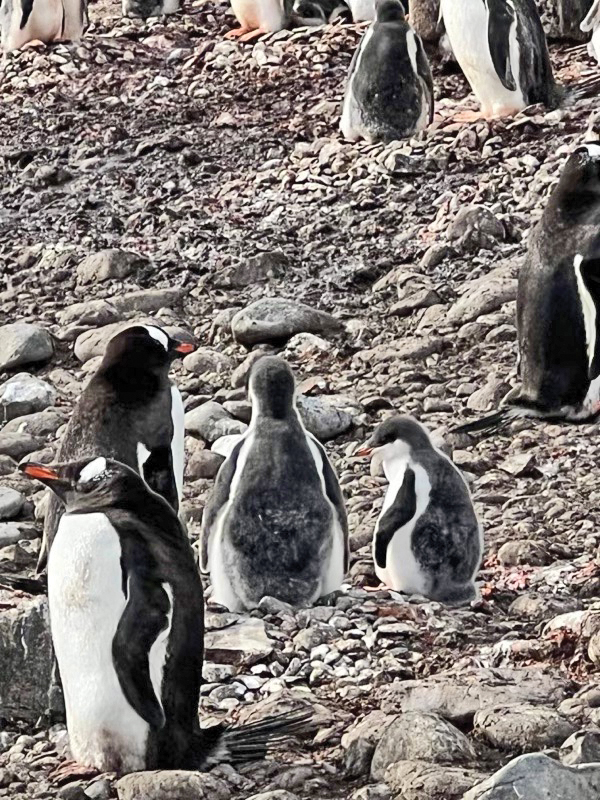
Antarctica’s rock covered shore-line is the home to these Gentoo penguins, and other marine creatures.
We stayed the night at the dock in Puerto Williams because the winds at sea were over 50kts, and the captain felt it best to wait for more favorable weather.We sailed south the next morning, and were not able to make a planned stop at Cape Horn, South America because the winds and high seas made landing there impossible. The ship was tossed around for about 24 hour, the first night, only five or six of us made it up to the main deck to hear the evening lecture, the other 50 or so passengers were absent, many had become seasick as bottles and glasses were broken and items tossed about during the voyage. The crew told us that when we passed through the Antarctic Convergence (a region of cold water that continuously circles Antarctica) we would see a marked change in the weather, it would become cold, foggy, and calm. They were spot on, we knew when we crossed it, it was just as they said it would be.
About two days later, we dropped anchor in a place called Yankee Harbour in the South Shetland Islands of Antarctica.On the way in, we were treated to many whale sightings, thousands of penguins swimming alongside the ship, even hundreds of miles from shore, and some of the most rugged and desolate landscapes I have ever seen.
We then boarded small Zodiac float boats to go the last thousand feet or so to the shore. The shore was composed of rocks of various sizes, huge cliffs towering 1000’ or more, and an even larger glacier which may have been 2000’ or higher. On this rocky, unforgiving beach, there were thousands of Gentoo penguins (and a few Chinstrap penguins as well).In addition, there were about a dozen adolescent elephant seals, and the ever present humpback whales kept surfacing, blowing out their airholes, and diving back beneath the surface.
It never really got dark down there, the sun stayed up nearly 24 hours, and when it set, it never really set all the way. We only spent about 3 hours on land, then it was time to board the ship, and sail to Frei Station a Chilean Research Station and Bellinghausen, a Russian Research Station (they are separated by a stream that you can literally step across). We then grabbed our gear, and walked about 3/4 mile up a long, winding, gravel hill between the bases which led to an airport with a long, rough, gravel runway. It was here that we waited for our aircraft to fly us back to Puerto Williams.
The aircraft was delayed because there was word that a tsunami could be coming toward the Antarctic Peninsula as a result of an earthquake in Tonga but, after about an hour, they determined it was safe to come and get us. We then flew to Puerto Williams, then to Punta Arenas and spent the night, it was here that I had to take my last COVID test and get a negative result in order to be able to fly into Santiago, and then board my flight to Dallas which would ultimately take me home.
I should point out that while in Chile, I was required to carry a piece of paper called a Mobility Pass in my possession at all times, along with my most recent negative COVID test results, and always wear a mask. If I violated any of these orders, I could have been subject to police action. I never once saw anyone maskless anywhere I went and all establishments asked to see the mobility pass proving vaccination before they would allow you to enter.
The temps were in the high 30s with steady winds. It was like a late March day around here.
