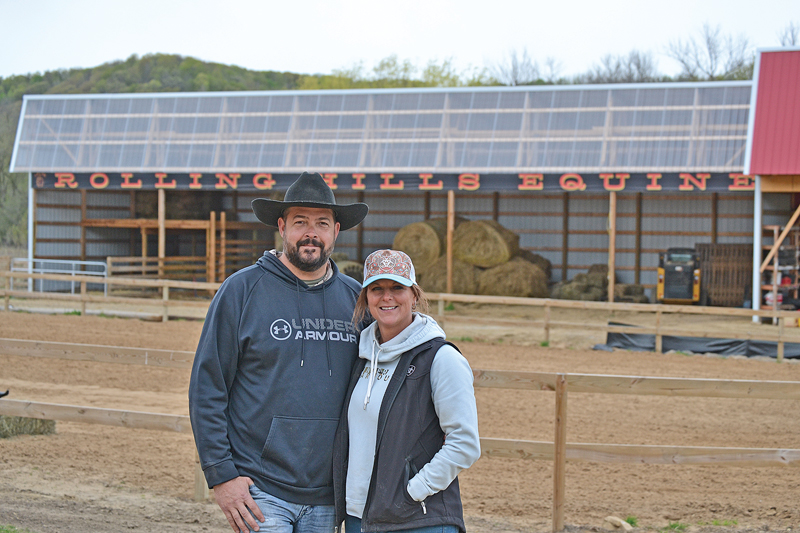
PARTNERS — Josh Edhlund and Jill Charland have combined their talents to operate Rolling Hills Equine Inc. just north of Knapp. Rolling Hills provides therapeutic services to children and adults suffering from mental health issues or substance abuse. —photo by LeAnn R. Ralph
By LeAnn R. Ralph
KNAPP — Jill Charland and Josh Edhlund make a powerful team.
Jill is a master’s degree level mental health professional, and Josh is only a dissertation away from a PhD in supply chain management.
Together they have created Rolling Hills Equine Inc. just north of Knapp that uses horses, dogs and the great outdoors to treat children and adults with mental health or substance abuse problems.
Rolling Hills works with programs within the counties, is contracted with 23 counties in Wisconsin, has served people from the age of four to 72 and uses more than 40 therapy providers, Charland said.
Equine therapy is provided at Knapp, and many non-equine therapy services are provided off site. The providers will go into the communities to work with people suffering from anxiety, for example, to help them find employment and housing, to work on wellness and on healthy eating, she said.
“The program is based on getting them in, helping them reach their goals, and getting them out of the program so they can live independently — helping them develop coping skills, to help with their mental health symptoms,” Charland said.
Comprehensive Community Services (CCS) is the main program, but there are other programs as well for children and adults, she noted.
According to the Wisconsin Department of Health Services website, CCS “is a program that helps individuals of all ages live their best life by providing supports that address their unique needs related to mental health and substance use.”
Qualifying for CCS requires a dual diagnosis in mental health, such as depression and anxiety, as well as eligibility for Badgercare, Charland said.
Rolling Hills has 60 acres and trails in the pine trees where clients — Charland refers to them as consumers — can go geocaching. There also is a Class A trout stream running through the property.
“The kids like to explore,” Charland said.
“We meet all of our consumers in the moment, where they are in the present time. We do not force anything,” she said.
Many facilities have only one program that is used, Edhlund said.
“We will modify what we are going to do for that day and meet them in the moment and figure out what they want to do,” he said.
In addition to horses, Rolling Hills has goats, donkeys, bloodhound dogs and chickens.
The youth who come to Rolling Hills also like to collect eggs from the flock of chickens, and there are raised garden beds where they can pick vegetables during the summer. The providers will help them make meals with the vegetables and will give them recipes they can use, Charland said.
Eagala
Rolling Hills is certified in the Eagala Model of equine assisted therapy.
Eagala certification requires a minimum of a two-person team, one person who has extensive experience with horses and the other who is a mental health professional.
Rolling Hills teaches appropriate horsemanship, including how to halter the horses, how to stand with them and how to lead them, Charland said.
“It’s about building healthy relationships,” she said.
Brushing the horses is especially therapeutic in the spring when the horses are shedding, Charland noted.
One of the horses who has been with the program the longest, named Jake, has a trachea tube. The horse had a problem with his larynx, and after two surgeries failed to fix the problem, veterinarians told them it would be best to euthanize the horse.
Charland and Edhlund were unwilling to put the horse down. After doing some research and working with a vet in Stillwater, and after trying two or three gadgets, they finally found one that works. Charland changes out the tube every few days.
The youngsters who have trouble verbalizing what is going on with them gravitate to the horse with the trachea tube, Charland said.
Jake cannot whinny — cannot “talk” in horse language — and the kids can relate to him and his story, she said.
“He loves kids … He is Mr. Personality. He’s like a dog. He licks you,” Charland said.
Rolling Hills has 23 horses all together, and another popular horse is a Gypsy Vanner mare.
The kids like the Gypsy Vanner because she is a smaller horse and is not so intimidating and also because she has a long mane and tail and long “feathers” on her legs, Charland said.
The youngsters just love to braid her hair and brush her feathers, she said.
While most horses have some feathering on the backs of their lower legs, the Gypsy Vanner’s feathers extend from her knees to the top of her hooves.
“It’s all about the temperament,” Charland said, noting that the horses work with a variety of people all throughout the day.
Groundwork
Most of the work with the horses is groundwork and often with props.
A barrel, for example, could represent a family member. The youngster will walk up to the barrel with the horse and then will tell the horse a story about the barrel/family member, Charland said.
“We do a lot of metaphoring. They are talking to the horse and not to a person,” she said.
“We have seen a lot of success using the equines with the different individuals,” Charland said.
Rolling Hills has a heated indoor arena for winter sessions when the weather is too cold and snowy to be outside, and even the office is used on especially bad winter days.
Last winter at Christmas, Charland put up a Christmas tree in the office and had a variety of art supplies so the kids could make ornaments for the tree.
The youngsters also could make ornaments for gifts, and Charland had wrapping paper available so they could wrap the gifts and give them to a family member.
Between the two of them, Charland and Edhlund have nine children. Their children interact with the kids who come to Rolling Hills for therapy, making friends and playing games, such as kickball.
The interactions let families know that Rolling Hills is family-friendly, and the interactions also help their clients with learning to build healthy peer relationships, Charland said.
One thing visitors will notice immediately at Rolling Hills is the black chain link security fence with a rolling gate across the driveway that can be operated by remote control or by a motion sensor.
The security fence, Charland said, is to keep their dogs from getting out into the road and also is there in case a horse gets away from someone so the horse does not end up in the road.
Rapid growth
Charland has been in the mental health field for about seven years.
She started out working as an intern with Dunn County and then went on to work with a variety of other places, such Aurora Health and Milkweed Connections.
“She really wanted to do equine therapy but it wasn’t offered. She took a class in Eagala at Trinity Equine in Eau Claire,” Edhlund said.
At first, after securing contracts with several counties to provide services, Charland said she did not want to run a business, but then there were more counties, and then she needed someone to help, and then there were two therapists, and the next the thing you know, it went to 45, he said.
Charland works on managing the program and on building and maintaining relationships with the counties, training employees and matching providers with clients, while Edhlund is “the business side” of the operation.
“We have a really good balance with us,” Charland said.
“There is so much demand for this. There are waiting lists in places. There are not enough providers,” Edhlund said.
“In three years we from three employees to 45. It’s not slowing down. We’re hiring as fast as we can,” he said.
Although Edhlund refers to the providers as “employees,” they are not employees in the traditional sense, but rather, are independent contractors who provide services.
“Our agency, Rolling Hills, is very goal oriented. We get in there, we help them reach their goals, we help them graduate and go onto another chapter in their life. That’s the point of the CCS program, and that’s how we work and that’s what we do,” Charland said.
“We have a lot of counties giving us feedback about why they like to use us all the time. It’s for that reason. We have a good success rate,” Edhlund said.
Rolling Hills has many different people on the team with different personalities and different backgrounds. Charland is exceptionally good at assessing the needs of people and then matching them with a provider, he said.
Expansion
Edhlund bought the place near Knapp in 2010 and built the house.
Charland has lived there for about six years.
They started out with one horse for Charland’s oldest daughter, who was having difficulty in school after a change in circumstances meant she could no longer take riding lessons and spend time at a stable where she had previously spent many happy hours.
Charland says her daughter’s “gift is horses.” In addition to working with the Rolling Hills program, her daughter gives riding lessons in the evenings and also trains horses.
Rolling Hills is planning to add an event center with a bigger indoor arena.
“We are growing so big, we need a bigger facility,” Charland said.
The event center/indoor arena also will be used for horse shows and other events, such as fun shows.
“We want to involve the whole community,” Charland said.
The indoor arena will be 110 feet wide with room for 42 stalls along the outside for people who bring their horses in for events, Edhlund said.
The event center will have a catering kitchen, office space, a workout room and conference room space as well, he said.
Rolling Hills is outgrowing the current space, and providers could use the kitchen, for example, to work with clients on cooking, Charland said.
“When we started this business, Jill said she loves providing services. She’s really good at it. And it took a little convincing, but I was telling her — you are really good at it, and you need to train other people to be good at it, and then more people will get help,” Edhlund said.
Edhlund worked in supply chain management until about a year ago.
After the Rolling Hills business grew to a certain point, “I didn’t have time for a full-time job and something had to give,” he said.
Edhlund also was teaching classes at Chippewa Valley Technical College and at UW-Stout.
“I love what we do now. It’s worked out great,” he said.
“If I ever go back to supply chain, I might finish (the PhD),” Edhlund added.
Charland originally is from New Richmond, and Edhlund graduated from Osceola High School.
“We grew up a few miles away from each other, but we didn’t know each other,” Charland said.
“Now we’re trying to grow (Rolling Hills Equine) and make some more magic happen,” she said.


