
MRE Challenge: Colfax students try their hand at “Meal-Ready-to-Eat”
PROTECTED CONTENT
If you’re a current subscriber, log in below. If you would like to subscribe, please click the subscribe tab above.
Username and Password Help
Please enter your email and we will send you a password reset link.


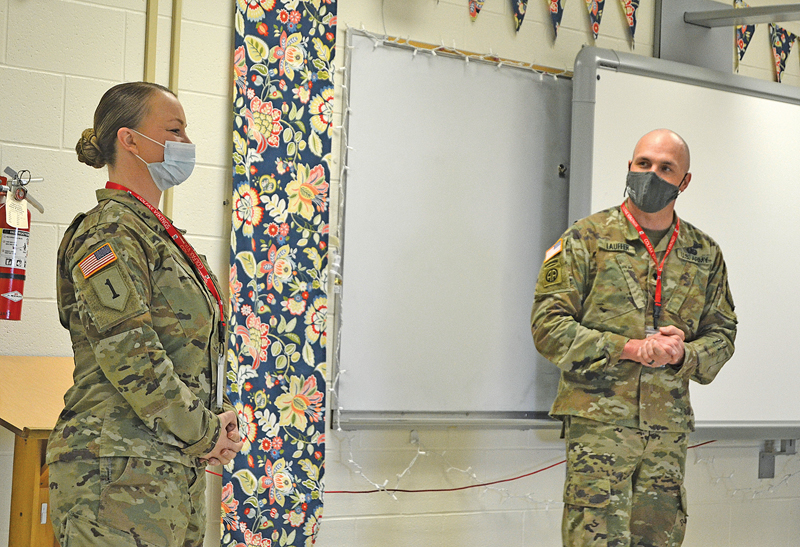
MRE CHALLENGE — Staff Sergeant Andrea Wahl and Specialist Lance Lauffer of the Wisconsin National Guard presented the MRE Challenge (Meal-Ready-to-Eat) to students in one of Amanda Kalscheur’s Family and Consumer Education classes at Colfax High School on April 14. Lauffer is a 2007 graduate of Colfax High School. —photo by LeAnn R. Ralph
By LeAnn R. Ralph
COLFAX — If you’re in the Wisconsin National Guard and you’re out on a mission, you look forward to your MRE — Meal-Ready-to-Eat — although you may not necessarily enjoy the appearance.
The food in the MREs does not look very appetizing, admitted Staff Sergeant Andrea Wahl.
Sergeant Wahl, a recruiter with the Wisconsin National Guard, and Specialist Lance Lauffer, a 2007 graduate of Colfax High School, presented the MRE Challenge to students in one of Amanda Kalscheur’s Family and Consumer Education classes April 12.
Sergeant Wahl taught the class, while Specialist Lauffer said he was in the process of learning how to conduct the MRE Challenge.
“I’m going to warn you. They don’t look the greatest but they taste pretty decent,” said Sergeant Wahl, who has served in the National Guard for 19 years.
The MREs come packed in especially heavy cardboard boxes, she said, holding the box above her head and letting it fall to the floor.
The reason they are packed in sturdy boxes is so they can be dropped out of airplanes from 3,700 feet for soldiers or for humanitarian purposes, she said.
The MREs — specifically developed for soldiers in the field to have a quick and easy meal — have 27 different menu items. Each MRE contains an entree (such as chili-mac or ravioli), a side meal, a drink mix, condiment kits with salt and pepper, utensils, bread or crackers and cheese spread or peanut butter.
The crackers are “hard tack” (basically flour and water), Sergeant Wahl said.
The MREs “are very versatile in the way they are designed,” she said.
In addition, the meals come packaged in a thick plastic pouch which has a dual purpose, because the plastic can be used as a wound dressing. The pouches, when opened from the side, also can serve as a bowl, Sergeant Wahl noted.
In addition to the current 27 menu items, more MREs are being developed such as pizza, vegetarian meals and glutton-free, she said.
MREs are made to be eaten cold, but the food also can be heated up.
Inside each MRE is a pouch that is a “flameless reaction heater” that can be used to warm up the meal. The “heater” is a hydrogen base to which a couple of tablespoons of water is added. The water sets off a chemical reaction that produces heat, “and they get very hot,” Sergeant Wahl said.
Five-star
The “challenge” for Kalscheur’s students was to make the MREs look like a five-star meal arranged on a plate.
The plates were then scored by a panel of judges (Kalscheur, the Colfax Messenger reporter and Specialist Lauffer) based on originality, creativity, resourcefulness and presentation.
The MRE Challenge, Sergeant Wahl said, was patterned after the Food Network’s cooking show Cutthroat Kitchen.
In Cutthroat Kitchen, the chefs are given money they can use to buy items to make their competitors lives’ more difficult. In the MRE Challenge, students could “buy” with jumping jacks or pushups something to make another team’s task more difficult, Sergeant Wahl said.
The eight students in the class were divided up into four teams, and each team was required to make two plates for their presentation.
The students in the class were Brynn Bergeson, Brodee Everson, Anna Geissler, Haley Mikesell, Tyler Noll, Brooklyn Stehling, Brian Tuschl and Katie Riley.
The MREs were dumped out onto a table. The students grabbed two of them per team, and off they went to their kitchens.
The students had 15 minutes to complete their five-star plates.
Challenge
At one point, Sergeant Wahl called a challenge, and for the “price” of 52 jumping jacks — they were bidding against each other is how they arrived at 52 — one team purchased the difficulty for their next-door neighbors of being required to only use one hand to prepare their five-star meal while holding the other arm above their heads.
After a few minutes of holding one arm up — which seemed to make it especially difficult to move around the small space of the kitchen without bumping into the other partner, what with an elbow sticking out and all — both young woman resorted to holding their arms behind their backs.
When Sergeant Wahl called “time is up,” the students then made their presentations to the panel of judges.
Each of the teams did a credible job of putting together a plate, serving a beverage with the meal and making an appetizer or a dessert out of items in the MRE, such as what appeared to be a parfait made of cookies, crackers and peanut butter.
One team, Brynn Bergeson and Brooklyn Stehling, stood out for their presentation — not the appearance of the plates so much as it was that they “danced” the plates over to the judges. One gracefully twirled across the floor with the plates in her hands while the other spoke about the exceptional dining experience that awaited anyone who would partake of their five-star plates.
Brynn and Brooklyn could probably make a career, if they wanted to, out of performing in television commercials.
They also were the team members who had to complete the challenge using only one hand.
In the end, the judges declared the team of Brynn Bergeson and Brooklyn Stehling as the winners of the MRE Challenge.
MREs, Sergeant Wahl noted, have come a long way from the C-rations that featured canned Spam.