
60th Anniversary of Colfax Tornado – Chuck Mehls: “I heard what sounded like a squirrel chirping.”


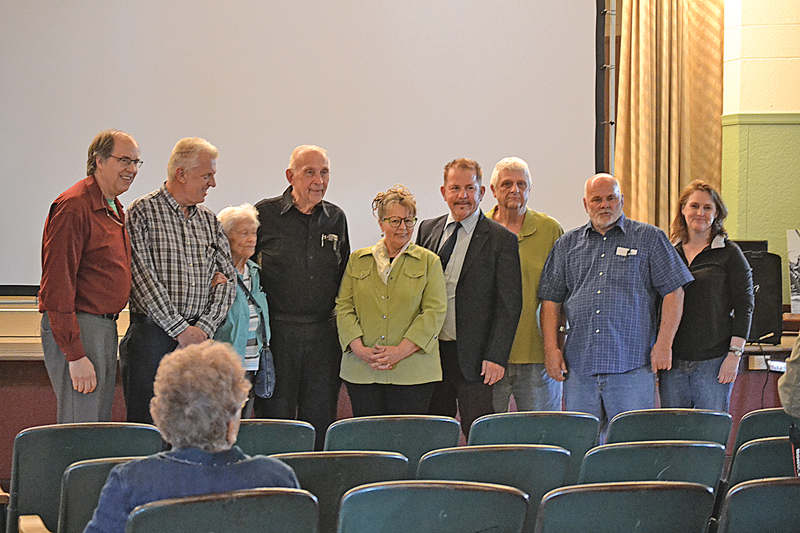
TRUTH BE TOLD — Four keynote speakers told about their experiences in the June 4, 1958, tornado in Colfax during the Truth Be Told 60th Anniversary of the Tornado June 2 in the Colfax Municipal Building auditorium. Pictured here (from left) are Steve Russell (co-host of the event); Chris Lunn (who was an infant and injured in the tornado); Anne McCoy Mehls (a student reporter at the time of the tornado); Chuck Mehls (a member of the National Guard who came to Colfax that night); Nancy Odom Mouledoux (she was seven years old, and her parents were injured in the tornado); Rev. Tim Vettrus (was a child at the time of tornado); Mike Henderson (he and his brother were caught in the barn milking when the tornado hit); Ron Fjelstad (lost his father and his cousin in the tornado); Kobi Shaw (co-host of the event). — Photo by LeAnn R. Ralph
By LeAnn R. Ralph
COLFAX — Following the F5 tornado on June 4, 1958, two hundred national guardsmen and 50 county and state officers came to Colfax to help, to keep sightseers from overwhelming the village and to stand guard by the ravaged buildings.
Originally from Chippewa Falls, Chuck Mehls lives in New Richmond. He was a helicopter medic in the National Guard and was in the active reserve for twenty-five years. He started the first certified ambulance service in St. Croix County.
Mehls was one of the National Guardsmen who came to Colfax the night of the tornado.
The Colfax tornado had a profound impact on Mehls and inspired him to devote his entire career to emergency services. He was one of the featured speakers during the “Truth Be Told 60th Anniversary of the Tornado Edition” at the Colfax Municipal Building June 2.
Truth Be Told — real stories by real people — is hosted by Kobi Shaw and Steve Russell and sponsored by the Colfax Municipal Building Restoration Group and the Colfax Commercial Club.
Here is Chuck’s story:
I have a couple questions for you. Was there a siren sounded in the village?
[“No” came the answer from the audience.]
I was just wondering if there was any warning what-so-ever, other than what these folks saw in the air.
I talked to so many people, who are not living anymore, who were in my platoon, and we got to talking about “what if.”
“What if” we had the helicopters back then that we have now. We could have used a ball field and Medivaced some of those patients.
On the night of the tornado, that day, we’d had final exams at the University of Wisconsin in Eau Claire. So, I was sitting around with some of my buddies. The sky got dark. It started to rain and to blow. And we thought, “Eh, this is not good.”
About 8:30, I said I was going home. I went back to Chippewa Falls, and at one end of city, there were trees down and some damage. I turned down Elm Street and went to my folks’ house. My dad and my little brother and my mom were out cleaning up some damage. We had two broken windows. It was only then that I learned a twister had hit Colfax and had come through Chippewa, the north end.
We had three people dead in a small trailer court, and a lot of animals at Irvine Park, which was a beautiful park. The police ended up shooting a half a dozen of them.
My dad said they might need a medic up at the north end of the park. We had three dead and 16 wounded taken to the hospital in Chippewa, as were some later on from Colfax.
The company commander — we just visited in a nursing home, a brand new one outside of Chippewa Falls. He is 96 years old. He was our company commander. He’s still pretty sharp. He’s still with the program. And we talked about that night.
His decision was to bring part of our combat support company into Colfax, even before the governor had authorized it. Later on, a rifle company, a B company, came in and set up security around the place. But he called me about 10:30 and said, “I want you to get your platoon together because we’re going over to Colfax.”
I said, “Colfax?”
He said, “Yeah, Colfax really got whacked. There might a couple dead and some wounded. We’ve got to get over there to see what we can do.”
Of course, that estimate was way off, as you are aware.
[All together, 12 people were killed and dozens of others were injured, some with severe injuries. The downtown area was spared, but much of the rest of Colfax was destroyed.]
Recon
I got our people together, a recon intelligence. Some of the guys were out of town at the time. And we formed a convoy at about 10:30, quarter to 11, and we came up the back road and came into Colfax. And it was something else. There was debris all over the place.
Before we formed up at the armory in Chippewa, we grabbed everything we might possibly need.
In a recon platoon, we had two armored cars and 12 Jeeps. The Jeeps had military radios in them so we could contact each other, but there was not a way to contact police, fire or state patrol or anybody else on the way over here.
We put blankets and equipment and extra first aid supplies in the Jeeps. These are machine gun Jeeps. We didn’t bring the machine guns.
Thinking about what happens in disasters, in tornadoes, looting is a possibility. We had a few small arms with us, just in case. We tucked those away.
I don’t think there were any cases of looting that I’m aware of. In so many of these cases, that’s what happens.
We pulled into town. We came upon a root beer stand, and the company commander said let’s set up a command post here. So we pulled over. Went up to the door, and of course it was locked. We always carried tools in our Jeeps. So suddenly, the lock disappeared. We set up some flood lamps and our military radios and the command post. And over in one corner was this big root beer barrel. They tapped on the barrel and it was half full. You didn’t hear this, but for the next two or three minutes, nothing happened for rescue work.
Quadrants
We divided the village up in quadrants and coordinated with the fire department and whatever other groups were here, and we set about doing a recon checking for the dead and the wounded.
It was not a good night, except for one exception, which I’ll get to later.
We set up a triage area, and eventually those folks were moved down here (to the municipal building) in the basement. There was a doctor, a dentist and a veterinarian.
We did not have the capability of transport. We were not going to haul wounded to Menomonie or Chippewa or Eau Claire. But this was being taken care of. There were a few ambulances out here.
Our battalion medical platoon, which has 12 ambulances, was in Mondovi and that was about two-and-a-half hours from one place to another, and they were not notified until the next morning. At that time, those rigs weren’t needed because the wounded were pretty much taken care of. As the night wore on, we started filling body bags.
At one point, at the high school, the roof had caved in on (part of) the gym floor. And there was a custodian in there. I do not know his name. You probably do.
[Someone in the audience said “Mike Flynn.”]
The family was concerned, and so were some of the neighbors and some of the parents of students who went to school.
Some of the farmers brought in front loaders. A squad of two Jeeps and six people went over there to see what they could do. They lifted up the debris from the edge of the gym floor and blocked it and then they called a halt and shut off the engines on all the tractors. And they’d yell, “Is anybody here? Is anybody under here?”
And hearing nothing, they’d continue on, lifting and blocking and lifting and blocking. And they’d yell, “Anybody here?” And then a voice suddenly said, “Get this off of me.” And it was the custodian. Then they really went to work, chainsaws and everything else, to get him out of there. He had two fractured legs. But he made it.
South side
The night went on. We were doing what we could. When it was almost starting to get light, two or three ladies came into the command post, and they were crying, and said a family had been killed and injured at the edge of town. Fifth Street. A little boy had been blown out of his crib and into a field.
So the captain said, “Mehls how many rigs do have you have left?”
I said, “I just sent one over to the hotel.” I told them to bring back blankets, sheets, towels, pillow cases, anything like that. One of my men said, “Sarge, that’s stealing.” “Yeah,” I said.
The captain said, “Put together a search and rescue team, some civilians if you can, and go with these people to see if you can find that little boy.”
So we headed out to Fifth Street. I had a whistle, and I had a flashlight. We formed up an S and R (search and rescue) line. I said, “One whistle, move out slow.” It did rain more that night, which made mud, which was good, I think in this respect. Because the ground was soft and muddy. “Two whistles you stop and reform and we’ll go out again.”
I don’t think it was more than the first whistle or so before my driver, who was also a medic, yelled, “Over here, over here.”
I went over there, and here in the mud, was this little thing covered with mud.
I picked him up. I carried my trauma pack in my bag. I opened it up, and I always carried a couple of towels in there too. I picked him up and cleaned him off. He was bleeding from the ear, intracranial hemorrhage, and opened the airway and cleaned it up.
And I heard what sounded like a squirrel chirping.
This was coming from the kid. He was breathing, and he had a pulse.
And I couldn’t believe it.
I could not believe it.
I saw an ambulance over in the road. I don’t know where it was going. But I told my driver to run over and put a hold on the ambulance. He came back and “Sarge, the driver said it’s full and he can’t take anymore.”
I said, “You run back and say it is a military order.”
Now, we weren’t under military operations. But they put a hold on it.
I got over there and opened up the back door, and there was a critical injury on the main cot. And there was a cot with another patient. There were three other people and a lady up in front with the driver with bandages on her chin.
I said, “Where are you going?” He said, “We’re headed to Eau Claire to Sacred Heart.”
I say, “Okay, you’ve got to get this little guy down there because he’s in tough shape.”
And the lady said, “I’ll take him.”
I gave her a fistful of eight-by-eight gauze pads and some towels, and that was the last I saw of him. I didn’t know what happened after that.
Life went on for a few days like that. We were scheduled to go for training at Fort McCoy, named after my wife’s grandfather, who was a division commander of the 32nd in World War I. We were going to go down there that Saturday morning. We stayed in Colfax for three or four days, and then we had to head out.
[At the 50th Anniversary of the Colfax tornado at Colfax High School, Dr. Ralph Hudson, who had treated Chris Lunn at Luther Hospital, was the keynote speaker. Dr. Hudson said Chris’s skull had been cracked like an eggshell. Hospital staff did not know what to do for a baby with skull fractures, so Dr. Hudson said they had started taking care of him as you would take care of any baby. By morning, the infant Chris was doing much better.]
Years later
Fast forward to 2002 or 2003. I stopped at a garage sale and picked up whatever I could sneak in the house without my wife knowing it. This was in New Richmond.
A couple came up out of the basement, and he was bringing up some things for the garage sale, and he was wearing a tee-shirt that said “Colfax Twister Run” so I went over to talk to him and asked him if he lived in Colfax. He said, “No, I don’t. I work over there.”
I told him a little bit about what I’ve told you. I said, “I’ve always wondered about that little baby. I’ve heard nothing, and I’m wondering if he’s still around.”
He looked at me, and he said, “Go over to Colfax and stop at this combination gas station and store and ask for a gentleman named Chris.”
I said, “Okay. Would he know the whereabouts of the little boy from the tornado?”
And he said, “That’s Chris. That’s the little boy.”
I went home, and I talked it over with my wife.
I whistled over here and pulled into the station. I saw a guy standing there with (a shirt) on that had “Chris” embroidered on it.
I said, “I don’t suppose you remember anything about the tornado in 1958?”
He said, “No, I was doing other things at the time.”
I said, “I found you, picked you up out of the mud, cleaned you up and got you into an ambulance, and that’s the last I ever heard.”
We talked for two hours in between customers coming in and out.
The family went through a lot that night. Chris lost his brother. He lost his father. And a lady (who was Chris’s aunt). His mother was critically injured.
You folks have been through an awful lot, and you’ve done an awful lot.
[Mehls asked if Chris Lunn was in the audience. He was not — not at that moment. Mehls said he would like to present Lunn with a battalion crest from the 128th Infantry Regiment. Lunn did come to the auditorium a little while later, and Mehls presented the battalion crest to Lunn.]
[Chris’s mother, Mary Kiekhafer, recovered from her injuries and eventually became the first woman bus driver for the Colfax school district.]
Anne Mehls
“This is my wife, Anne, who was over here that night with her boyfriend,” Mehls said, introducing his wife.
“And this is my long-winded husband, Chuck,” Anne Mehls said with a laugh.
[At the time of the tornado, Anne McCoy was a student at the university in Eau Claire.]
I was over here, I was a junior at Eau Claire. I was dating a man named Jim. He was a photographer. I was a reporter on my college paper. We came out of the movie. After college exams, we went to a movie. We came out and saw the sky.
He said, “We’ve got to get in the car and go find out what’s happening.” And we did. We went to Chippewa Falls and by Irvine Park. The animals running loose. They said, “You can’t go in there.”
We went to Colfax. Two young 20-year-old kids from college.
I don’t know how we got here. He had an old black car. We wandered in. We came into town, and we talked to a few people.
It was chaos. I picked up a branch from a tree that was stripped (of bark). I wish I’d brought it. It’s in a box somewhere at home. I kept it as a souvenir.
Jim and I went down into this building (the municipal building). He took pictures. I talked to Ole Engen. He was 91 years old. He lived with a family. [The Burling family.] They took care of him. He rocked in the kitchen quite a bit. The father got Ole, and they crawled underneath the table.
Ole had scratches. I got down on my hands and knees to talk to him. We got pictures.
It was overwhelming. I had never seen tragedy like that. We were just young.
But what came of it is that summer, I started dating that guy over there (pointing at Chuck Mehls). We were married two years later.
I wanted to share that story — because it was powerful, being in Colfax that night.
[The Colfax Municipal Building Restoration Group had a copy of the picture of Ole but did not know who he was until the 50th anniversary of the Colfax tornado in 2008 when he was identified by a member of the Burling family.]