
Northwoods Quilts of Valor presents 10 quilts on Veterans’ Day, Nov. 11
PROTECTED CONTENT
If you’re a current subscriber, log in below. If you would like to subscribe, please click the subscribe tab above.
Username and Password Help
Please enter your email and we will send you a password reset link.


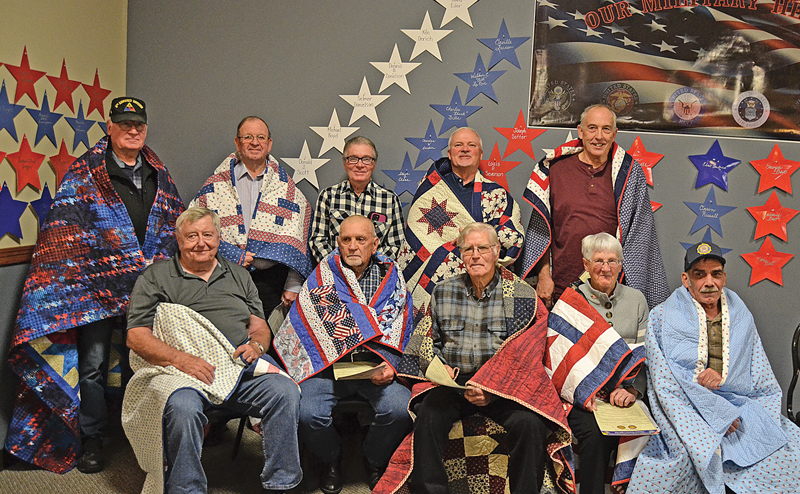
HONORED VETERANS — The Northwoods Quilts of Valor awarded quilts to 10 area veterans at the annual Veterans’ Day Supper at the Viking Bowl on November 11. First row from left: John Kragness, Rodney Johnson, Gordon Vandyke, Diane Ternes and Ken Dierich. Second row from left: Derald Tuschl, Jim Irwin, Dale Bergeson, Mark Gilberts and Jerry Weiland. Bergeson’s quilt was actually awarded that morning during the Veterans’ Day program at Colfax High School. In the background, you can see some of the stars that the American Legion Auxiliary made to honor local veterans. The walls of the Viking Bowl are decorated with about 400 stars. The stars will remain up until the end of November.
—photo by LeAnn R.Ralph
By LeAnn R. Ralph
COLFAX — The Northwoods Quilts of Valor presented 10 quilts all together on Veterans’ Day, November 11.
One of the quilts was presented to Dale Bergeson (Major; U.S. Army retired) at the Veterans’ Day program at Colfax High School on the morning of November 11.
The other nine quilts were presented to veterans at the annual Veterans’ Day Supper that was held at the Viking Bowl this year.
“What a wonderful turn-out. We’re happy to have you all here,” said Nancy Hainstock, a member of the Northwoods Quilts of Valor.
The banquet area at Viking Bowl was filled with veterans, friends and family members.
Wisconsin Quilts of Valor awarded 500 quilts last year, Hainstock noted.
Northwoods Quilts of Valor started in 2022 and has given 31 quilts, not counting the 10 that were awarded on Veterans’ Day, she said.
Quilts of Valor was started in 2003 by Katherine Roberts, whose son was deployed in Iraq, and the quilts are a civilian award for the service of veterans, Hainstock said.
A Quilt of Valor can never be bought or sold, and it is not a gift. The quilt consists of three layers. The top of the quilt, with many shapes and colors, represents the various communities and individuals. Each stitch represents the love, gratitude and sometimes the tears of the maker.
The batting is for warmth and represents the hope for warmth, comfort and healing to the individual who receives it. The backing and the stitching are the strength that holds the many pieces together and represents the strength of the recipient and his or her family, community and the nation, Hainstock said.
The information provided here is based on the biographies that the veterans wrote for the Northwoods Quilts of Valor.
Kragness
John Kragness entered the Great Lakes Naval Training Center in 1958. He served as a boilerman/fireman aboard the attack aircraft carrier USS Bon Homme, where he served until he was discharged.
The countries where the USS Bon Homme sailed included Hawaii, Okinawa, Japan, and India.
According to his biography for the Quilts of Valor, John said, “I would do it all again.”
He and his wife, Jane, were married in 1963.
Johnson
Rodney Johnson entered basic training was at Lackland Air Force Base in San Antonio, Texas, and was assigned to the 63rd Civil Engineers Squadron Military Air Command at Hunter Air Force Base in Georgia.
He was trained as a crash rescue firefighter. The base had a large volume of air traffic, mostly cargo planes transporting supplies during the Vietnam War. There were also squadrons of jet fighter planes arriving and departing from the base.
From 1965 to 1966, he was assigned to the dispatch tower and was in contact with air traffic control.
“They informed me of incoming emergencies, and I would dispatch the fire trucks. I also had to be observant of runway traffic,” he wrote in his biography.
From 1966 to his discharge in 1967, he was assigned to the 375th Civil Engineering Squad Aircraft Command at Scott Air Force Base in Illinois as a firefighter.
He was honorably discharged on September 9, 1967.
Johnson received the National Defense Service Medal and the Air Force Good Conduct Medal.
Irwin
Jim Irwin was in basic training for the United States Army in Fort Campbell, Kentucky.
He was captured in war games at night and escaped, but then he struck a barbed wire fence and acquired the scar he still has on his chin today.
Irwin served in combat in Vietnam for a year. Most of the time he was dropped in by helicopter, slept in a poncho for six nights, and was then picked up by a helicopter and brought to the rear for two nights. This schedule repeated for the year. He carried an M-16 and a radio.
Irwin’s medals include the National Defense Service Medal, the St. John Service Medal with two bronze service stars, Combat Infantryman Badge from the Republic of Vietnam, the Campaign Medal, Air Medal, Army Commendation Medal, Bronze Star Medal, Marksmen M-16 and Sharpshooter M-14.
Tuschl
Derald Tuschl started serving in the United States Army in 1968. In 1970, he went Germany and worked in the motor pool as a mechanic.
Gilberts
Mark Gilberts served for 31 years serving in the U.S. Navy Dental Corps.
“Our goal was to maintain the health of the war fighters and get them back to the front as soon as possible to carry on the mission, working hand-in-hand with the medical department, physicians, nurses and navy corpsmen. My assigned Navy dental personnel were always trained in mass casualty and functioned as triage officers when required,” he wrote in his biography.
Gilberts served with all three Marine divisions in Camp Lejeune, North Carolina, Okinawa, Japan, and at Camp Pendleton, California.
He was assigned to two-year tours on three different ships, the USS Iwo Jima, the USS New Jersey and the USS Theodore Roosevelt.
The tours of duty were tough on any family, “and Patti deserves a medal. She was the best Navy wife, ever,” Gilberts wrote.
According to her obituary, Patricia Gilberts passed away November 19, 2007.
Gilberts was involved in three different theaters of conflict, providing support and treatment of casualties. His first war-time experience was in 1990, serving as an exchange dental officer in the British Royal Navy. He served on the HMS Bristol (a destroyer) for three months, which was involved in the evacuation of UK and US citizens in Israel during the opening days of the first Gulf War.
The second war-time experience was on board the USS Theodore Roosevelt, sailing off the coast of Bosnia during the Bosnian War.
In the twilight of his career, Gilberts volunteered to go to Kuwait for an eight-month tour.
He also worked alongside the Army medical department. The medical-dental detachments were often called in the middle of the night with incoming Medevac casualties from Afghanistan.
Serving in the U.S. Navy, following in his father’s footsteps, “has been the honor of my life,” Gilberts wrote.
His father, Norman (Snort) Gilberts, joined the Navy at the age of 17 at the end of World War II and became a Seabee (Construction Battalion — CB).
“His selfless sacrifice and service that he demonstrated has always been a driving force in my life. He loved the Navy, and so do I. To be able to take care of wounded and apprehensive patients and still show them compassion and encouragement is professionally rewarding. I sincerely thank you for this incredible honor of receiving this Quilt of Valor. It feels like the crowning jewel on my wonderful Navy career,” Gilberts wrote.
Vandyke
Gordon Vandyke served in the U.S. Air Force from 1956 to 1960 and received the Vietnam Service Medal and the Cold War Service Medal.
Ternes
Diane Ternes enlisted in the United States Army in 1973 and went to basic training in Alabama and then onto advanced individual training in South Carolina.
She was sent to Korea and became a legal clerk for the 38th Air Defense Artillery Brigade.
She was reassigned to the Fort Stewart 24th Infantry Division from 1980 to 1983. She was the chief legal clerk for the 11th Air Defense Signal Battalion in Darmstadt, Germany, and was a non-commissioned officer in charge of claims.
Ternes was then assigned to the U.S. Army Claims Service of the Judge Advocate General in Fort Meade, Maryland, from 1983 to 1988.
She was then transferred to Germany as a brigade legal non-commissioned officer and served in Operation Desert Storm for six months.
Ternes returned to the United States in 1991 and was stationed at the Criminal Law Division in Fort Knox, Kentucky, as part of the U.S. Army Judge Advocate General’s Corps until she retired in 1995 as a Sergeant First Class.
Ternes was the first female veteran to whom the Northwoods Quilts of Valor has awarded a quilt, Hainstock noted.
Dierich
Ken Dierich was part of Company A in the 128th Infantry in Menomonie and the 544th Maintenance Company in Wabasha, Minnesota.
From November 10, 1980, to February 4, 1981, he served in Germany. From January 8, 1986, to February 4, 1986, he served in NATO exercises in Germany (Return of Forces to Germany, or “Reforger”).
His medals include the Army Reserve Components Achievement Medal, Amy Oak Leaf Cluster, Army Service Ribbon, Expert Grenade Bar, Marksmen Badge, Pistol Bar and a Rifle Bar.
Weiland
Jerry Weiland enlisted in the United States Marine Corps in October of 1972. He went to boot camp in November and then flew to the Marine Corps Depot in San Diego, California.
Weiland graduated from boot camp at the end of February in 1973. He came within 10 seconds of acing the physical conditioning test. He performed 100 sit-ups in two minutes, 20 pull-ups without stopping, and ran three miles in 18 minutes and 10 seconds.
Weiland needed to run the three miles in 18 minutes or under.
After boot camp he was assigned to the Naval Air Station in Memphis, Tennessee, for the first half of his training.
Upon graduation, he was sent to San Diego for the second half of training. He graduated meritoriously as a computer operator/programming/systems coordinator as a Lance Corporal E-3 in August of 1973.
Weiland was then stationed at the Marine Corps Air Station in Iwakuni, Japan.
After he got to Japan, for three months, they had no idea why he was there.
Weiland found out eventually that he was supposed to be at the Da Nang Air Base in Vietnam.
His orders were changed because President Richard Nixon had in the meantime signed a peace treaty, and the Marines were being pulled out.
Weiland finally was assigned to use a Univac computer system to maintain the Naval supply system, to log all pilot and aircraft hours, and to print paychecks, where applicable.
Military personnel were paid with Military Payment Certificates (MPC), which was “miniature, fake money in different colors” and was only good on base, Weiland wrote in his biography.
“If we went off base, we had to convert it to real cash,” he said.
Weiland left Japan in September of 1974 and was assigned to naval reserve duty in Louisiana at Belle Chasse where his job was to train weekend reservists.
“Most of them came to New Orleans to party and not to train,” Weiland wrote.
After two years in Belle Chasse, he was honorably discharged in November of 1976 as a Sergeant E-5.
