
Northwoods Quilts of Valor honors Colfax’s Dale Rostamo
PROTECTED CONTENT
If you’re a current subscriber, log in below. If you would like to subscribe, please click the subscribe tab above.
Username and Password Help
Please enter your email and we will send you a password reset link.


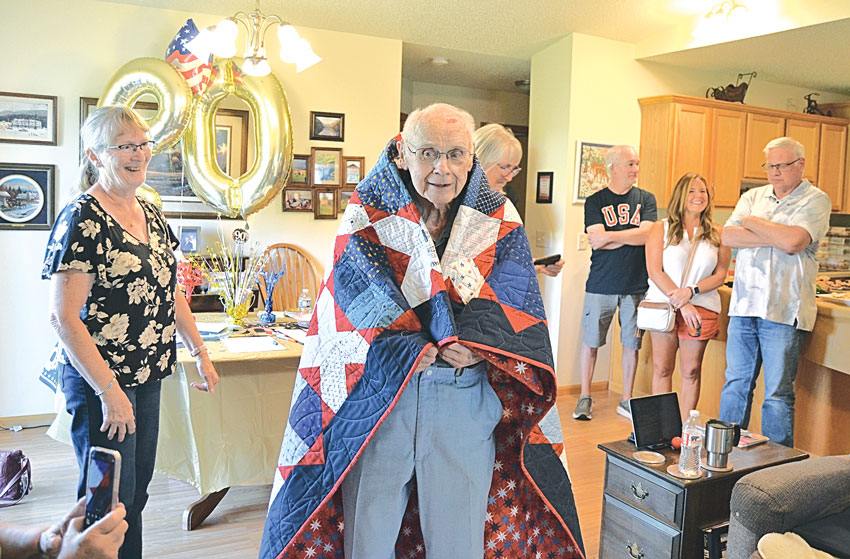
QUILT OF VALOR — Dale Rostamo of Colfax, a veteran of the United States Army who served in the Korean Conflict from 1954 to 1956, received a Quilt of Valor from Northwoods Quilts of Valor during a celebration of his 90th birthday on Saturday, August 24. Diane Goers of Colfax, a member of Northwoods QOV, is on the left. —photo by LeAnn R. Ralph
By LeAnn R. Ralph
COLFAX — Members of the Wisconsin Northwoods Quilts of Valor have presented a quilt to Dale Rostamo of Colfax.
Rostamo, who served in the United States Army during the Korean Conflict from 1954 to 1956 and was discharged as an E-3, received the quilt on Saturday, August 24, which also was Rostamo’s 90th birthday.
The mission of the Quilt of Valor Foundation is to cover service members and veterans touched by war with comfort and healing Quilts of Valor, said Sally Johnson of Colfax, a member of the Wisconsin Northwoods QOV.
“Mange tusen takk” (pronounced munga toosen tuck), Rostamo said when he had been presented with his quilt, which means, “Many thousand thanks” in Norwegian.
Rostamo, who is of Norwegian heritage, attended grade school at the Running Valley School located east of Colfax on county Highway A, a picturesque school built of locally-quarried stone that was demolished in November of 2021.
He graduated from Colfax High School in 1952.
2003
The Quilts of Valor Foundation began in 2003 with a dream experienced by the founder, Catherine Roberts, whose son was deployed in Iraq.
According to the Quilts of Valor Foundation website: “The dream was as vivid as real life. I saw a young man sitting on the side of his bed in the middle of the night, hunched over. The permeating feeling was one of utter despair. I could see his war demons clustered around, dragging him down into an emotional gutter. Then, as if viewing a movie, I saw him in the next scene, wrapped in a quilt. His whole demeanor changed from one of despair to one of hope and well-being. The quilt had made this dramatic change. The message of my dream was: quilts equal healing.”
Originally known as Quilts for Soldiers, the Quilts of Valor Foundation gave out the first quilt at Walter Reed Hospital in October of 2003.
The chaplain at Walter Reed when the first quilt was awarded, Chaplain John Kallerson, noted that a Quilt of Valor is “a lifetime award” and it is “not a blanket.”
Quilts are made of the three layers representative of the veterans to whom they are awarded. The top layer is made of many pieces, colors, shapes and sizes representing the many men and women who have served, Johnson said.
The center of the quilt is the batting that is responsible for the warmth of the quilt and bringing comfort. And the back of the quilt, which holds the three layers together, is representative of the strength of the veterans, their families and their communities, she said.
A Quilt of Valor is priceless. It can never be bought, and it can never be sold — and it is never a gift, Johnson said.
To date, more than 360,000 Quilts of Valor have been awarded worldwide.
Minneapolis
Here is Dale A. Rostamo’s Army biography, in his own words, that he submitted for the Quilts of Valor presentation:
On 6 January 1954, I was sworn in to the U.S. Army in the Minneapolis, Minnesota, Federal Court House.
I thus became a government issue (GI) with a serial number of US55412501. I was immediately sent by bus to Fort Riley, Kansas, for basic training. I was assigned to the 10th Mountain Division, 85th Regiment, Company B.
This was a period when the Army still considered the Korean War not officially ended. As a result, the Basic Training was still running as if the war was not officially over.
The result was a tough Basic Training.
Army Signal School
After Basic Training, I was assigned to the Army Signal School in Fort Monmouth, New Jersey, MOS Heavy Antiaircraft Director Repairman.
The Director was the computer that took in RADAR data, calculated data, to aim and fire the 90mm and 75mm antiaircraft guns.
The training took place five days a week, eight hours a day for 26 weeks. At the end of each week on late Friday afternoon, a test was given to see if the students learned enough from that week’s material.
If not, students had to go back a week and take the test again, and if they didn’t pass again, the Army could reassign you to a less desirable class of the Army’s choice.
After two weeks of leave, I was sent to Fort Lewis in Tacoma, Washington, to await the next troop ship bound for Korea, Japan and Okinawa.
That ship turned out to be the USS General Freeman. It took 22 days to cross the Pacific. The length of this journey was mostly because the ship passed through the backend of a typhoon.
It was so bad, the Navy ordered to batten down all the hatches … Miserable two or three days.
Yokohama
I arrived in Yokohama where I got new orders for an assignment at Misawa Air Base on the extreme northern tip of Honshu Island.
The organization was the 9th Ordinance Corps, detachment 8130 attachment to the 8160 detachment specific to my MOS.
I spent the next 14 months doing minor repairs on the Director, only had one major failure and only a few minor ones. The equipment was very well built.
Since I had so few maintenance calls, I was also assigned administration duties for the detachment.
I left Misawa Air Base early December 1955, and this time not by ship but by American Airlines. What a relief!!!
I landed on Midway Island, Hawaii, then Travis Air Force Base California.
Finally I arrived in Chicago at Fort Sheridan for processing out of the Army.
Christmas
The Army decided to get me home for Christmas that year.
With all the strict rules of the military, I don’t knowhow they did it, but that same day, I arrived home on the 400 passenger train.
Had a wonderful Christmas celebration.
A few days later, I was on the train again back to Fort Sheridan. This time to complete out-processing paperwork.
I was there for about a week before I got my DD214, back pay, medical and dental checkups.
Finally, a lecture on my responsibilities that remained with the military until my discharge date.
The following January of 1956, I registered at Wisconsin State College Eau Claire, Wisconsin, for classes beginning that spring semester.
Rest of the story
The Colfax Messenger had the privilege of interviewing Dale Rostamo for a “Remembrances of Christmas Past” story in December of 2023.
So here is “the rest of Dale’s story” —
Dale Rostamo spent his career as an electrical engineer, designing interfaces for computers for Univac (Universal Automatic Computer).
He installed computer systems all over the world for international customers and ultimately spent quite a lot of time flying in airplanes.
“After I graduated from college, there were no jobs in my field available,” Dale said.
Dale graduated from what is now UW-Eau Claire with a degree in physics.
“I did my practice teaching at Colfax, and then I took a job at Whitehall for the second part of the year,” he said.
Univac had invented a new computer system, and the company was looking for people to provide support for the new computers.
“I applied, and when they found out I had computer training in the Army, they hired me,” Dale said.
After basic training, he went to the Army’s Signal School at Fort Monmouth, New Jersey, where he received training in computers for the computers used with anti-aircraft guns.
“I was hired to figure out how to support the new computer system invented by Univac,” Dale said.
The new computer system was a computer that was mass produced. Prior to that, computers were individually built by hand, he explained.
In more recent years, Dale Rostamo served on the Board of Directors for the Colfax Health and Rehabilitation Center and was on the board when the new facility was built and opened in the late summer of 2013.
