
Taste & See Creamery Boyceville small dairy making it big with cheese curds
PROTECTED CONTENT
If you’re a current subscriber, log in below. If you would like to subscribe, please click the subscribe tab above.
Username and Password Help
Please enter your email and we will send you a password reset link.


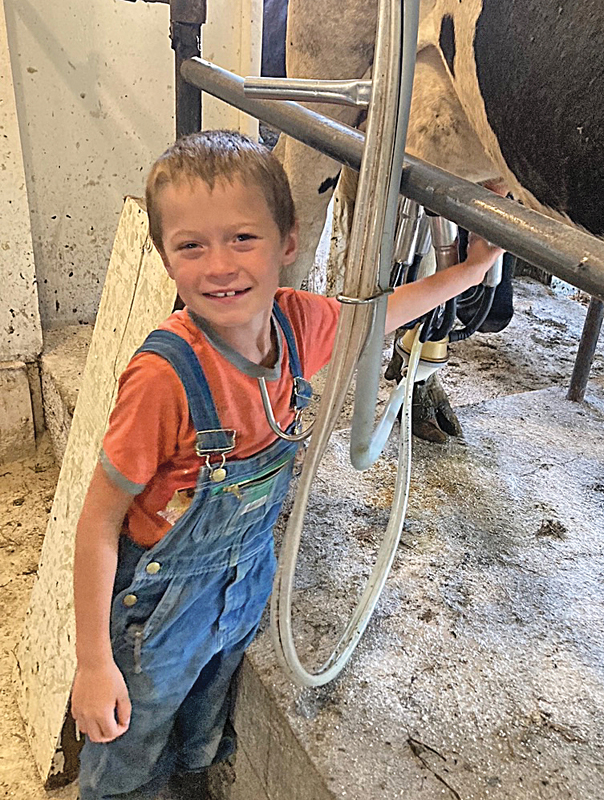
One of the Sutliff kids helping with the milking at Taste and See Creamery. —photo submitted
By Renee Bettendorf
BOYCEVILLE — With the long running trend in the dairy farming industry, where fewer and bigger farms produce most of the milk, it’s rare to find a new small family dairy operation. Taste & See Creamery, LLC is the exception.
For nearly three years, Licensed Cheesemaker and Dairy Farmer, Casey Sutliff has been milking cows and making cheese at her cheese processing plant located on her family dairy farm just north of Boyceville.
Known for their squeaky delightfulness, Taste & See Creamery cheese curds are made from the milk that her family’s small herd of dairy cows produce. Casey delivers her cheese curds to seven local gas stations every week within about an hour of making them.
“Curds are best fresh,” she said of one of the main types of cheese she makes.
Casey said she and her husband, Kyle, always wanted to milk cows, even though neither one of them was raised on a farm. Kyle grew up in Boyceville and Casey is from Woodville. She had some experience with dairy farming because her grandparents had a farm and she would help with the milking as a kid.
“I like the cows,” said Casey. “And I always thought a dairy farm would be a good place to raise kids”.
So, in April of 2008, Casey and Kyle bought their farm which included 25 acres, one shed and a trailer house. Since then they have built a barn with a milking parlor, milk house and cheese plant.
They also built their house and purchased more land. Currently they are raising about 30 head of cattle on 160 acres.
“It keeps us out of trouble,” chuckled Casey.
The Sutliffs started with five Holstein cows that they purchased from local farmers. Because their farm is very small, they knew they would need to produce some type of value added product to make a dairy operation work.
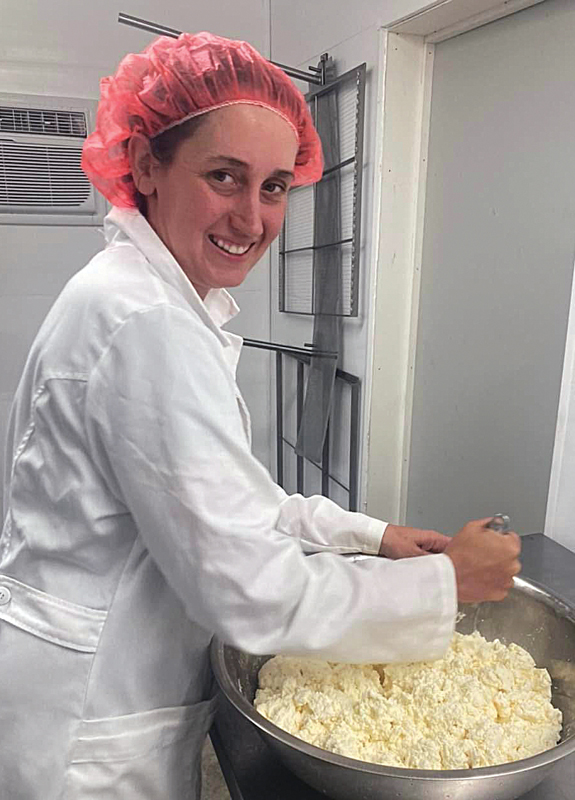
Casey Sutliff, owner and operator of Taste and See Creamery and licensed cheesemaker, in her on farm cheese plant working on a batch of curds. —photo submitted
“There’s no way a milk truck would come here,” pointed out Casey.
So, she started experimenting with making cheese in her kitchen. Eventually she went on to get a
Wisconsin Cheesemakers license. Depending on the time of year, she now makes up to 500 pounds of cheese curds each week at her plant.
Casey came up with the name of her cheese plant from the bible. Taste & See comes from Psalm 34 vs 8, “Taste and See that the Lord is good, blessed is the man who trusts in him”.
Casey and Kyle have seven children ranging in age from just under one year to 12 years old, they are homeschooled. Casey said the kids especially like to help with farm work when they think they can get out of school work.
“They help a lot,” she said.
It Ain’t Easy Being Cheesy
Taste & See Creamery will have its three year anniversary in May. Before she could start making cheese that could be sold to the public, Casey had to become a licensed cheesemaker. In Wisconsin getting licensed as a cheesemaker is a pretty rigorous process involving college classes and an apprenticeship.
It took Casey about two years to get her license. During that time she took classes at UW Madison and UW River Falls on pasteurization and food safety. She also did the required 240 hour apprenticeship under another licensed cheesemaker and had to pass a final exam before being awarded the license.
Wisconsin has one dairy code for all cheese producers no matter what size they are. As a result, Taste & See Creamery is held to the exact same standards as very large cheese plants. They are regularly inspected to make sure they uphold those standards.
In addition to curds, she also makes natural rind aged cheddar. To make the cheddar, first she makes curds and then forms them into 40 pound blocks. The blocks are then stored in a walk in cooler and oiled with olive oil on a regular basis. Under these conditions, the blocks naturally form a rind which allows the cheese to get more flavorful faster.
She makes cheddar whenever she can, usually in the winter, when things slow down a bit. After the cheddar has aged for two years she sells it at two farmers’ markets during the summer. She also makes a type of cheese known as quark, which is somewhat like cream cheese and sells that at two local grocery stores.
All of her cheese is produced in her on-farm cheese plant. Her plant is located right next door to her milkhouse, which is attached to her six stall milking parlor. The parlor has automatic milkers and a pipeline.
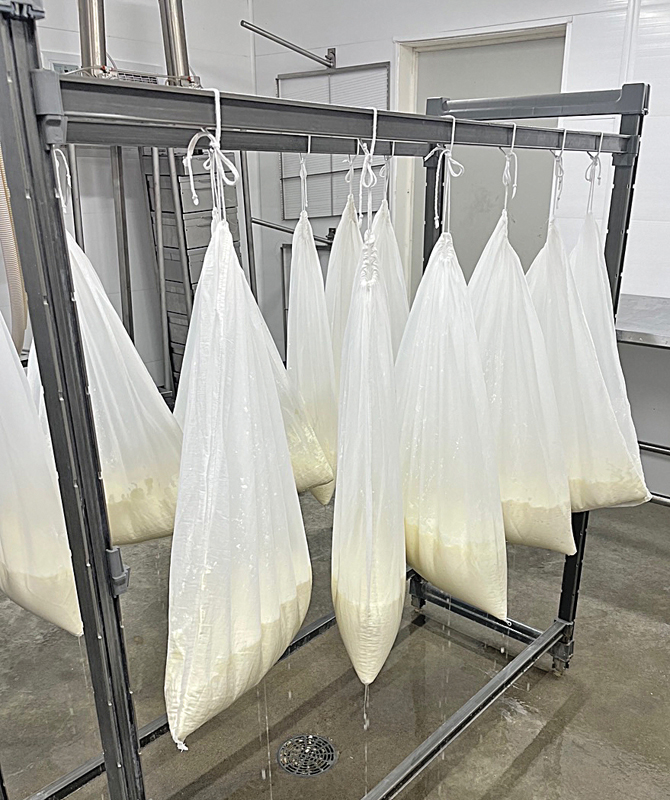
Quark being processed. Quark is somewhat similar to cream cheese and is a type of cheese produced at Taste and See Creamery.
—photo submitted
With help from her husband and their children, Casey is currently milking 12 cows twice a day at 5 a.m. and 5 p.m. She makes cheese twice a week. During their peak production time, which is during the summer, her cows can produce up to 2,400 pounds of milk in about four days.
Casey said that making a batch of cheese curds is about a 10 hour process, not counting milking time. First the milk is pumped from the bulk tank to the cheese vat where it is pasteurized and then cooled. Culture and rennet are added to get the curds to form.
Once the curds form they are cut. Then the curds are stirred and cooked for an hour. Next the whey is drained. Finally the curds are cut a second time, salted and seasoned.
The Sutliffs have always farmed using organic methods and are working on becoming certified organic. They recently bought some land that was conventionally farmed and have to wait three years before it can become certified organic. Once they get the certification, they can sell their cheese under the certified organic label.
It’s the Cows
Their cattle are rotationally grazed on pasture during the summer. During the winter the Sutliffs feed their cattle mostly hay and a bit of cob corn and corn silage. Their calving season is from March to May. They eat, sell or trade their steers. Milk production tapers off after Christmas.
They have plans to expand their herd with seven of their own heifers and two purchased heifers that they plan on breeding. Currently they have mostly Holstein genetics in their herd, but are adding in other breeds that have a higher milk fat ratio since higher fat milk is better for cheese making. This will be their first year milking crossbreeds.
“We’re transitioning away from Holsteins,” said Casey.
Since they don’t own a bull all of their cows are bred through artificial insemination. Some genetics they are incorporating into their herd include: Guernsey, Jersey, Fleckvieh, Ayrshire and Brown Swiss.
“We’ll throw anything in!” said Kyle.
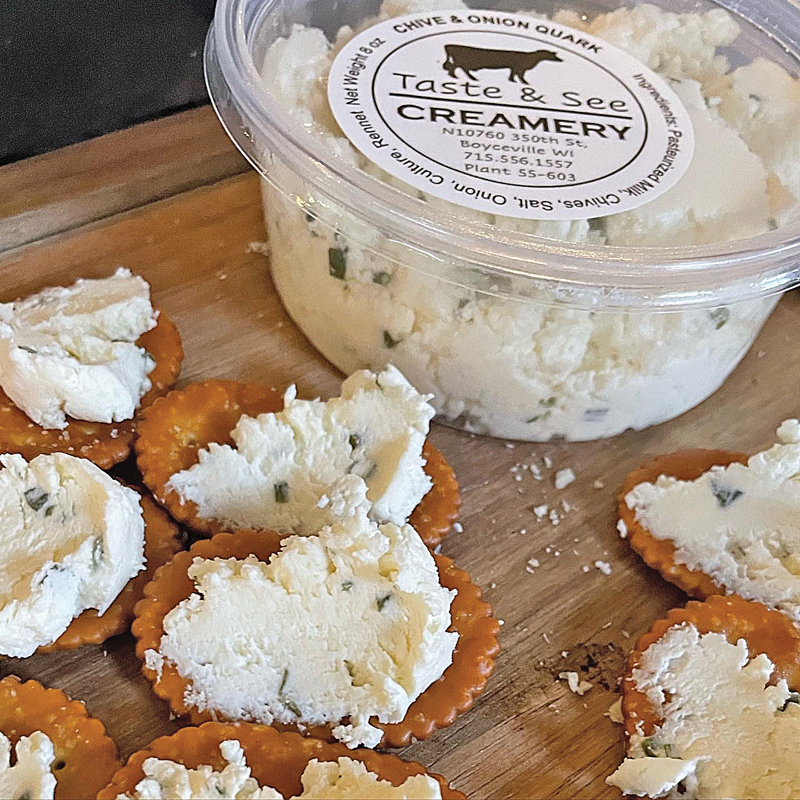
FINISHED PRODUCT — Pictured is what Quark looks like as the finished product. —photo submitted
The Sutliffs have a lot of fun selecting different breeds. Currently their 12 cows are carrying calves from five different breeds. Their cows all have names and their own personalities, since the cows are handled at least twice every day, they are calm and friendly, almost like pets.
Farm animals, even calm, pet-like ones, do the darndest things sometimes and the Sutliffs got some first hand experience with that last fall when one of their cows fell into their house through a window.
It was the evening of the gun deer opening and since the Sutliffs had all been up very early that day, they all headed to bed early. Little did they know that their cattle had gotten out and were wandering around in their yard.
At about 10 pm Kyle heard the cattle and thought maybe they were out and was going to go check on them when there was a loud crashing noise. At first Casey thought a rank of firewood had fallen over.
“We all heard it,” she said.
Upon investigation they learned that one of their cows had fallen into an egress window well. Since she was unable to climb back out she slipped through the window and landed on top of a dresser.
The noise they heard was of the window smashing and of the dresser giving way under her weight. Despite her fall and subsequent crash through the window, the cow, named Sweetheart, was completely uninjured.
Since their basement does not have a door that leads outside, the Sutliffs had to find a way to get her up the basement steps. At first they just tried to lead her up them. But she fell and they started worrying that she might break a leg.
So, with the help of some neighbors, they made a makeshift ramp out of plywood on their basement staircase. They fashioned a harness out of a rope and tied it around her. Then they put the rope through another window in their house and tied the other end of the rope to a skid steer.
They were able to pull her up the ramp using the rope and skid steer and then lead her outside. The whole ordeal took almost three hours during which time Sweetheart remained calm and cooperative.
Taste & See Creamery cheese curds come in 18 different flavors including black pepper, taco, ranch and lemon pepper. Casey usually does between five and eight flavors per batch. Curds are available at gas stations in Boyceville, Wheeler, Dallas, Chetek, Colfax and Menomonie. They are delivered on Mondays and Fridays.
The Grain Bin and Menomonie Market Food Co-op carry curds and quark and Taste & See aged cheddar can be found at the Menomonie and Hudson farmers markets.
Casey is heading back to UW Madison in May for an advanced cheesemaking class. The class will help her expand Taste & See cheese variety offerings this summer.
