
Three friends reconnect 50 years after growing up together in Colfax
PROTECTED CONTENT
If you’re a current subscriber, log in below. If you would like to subscribe, please click the subscribe tab above.
Username and Password Help
Please enter your email and we will send you a password reset link.


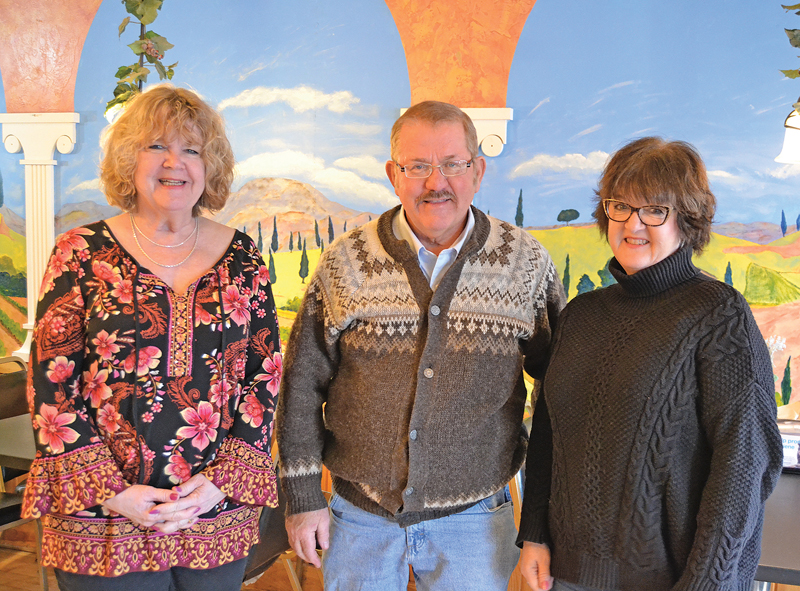
RECONNECTING — After not seeing each other for about 50 years, these three friends had lunch together at A Little Slice of Italy in Colfax recently. From left Lori Eklund Quello, Pastor Tim Vettrus and Kari Eklund Logan. —photo by LeAnn R. Ralph
By LeAnn R. Ralph
COLFAX — What do you remember about your friends when you were growing up?
Do you still see them? Do you talk to them once in a while? Or have you lost touch with them but wonder what is going on in their lives now?
A Little Slice of Italy in Colfax was the venue January 6 for three friends who have not seen each other in 50 years to meet up and have lunch together.
Pastor Tim Vettrus, Lori Eklund Quello and Kari Eklund Logan had a grand time catching up in a restaurant that very much appealed to Lori Quello because she is an artist, and Little Italy is decorated inside with impressive murals of the Italian countryside.
“We are rediscovering Colfax,” Lori said.
“It’s the center of the family,” Kari said.
Lori and Kari’s roots run deep in Colfax.
Pastor Vettrus grew up in Colfax. The Vettrus family arrived in Colfax on Christmas Eve in 1954, when his father, Reverend Ole Vettrus, became the pastor at the Bethany Brethren Lutheran Church in Colfax.
Lori and Kari spent part of their summers in Colfax, visiting their great-aunt, Ruth Anderson, who served as the postmaster in Colfax and lived next to the church.
Ruth Anderson retired June 27, 1969. She was appointed as postmaster to replace L.A. Fjelsted, whose commission expired in February of 1933.
A. Ruth Anderson was born in 1902 and died in 1990. She is buried in the Holden Church cemetery.
Ruth Anderson’s brother, Axel, was a pastor and died in a roll-over accident in Montana before Kari was born in 1960.
Lori and Kari started to rediscover their roots when visitors from Norway came to Colfax last summer.
Norway to Colfax
Bjørn Arne Sørslett, his daughter, Hanna Mæland Sørslett, mother, Sigrun Sørslett, and father, Gunnar Sørslett, began their visit to Colfax by attending the worship service at Colfax Lutheran on August 6 as the invited guests of Colfax Lutheran members Troy and Michelle Knutson
The Sørsletts’ family members all settled in the area around the Holden Lutheran Church on county Highway M. Later on, some of them moved into Colfax, some moved to Minnesota and some to Washington state and to California.
Anders Anderson Frami was born September 4, 1816, and died August 23, 1898. He was born in Ringebu kommune, Oppland fylke, Norway, according to information posted on Find-A-Grave.
Ingeborg Andersdatter [Anders daughter] Frami was born in Norway in 1832 and died in 1914.
Anders Anderson Frami and Ingeborg Andersdatter Frami are buried in the Holden Lutheran Church cemetery.
Bjørn Arne’s grandmother visited Colfax in 1971 to visit her relative, Ruth Anderson.
The family, he said, has kept in contact for 170 years.
Kari and Lori were among the group of family members who visited Holden Church with the Sørsletts, where many of their family are buried, including their Great-Aunt Ruth.
Colfax native Dale Rostamo is a relative, too.
And so, as it turns out, is one of Colfax’s historians, Troy Knutson.
Bjørn Arne returned for another visit to Colfax in October with his fiancée and a family get-together, including Lori and Kari, at Troy and Michelle Knutson’s home.
While the Sørsletts were in Colfax in August, they visited the farm now owned by Roger and Deb Sonnenberg. The Norwegian settlers called the farm Framidalen, which would translate to “Frami Valley” or “Frami Dale.”
Timmy
Lori and Kari lost touch with “Timmy” many years ago.
“We must remember not to call you Timmy and to call you Tim,” Kari noted.
Tim Vettrus spent many happy hours as a young boy at Ruth Anderson’s house because she lived next to Bethany Brethren Lutheran Church.
In fact, Tim Vettrus was at Ruth Anderson’s house, watching “Wagon Train” on television, when the June 4, 1958, tornado struck Colfax. He looked out the window just in time to see Bethany Church collapse, and then Ruth Anderson hustled him to the basement where her cousin, Selmer Anderson, was holding the door open with his foot until they could all safely escape into the basement.
“Tim helped our Great-aunt Ruth quite a lot,” Lori said.
“I was talking to my brother Jerome, and he thought the tornado was at 6:10. And I said, ‘No it was at 7:10.’ The clock had either stopped at home for some reason or it was not moved ahead for Daylight Saving Time,” Pastor Vettrus said.
“When we were growing up, we would come for the fair, and Tim would come over. We’d watch T.V.,” Kari said.
“Selmer had worked on the Hoover Dam years ago,” Pastor Vettrus said. “During Roosevelt’s era. The work projects. Late ‘30s or early ‘40s.”
Lori and Kari did not know that Selmer had worked on building the Hoover Dam.
Hoover Dam is described as a concrete arch-gravity dam that was built in the Black Canyon of the Colorado River. The dam is located on the border between the states of Nevada and Arizona.
According to the Bureau of Reclamation’s website, Hoover Dam “is a National Historic Landmark and has been rated by the American Society of Civil Engineers as one of America’s Seven Modern Civil Engineering Wonders.”
More than 21,000 workers from 47 states worked on completing the Hoover Dam. North Dakota is the only state not listed on the Bureau of Reclamation’s website.
Postmaster
“One of our prize possessions is Ruth’s certificate, certified as Postmaster of Colfax, Wisconsin, signed by Franklin Roosevelt. Lori has one year. I have another year. Our cousin Eric has another year,” Kari said.
“She was ahead of her time,” Lori said.
“There were very few women who had that responsibility,” Pastor Vettrus said.
“When I went into business on my own, every time I would get frustrated, I would think of Aunt Ruth. She really paved the way for me,” Kari said.
“We had a lot of holidays, mainly Thanksgiving, at Ruth’s house,” she said.
“There was a lot of lefse served,” Kari said.
“We were talking about furniture earlier. We have a lot of Ruth’s furniture in our lake home. Including the chair Lori used to put me on and spin me around until I thought I was going to get sick,” Kari said.
“I remember the old studio couch,” Pastor Vettrus said.
“And the old pump organ out on the porch,” Kari said.
“Do you remember the little chalet box that would open and play music?” Lori asked.
Pastor Vettrus said he recalled seeing the chalet box but that he had not known it played music.
“We’ve got that at the lake, too,” Kari said.
“Ruth added that front porch onto the house after the tornado to have extra room for the organ,” Pastor Vettrus said.
“It was so much fun to play as a kid. Pull out the stops. ‘I want to be a trumpet,’” Kari said.
“I remember how hot it was out there. You couldn’t be out there for long,” she said.
“We still have the original pump organ at the church where I serve. It would have burned in the fire, but someone had taken it out and stored it at home because it wasn’t being used at the church,” Pastor Vettrus said.
Pastor Vettrus serves at First Lutheran Church of Arland in Clayton and lives in Prairie Farm.
The three friends supposed that the heat and the cold and the moisture from being out on the porch had not been very good for the pump organ.
When it was pointed out that pump organs were used in churches before there was such a thing as electric organs and were used at a time when churches were not heated at all during the week between church services, even when the temperature was 40 degrees below zero, since the church did not need to be heated because there was no plumbing, Pastor Vettrus said that was true and that the pump organs must have been built to withstand extremes in temperature.
Free fair
And then there was the Colfax Free Fair.
Lori and Kari’s parents would “drop off us off so we could have a week with Aunt Ruth and go to the fair,” Lori said.
“It was in the first part of July,” Kari said.
At the time, the Colfax Free Fair was in July. Originally, the very first fairs were in September. Then the Colfax Free Fair moved its way back into August, then July, and now it is in the middle of June.
Kari’s birthday is June 24, and the fair at that time was always after her birthday.
“The free fair and the free acts. Now that I’m older and look back, it was really fun people doing crazy things. People performing. Lots of clowns and magicians,” Kari said.
“Ruth always said, ‘Go and get a good seat.’ She would be at the Holden stand working, and she’d say, ‘Save me a seat,’” she said.
“I remember this guy who put on women’s clothing and talked like a girl. He did all these funny things. He had these props under a stool, and he would change, and then he’d become a different character. I went into acting. I earned a theater degree in college. I was particularly drawn to that free act. Improv,” Kari said.
Reconnecting
Pastor Vettrus was able to get contact information for Lori and Kari from Troy Knutson.
He became aware that the two sisters had visited Colfax after reading the story about the Norwegian visitors in the Colfax Messenger.
The pastor visits Colfax regularly and has dinner at the Grapevine Senior Center as a way to catch up with some of the older residents around Colfax.
“I called Lori and told her, ‘Timmy Vettrus called me!’ I am having a difficult time not calling him Timmy,” Kari said.
“We have to say Tim now,” Lori said.
Lori and Kari grew up in Minnesota.
“Ruth always came to our house for Christmas, but as she got older, Mom did not want her to drive alone, so we came here more,” Kari said, adding “Mom took care of her after she broke her hip.”
“Ruth wasn’t afraid to go places. She liked to get around,” Pastor Vettrus said.
“We were talking about her car. Tim remembers all her cars,” Kari said.
“She had a ’53 Chevy first. The green and white one I remember the most. Then the maroon one. All Chevys,” Pastor Vettrus said.
“When she was visiting us, and she had the Impala, which was before I got the Firebird, she’d let us take her car. ‘Oh, you’re going there? Take the car,’” Kari said, noting that they were always happy to oblige their Great-aunt Ruth and take her car when they needed transportation.
“I bought Thorvald Barstad’s car. The yellow and white Pontiac. It was one of a kind. A ’54. They bought it new at Score Pontiac in Menomonie,” Pastor Vettrus said.
“We found out at Troy’s house this summer, that Ruth’s cousin, Helen Anderson, we used to visit her all the time when we were little, and she lived right next door to the house that Troy and Michelle have now,” Kari said.
“The woman who lives across the street, she said, “See where Troy’s gazebo is? That’s where Helen lived,’” she said.
“She kept the house where she grew up. So she goes all the way back. She was a little girl when Helen lived there,” Kari said.
“It’s amazing how there are all these connections,” she said.
“That’s why it is important to be nice to everyone. They might be related or they might be a good friend of someone you’re related to,” Lori said.
Treats
Lori asked if Tim remembered any treats that Ruth Anderson would make.
Pastor Vettrus said he recalled a coffee cake.
“And we would always have ginger ale with everything,” he said.
“My Dad’s nickname for me was peanut, and sometimes he would call me the Peanut Butter Kid because I loved peanut butter. When we went to Ruth’s, she would buy one of those little tiny jars of peanut butter so I would have peanut butter when I visited,” Kari said.
“She spoiled us,” Lori said.
“And do you remember her saying she liked her coffee so hot that it would burn all the way down?” Kari asked.
“And the bakery would save all of the burned cookies for her because she liked burnt cookies,” Lori said.
“We know they had to have burned some on purpose because you wouldn’t always have burnt cookies. She always liked her burnt cookies,” she said.
“When Dad made steak on the grill, she would ask him to burn it for her,” Kari said.
“She really liked the carbon,” Lori said.
The Colfax Messenger reporter’s mother liked burnt toast and claimed that it helped to settle her stomach.
“I don’t remember Aunt Ruth cooking much. We always went out to eat. The root beer stand,” Kari said.
“She was a busy lady. At the post office every day. Then she was busy helping people,” Pastor Vettrus said.
“She made cakes to bring to church,” Lori said.
“They called her the Angel of the Northside. Remember the Vietnamese family that came to town? She adopted them. She would get clothes from Lori and me that didn’t fit us anymore, and she’d give them those clothes, and food. She took care of the whole family,” Kari said.
“Then they moved to California,” Lori said.
“It was too cold for them here,” Kari said.
“I always thought her first name was a good name. Alfa. But she didn’t like to use it,” Pastor Vettrus said.
“She had an Uncle Alf on the family tree. She might have been named for Alf — Alfa,” Lori said.
“She would write A. Ruth Anderson for her signature,” Pastor Vettrus said.
Mowing
When Tim Vettrus was growing up, he would mow lawns for various people in Colfax.
“We remember Tim mowing the lawn,” Kari said.
“That was one of my early jobs,” Pastor Vettrus said.
“You did a good job,” Lori said.
“I had a lot of lawns I mowed in town,” Pastor Vettrus said.
“I remember your Dad. I don’t remember your mom. But I remember your dad being at the church,” Kari said.
“Once the new church was built, he had an office there. He didn’t have one before,” Pastor Vettrus said.
After the tornado, the congregation worked diligently to rebuild Bethany Brethren Lutheran Church and had completed the new structure by the next year in 1959.
“And all of us are Norwegian. We’re trying to figure it out. Maybe we [they and Pastor Vettrus] are related too. Like everyone else in town,” Kari said.
Foreign language
“Ruth would speak Norwegian to our mom when they didn’t want us to know what they were talking about,” Kari said.
“That’s a good way to learn the language. Because you want to know what they’re saying,” Lori said.
“But we had no one to teach us at that time,” Kari said.
Kari said they receive e-mailed pictures from Bjørn Arne of him skiing in Norway.
“It looks like a travelogue,” she said.
So, Kari decided that maybe she ought to send Bjørn Arne a picture them at Little Italy, “doing something, too. Just without snow.”
Kari works in media relations representing various companies. Because of the lack of newspapers and other print publications, and the fact that there are far fewer reporters than there were even 10 years ago, it is difficult to get the attention of reporters.
“I remember every time we came to visit Ruth, we would be in the paper,” Kari said.
“Even when she was in the nursing home, they would say who had visited who at the nursing home,” Lori said.
“It’s nice to be back somewhere that the newspaper writes about people, about relationships. We appreciate that,” Kari said.
The two sisters always knew that Tim Vettrus and his visits meant so much to their great-aunt.
“Aunt Ruth loved you. She talked about you all the time,” Kari said.
“I was with her a lot. I enjoyed her music. She was quite the musician,” Pastor Vettrus said.
“She was a singer and a pianist. Axel sang a solo at our parents’ wedding, and Ruth played the organ,” Kari said.
“Ruth lived alone, and she really appreciated you,” Kari said.
“You were a great help to her,” Lori said.
“You remember the little black and white TV,” Lori said.
“I try to explain that to the kids, but they don’t understand it,” Kari said.
“But there was more contrast with the black and white,” said Lori, whose background as an artist informs her appreciation of contrast.
Pastor Vettrus noted that some of the late episodes of the Perry Mason television show were in color.
“My husband and I are Perry Mason fans. Wouldn’t be the same in color,” Kari said.
Postmaster
When asked if they knew what had inspired Ruth Anderson to apply for the postmaster position in Colfax, Lori and Kari said it was typical of Ruth Anderson’s can-do attitude.
“Ruth always was a hard worker,” Lori said.
“She never thought anything was impossible. If there was an opportunity, she would take it,” Pastor Vettrus said.
“She wasn’t married,” Kari said.
“If she was married and had children, she probably would not have been allowed to (be postmaster),” Lori said.
“Birdie Bronken and Cora. They weren’t married, and they played piano and organ, too,” Pastor Vettrus said.
Birdie and Cora Bronken, who were sisters, were both members at Holden Church.
“Hard working, and when a job needed to be done, you do it,” Lori said.
Aunt Ruth “taught herself how to play the piano,” she said.
“And she was brilliant. She was a brilliant mathematician,” Kari said.
“She could count columns of numbers without a calculator,” Lori said.
“She would not have been happy working somewhere else. She had to have something that challenged her,” Kari said.
A firecracker
Ruth, they said, was a tiny woman with a huge presence.
“Her birthday was on the Fourth of July. Mom called her our Little Firecracker,” Kari said.
“My mom left her own mother and father and came to Colfax to live with Ruth. At 13,” she said.
“Without telling them,” Lori said.
“She hated Texas. She was in school in Texas with [U.S. Supreme Court] Justice Sandra Day O’Connor. She called her Sandy Day,” Kari said.
“When [Sandra Day O’Connor] got on the Supreme Court, Mom said, ‘Well, I got better grades than Sandy Day,” she said.
Sandra Day O’Connor served as an associate justice of the Supreme Court of the United States from 1981 to 2006 and was the first woman to serve as a U.S. Supreme Court justice.
“Mom put herself on a bus and came to Colfax to live with Ruth,” Lori said.
“She hated Texas,” Kari said.
“El Paso,” Lori said.
“She didn’t want to be there in Texas. She was closer to Ruth than she was to anybody. They were so much alike,” Kari said.
“They were both valedictorians. She was valedictorian at Colfax High,” Lori said.
“Ruth was happy to see her,” Kari said.
“With Mom, I don’t think there was any talking her out of it,” Lori said.
“Every time I’d come to the fair, people would tell me I look like my mom. And people wouldn’t even know me. They’d look at me and say, ‘You’re Cecile Swenson’s daughter. You look just like her.’ And I’d say, ‘Yes, I am.’ ‘You look just like your mom,’ they’d say,” Kari said.
Lori and Kari’s mother lived with her Aunt Ruth from the age of 13 until she graduated from high school and then went to college.
“Mom started college at 17,” Lori said, “She went to Concordia.”
“Here’s something people don’t know. Ruth’s sister and brother, Inga and Axel, were at St. Olaf. “Ruth went for a year, but there wasn’t enough money for her to go, so she had to drop out so her baby brother could go and then go to seminary,” Kari said.
“I don’t know what she would have aspired to if she could have graduated from college. Probably math,” she said.
“Or maybe music. When she was at St. Olaf, the college professor stopped the choir to hear her sing. By herself. That’s how beautiful her voice was,” Lori said.
“She could have been in music, a music teacher,” she said.
The three friends concluded that their opportunity to reconnect through a long lunch and a leisurely visit at a wonderful restaurant in a town they all considered “home” was the essence of what they love about Colfax.