
Maintaining profitability by diversifying in sustainability, conservation, and renewables


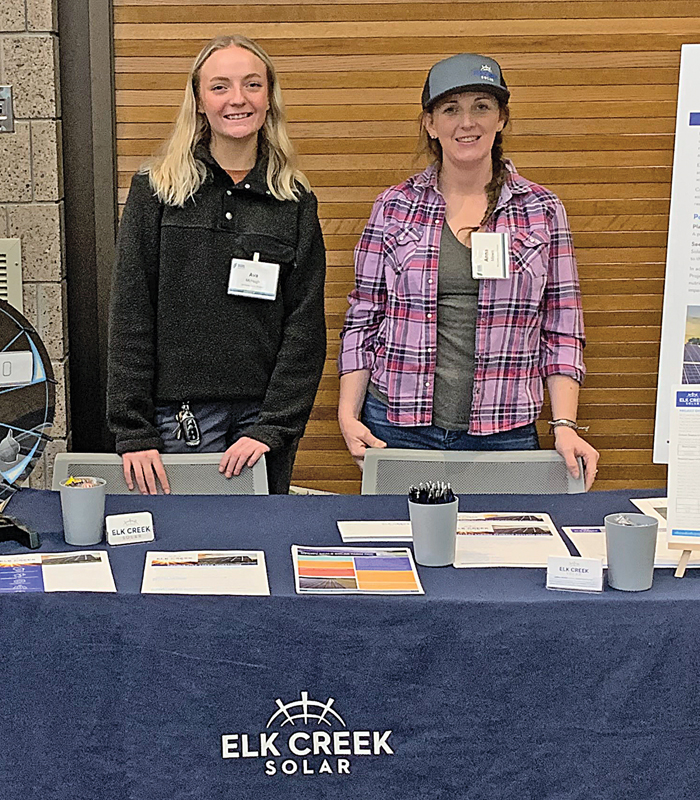
ELK CREEK SOLAR PROJECT — Ava McHugh (left), Elk Creek Solar Project intern and UW Stout student and Anna Mewis, local representative, had the chance to chat with community members about the benefits and timeline of the project at the Red Cedar Watershed Conference held Thursday, March 9. —photo submitted
By Anna Mewis
Wisconsin has been a leader when it comes to conservation and education. Hugh Hammond Bennett and Aldo Leopold are some of the founding members of the great conservation movement in Wisconsin who set a standard for overseeing our natural resources still used to this day. These great Wisconsinites blazed a path to remind us of the importance of our natural resources and why we should encourage sustainable land use – CRP, regenerative agriculture, organic farming, and even hosting renewable energy generation facilities.
Sustainability is using a resource in a way that ensures that it is not depleted or permanently damaged, while conservation is careful preservation or protection through planned management. The differences are subtle, but both are involved in landowners’ decisions to be part of solar farms in Wisconsin.
For the past 37 years, some landowners have used the Conservation Reserve Program (CRP), created by the Federal government in 1985, to help farmers and ranchers thrive. The long-term goal of the program is to re-establish valuable land cover to help improve water quality, prevent soil erosion, and reduce loss of wildlife habitat.1 In exchange for a yearly rental payment, enrolled qualified farmers agree to remove environmentally sensitive land from agricultural production and plant species that will improve environmental health and quality. The program in place today gives farmers and ranchers the ability to ‘rest’ their productive farm ground, while renewing the soil and improving water quality within the area. These programs have been a staple to the farming community, as they allow the ground to regenerate healthy microorganisms and nutrients beneficial to the soil and to the farmer, while protecting our natural resources for generations to come. In Dunn County, farmers and ranchers have been participating in CRP for years, and in 2022, roughly 3,265 acres of land in Dunn County were enrolled in the CRP.
The goal of removing land from standard agricultural practices and allowing the ground to rest and recharge can be similarly met through renewable energy projects like the proposed Elk Creek Solar Project. Renewable energy projects, like the proposed Elk Creek Solar Project, can help to achieve many of the same goals that CRP strives to fulfill. The project will plant deep-rooted vegetation beneath the solar panels and throughout the project footprint. Creating wildlife enhancements and planting pollinator-friendly landscapes can supplement and improve existing vegetation within the project site. These proven techniques increase wildlife and plant species, resulting in an increase of biodiversity within the project site and beyond. Although the ground may be “resting”, the solar components hosted on the ground are hard at work producing clean energy. In addition, at the end of the project’s life, it will be properly decommissioned; all solar components removed from the site and the ground restored for its use prior to the operation of Elk Creek Solar. While the process for participating in CRP is different from how one would participate in a large-scale solar project, the two have similar principles when it comes to regaining healthy soils, improving water quality, and creating habitat.
A solar project like Elk Creek Solar Project has the added benefit in helping diversify our electricity generation portfolio which helps ensure grid reliability. Once operational, this project will be a quiet neighbor, providing reliable, sustainable electricity while allowing the ground to recharge similar to ground enrolled in CRP. Along with providing clean energy, solar farms also benefit the landowners by diversifying their portfolios and bringing in additional revenue. One of the landowners involved in Elk
Creek Solar Project, Charles Wachsmuth, says, “Solar, it’s like CRP but better”. His statement points to the fact that hosting an energy project doesn’t only bring additional revenue to the landowner; it creates a new revenue source for the Township and County as well. Combined utility aid payments to the Town and County are expected to be $1.2 million annually, for as long as the Project continues operating. Unlike categorical aid, which must be used for a specific purpose, this unrestricted aid can be used in any way approved by the local governing body. Having access to additional resources means a stronger community that can prioritize advancements to infrastructure and continued support to essential services.
Moving to conserve our land through planned vegetation management coupled with sustainable solar energy production, which diversifies our grid and the landowners’ portfolios as well as financially benefiting the local government (and therefore the surrounding community), is a conservation win all around. “Doane Ltd is very excited to participate in this multi-faceted project, and we look forward to hosting your new quiet neighbor,” says Charles.
