
Tainter Machine celebrates 30 years — and now onto to the next chapter
PROTECTED CONTENT
If you’re a current subscriber, log in below. If you would like to subscribe, please click the subscribe tab above.
Username and Password Help
Please enter your email and we will send you a password reset link.


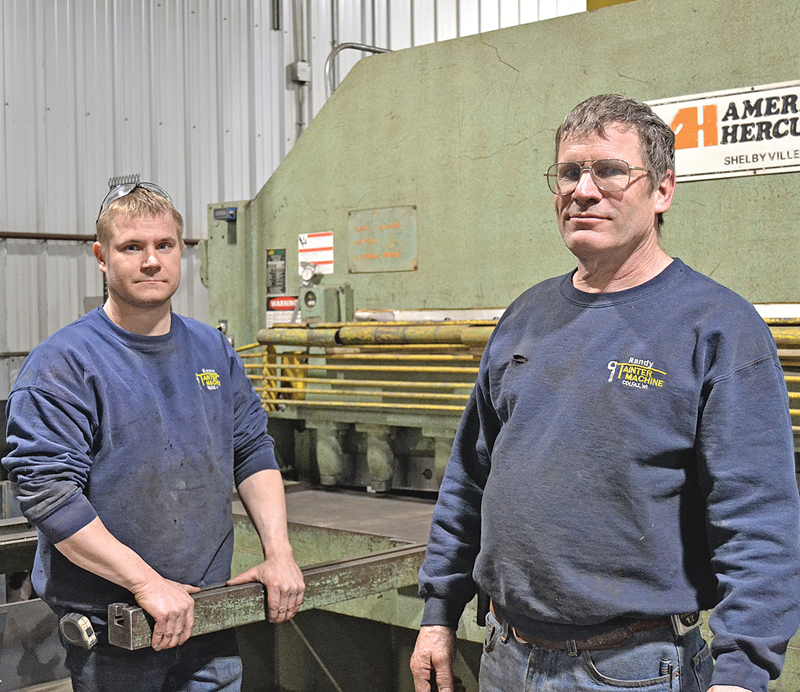
NEW GENERATION — Randy Valaske (on right), the owner and founder of Tainter Machine, plans on stepping back a few days a week while his son, Ken, works on taking over the business. Tainter Machine celebrated its 30th anniversary February 24. —photo by LeAnn R. Ralph
by LeAnn R. Ralph
COLFAX — Tainter Machine — operating under the motto of “Building your ideas! — celebrated its 30th anniversary February 24.
The rural Colfax business, located on county Highway D not far from Tainter Lake, is one of the few machine shops that will do a “one off” and can fabricate just about anything you want.
Need a part for the antique tractor you are restoring and can’t find it anywhere? They’ll make one for you.
Your factory line is down, and you can order the part, but it will take three months to come from Germany? They’ll make one for you.
You have a little one-horse trailer that would come in handy for emergency veterinarian care in Stillwater or the Twin Cities, but the trailer is not high enough to accommodate the 18-hand horses you have? They’ll modify the horse trailer for you.
The founding machinist at Tainter Machine, Randy Valaske, puts his heart and soul into solving problems and likes nothing better than the challenge of building a “one off” piece or a part or a modification.
But now, after 30 years, Valaske is ready to step back a little bit. Not retire completely or pack up and move away. Just step back a few days out of the week.
And that has some of his customers worried.
After all, Valaske has the reputation of — if he cannot figure out how to fix it, it cannot be fixed.
Here’s the thing, though. Randy’s son, Ken, is working on taking over the business.
Ken, too, likes nothing better than building a “one off” piece or a part or a modification.
The apple, as they say, did not fall far from the tree.
Ken has worked alongside his dad, and his dad’s right-hand man, Tom, for quite a few years.
Even though Randy is stepping back, he’ll still be around, and Tom is not planning on going anywhere, either.
The story of how Tainter Machine came to be is quite a remarkable story in and of itself.
It all started with a little boy growing up on a farm, fascinated with how things worked and how they were put together, and progressed to a young man who did not do very well in high school academically but who had two teachers who believed in him.
Mr. Slind
Valaske says he owes the direction he took to being a machinist to his Colfax High School shop teacher, Jerry Slind.
“I had Mr. Slind on my side. He taught me how to do what he knew how to do. I was getting past him on some things. But he was willing to let me work on what I wanted to because he knew I wasn’t going to wreck anything,” he said.
“I got a free rein to do what I wanted, and he graded what I turned in. Having no specifications on any of it. I just had to make up drawings, and as long as the part matched the drawing, it was all good,” Valaske said.
(Just? Valaske only “just” had to make up drawings that matched the part and then make the part?)
“He let me make all kinds of stuff. And any of the teachers who had welding to do or whatever, I was the one out in the shop who could do it. They had to come and ask me if I would take the time to do it. That was kind of neat. I got to do a lot of work for the teachers,” he said.
At that time, when Valaske was in high school, education had not gotten around yet to fully embracing that there are all different kinds of learning styles. Some people are visual learners and can learn by seeing diagrams or reading about how to do something. Some people learn by listening. Some people learn by doing a task hands-on. Some people learn by watching someone else perform a task. Some people (many?) are a combination of learning styles — they have to read about it first and then watch someone else do it, for example.
“Mr. Slind was the only one who understood that I had intelligence but that I had to tap it differently. He knew how to reach that. Mrs. LaRue knew how to reach it, too. There were two teachers. But at least I had two teachers!” Valaske said.
Some Colfax Messenger readers will remember Jean LaRue as an English teacher at Colfax High School.
Valaske was fortunate as well that his parents were completely supportive and believed in him too.
Engineering
During Valaske’s senior year in high school, he dreamed of going to the Milwaukee School of Engineering.
“But when you’ve got your guidance counselor telling you that you’re not smart enough — you don’t go to the Milwaukee School of Engineering,” he said.
“Now that’s all I do all the time is engineer stuff. Machining. Drawing. Welding. That was all easy. I had the imagination to dream up just about anything. I never learned math until I got out of school. But I taught myself math at CVTC. Because what do I do now? It’s all math,” Valaske said.
“I learned it then because I had something to relate it to. That’s what was missing in school. It was new math. It was equations. And you come up with this answer, but you don’t know why, and it doesn’t apply to anything you are doing,” he said.
“Decimals and fractions. Now that’s something you can do something with. You can build things if you know math. That’s what I’ve done for 30 years now. I have, luckily, gained the reputation as being that guy who is going to figure something out when nothing else will do. I like that. I like helping people that way. To take something that’s not fixable — and fix it anyway,” Valaske said.
CVTC
When Valaske was told the Milwaukee School of Engineering was out of reach for him, he turned to Chippewa Valley Technical College and enrolled in the one-year machine tool program.
“My instructor saw something in me. I was lucky to have the instructor I had. Bob Verbrugge,” he said.
“I got a good start. Mr. Slind was a big part of that, too. Bob got a hold of Jerry just after I got out of CVTC and told Jerry they never knew where Colfax was until I went through there. I don’t know what that means. I’m not sure what he meant by that,” Valaske said.
“The program at CVTC was a year-long program. Just after I graduated, they changed it to a two-year program. I finished it up 18 weeks early. Bob was an excellent teacher and it came easy to me. I understood everything that man said. It was fun to learn,” he said.
“I use his techniques to this day. He was the right guy for me,” Valaske said.
Robert James Verbrugge, age 93, died September 12, 2020, in Altoona. He grew up on the family farm in Iowa with five brothers. He retired from teaching at CVTC in 1991.
At the time of Verbrugge’s death, there were restrictions on mass gatherings because of the COVID-19 pandemic, and his family decided to have a burial at a later date, according to Verbrugge’s obituary.
“His daughter tracked me down last fall. I guess Bob must have talked about me,” Valaske said. “She tracked me down because I was a name she knew. I’m going to make a custom urn for Bob. It’s quite a privilege. I’ve got some fancy threads I’ve got to make. Bob was all about his threads,” he said.
Tainter Machine
After gaining some experience in working at welding and machine tooling, Valaske struck out on his own, and Tainter Machine was born.
The original shop was located about a mile east of the existing shop, and Valaske operated his business there for 13 years.
Those were long, hard years — 18 hour days, often seven days a week.
“I started out in that 40 by 45 building and about halfway through, put on the 38 by 45 (addition) and moved the machine shop in there. About 10 years after I started, no eight years, I hired Tom. He’s been here 22 years now,” Valaske said.
When he started thinking about expanding again, Dunn Electric intervened with an estimate of
$40,000 to install three-phase electrical service.
Valaske talked it over with his wife, Joan, and other family members.
“I thought, if we are going to spend $40,000, we might as well move the shop and put the money into a new building,” he said.
Along the way, Valaske’s dad, Kenneth, suffered a stroke and eventually became a resident at the Colfax Health and Rehabilitation Center.
Shortly after that, his mother, Ellda, moved to the nursing home as well “because she couldn’t navigate without Dad,” Valaske said.
In 2005, Joan and Randy moved into the Valaske family farmhouse right next door to where the new shop is located.
After five or six years, Tainter Machine built an addition onto the new shop.
“It’s like walking into the Taj Mahal every day for me, to have this beautiful facility to work in,” Valaske said.
Mr. Slind “would come out once in a while to see the place. He was one of my guests of honor when we christened the place. It was fun to have him and Dad here,” he said.
Next generation
Young Kenneth Valaske brings in a new era to Tainter Machine with his computer knowledge to run the CNC equipment.
Ken originally went to school for auto body work.
“He did that a couple of years. And then he started hanging around the shop and was talking to me. He was hanging around pretty tight. He hadn’t really done that before. Then he finally came out and said, ‘Would you teach me to be a machinist?’” Valaske recalled.
“I said, ‘I sure can. But I would rather send you to school and pay for your schooling, because then you can learn the stuff I don’t know. If you’re going to work here, you’ll need to know those things that I can’t teach you,” he said.
So he did. Ken went to CVTC for fabrication.
“We’ve got the plasma table, and he can make some really cool stuff on that. He can program it and make it. And the mill. It adds a big diversity we didn’t have before. And hopefully I can pass on some of what I know,” Valaske said.
“Some of my customers aren’t real tickled that I’m backing out a little bit. I said, ‘Don’t sweat it. I’m going to be around a little while,’” he said.
“I’m just going to back out a couple of days a week. It will be in good hands with Ken. Tom is still here. He’s going to stick around for a while. We’ve got Dave. We’re like everybody else. We could use more help. But I’ve got an excellent crew. All the dreams in the world — if you don’t have a good crew to work with you …” Valaske said.
Inside out
“I look at things inside out. That’s what I tell Kenny. I tell him before you even start, you have to visualize it done. And then you head in that direction,” Valaske said.
“We design and builds a lot of stuff that does not exist. I’ve told Ken, you’ll redesign it six times before you’re done. But hopefully some of the stuff you make in the process you can use in the end. But you’ll redesign it about six times,” Valaske said.
“Some of the neatest things we’ve built in the shop — I remember sitting with a friend of mine and drawing it on a napkin over dinner and bringing it back to the shop and showing it to the guys. And then you build it. You have to be able to see it,” he said.
When Valaske built his first pulling tractor, a friend told him to “machine everything away that’s not a cylinder and you’ll have it.”
Kind of like a sculptor making a bust of someone who chisels away all the stone that is not the person who is supposed to be in the bust.
Over the years, the equipment evolves and “you learn better techniques to where what we did 30 years ago is different than what we do today,” Valaske said.
Young Mr. Valaske was not overly enthusiastic about being interviewed by the newspaper.
But you can tell, when you talk to him, that he shares his dad’s love for the “one off,” for fixing the unfixable, for getting that factory machine up and running again or helping a farmer get back out in the field.
Working in auto body was okay for a while, Ken said, until one day he realized that although he was working on different cars, it was all the same work.
Now, no two days are alike.
What’s next?
Machinists are like farmers. You cannot expect them to stop working abruptly and to be content with that.
And Valaske has plenty of projects to work on.
He has his own little shop on the farm where he works on restoring tractors.
He’s got his artisanal projects, such as the crosses on the louvres at Norton Church, candle holders or special gifts he makes for special people in his life.
When it was time for a new roof at Norton Church, the old wooden louvres on the steeple were not salvageable, so Valaske built new louvres out of aluminum and then built the crosses that decorate the louvres.
Another of his artisanal projects is the lighted cross above the door at Colfax Lutheran Church in Colfax.
And then there’s the historic restoration project he is working on — the turbine in a grist mill built in 1864 — Dell’s Pond near Augusta.
Valaske says he has all the parts built for the turbine and that the work of getting it up and running will begin this spring.
“I’m pretty exited about that project,” he said.
A friend took him to Dells Mill for the first time on Valaske’s birthday last year. The paddle wheel and the dam have been rebuilt. The man who owns the place said he wanted to get the turbine running.
Valaske said he told the owner, “it’s something to get behind. I want to see this thing run. I want to see you grind flour with this thing.”
The turbine was built in 1919, the same year that Valaske’s father was born. It is 40 inches in diameter.
“I went into the hole. It’s a little unsettling. The hole is close to 30 feet deep. There’s a plank gate, about four inches thick and three feet wide. And that’s what’s holding the water back. You’re down in the hole with a whole bunch of water on the other side,” Valaske said.
The grist mill at Dells Pond is three stories tall. The beams are hand hewn, 10 by 10 inches and 40 feet long.
The owner said it took five years to obtain the permits from the state Department of Natural Resources to restore the dam and that the job involved four semi loads of cement powder.
“I had never seen a grist mill. It’s the coolest thing in the world,” Valaske said.
“A hundred years later you can spin the turbine with your finger,” he said.
“The farmers are what helped build (Tainter Machine). We have more industrial accounts than we’ve ever had. We’re one of the only shops around that do ‘one off’ work. But the farmers are still very important to the place,” Valaske said.
And of course, that’s why Valaske is committed to seeing the turbine in the grist mill work again, because it’s part of that long tradition of farming that takes him back to his roots and the roots of his parents, his grandparents and his great-grandparents.
