
Project to stabilize Red Cedar River bank progressing
PROTECTED CONTENT
If you’re a current subscriber, log in below. If you would like to subscribe, please click the subscribe tab above.
Username and Password Help
Please enter your email and we will send you a password reset link.


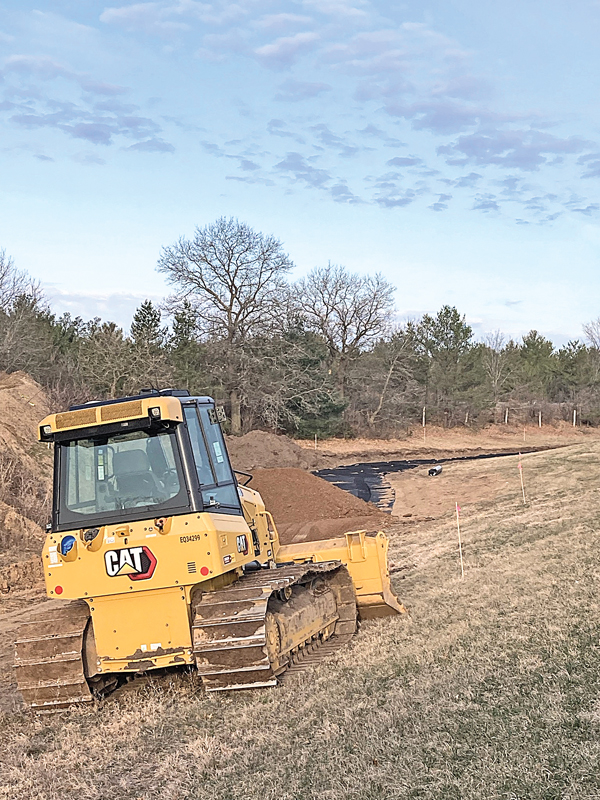
STREAMBANK STABILIZATION — Work on the project to stabilize the bank of the Red Cedar River so it will not wash out Colfax’s wastewater treatment lagoons has started with the construction of an access road. —photo courtesy of Lynn Niggemann
By LeAnn R. Ralph
COLFAX — Eight years after the U.S. Army Corps of Engineers first came to Colfax to assess the erosion near the wastewater treatment lagoons along the Red Cedar River, the project to stabilize the river bank has finally started.
The Village of Colfax was awarded $592,000 in Community Development Block Grant funds in 2019 to help cover the village’s portion of what has turned out to be a $2.6 million project.
As part of the requirements for receiving CDBG funds, the Colfax Village Board held the second public hearing related to the project on May 23.
The second public hearing in the process is to address public concerns and needs, said Jon Strand, project engineer with CBS Squared.
The Colfax Village Board hired CBS Squared to write an application for the CDBG funds.
The village board held the first required public hearing in April of 2019 on the application for CDBG funds to help pay for stabilizing the river bank.
The contractor has broken ground and has started work on the haul road, Strand said at the May 23 meeting.
The access road is mostly complete, and clear-cutting of the river bank is almost complete, said Lynn Niggemann, village administrator-clerk-treasurer.
Work on the project was required to be started by April 30 for the CDBG requirements, but the work will be paused now because the contractor must finalize the design with the Army Corps of Engineers, she said.
There was an initial surge in work, then there will be a lull, and then the work will be completed this year, Strand said.
According to the grant requirements, the work must be completed on or before October 15, Niggemann said, noting that she has been giving the village board updates on the project at every meeting.
One area that should be covered in the second public hearing is residential housing or businesses that are being displaced during the project, but that is not applicable in this case, Strand said.
Housing needs
Housing needs in the community is another important part of the block grant, Strand said.
Colfax has had some residential construction in the past few years, and recently there has been more interest from developers, Niggemann said.
A functioning wastewater treatment system that will not be washed out by heavy rain or flooding of the Red Cedar River would be an important consideration for existing housing and future development.
When the U.S. Army Corps of Engineers listed possible solutions for the Red Cedar River eroding the bank and washing out the Colfax wastewater lagoons, they reported that relocating the facility would cost $10 million.
The public hearing is offered as an opportunity for the public to provide input and feedback on the project, Strand said.
Niggemann said when she has been at construction meetings on-site out at the wastewater treatment lagoons, neighbors have stopped to ask how the lagoon bank project will affect their property or to find out what is going on with the project.
Other than six members of the Colfax Village Board, Strand, Niggemann and the reporter for the Colfax Messenger, no members of the public attended the public hearing.
Niggemann pointed out that the Colfax Messenger has been covering the issue of stabilizing the river bank and the village’s application and award of CDBG funding, which has provided an opportunity for village residents to be informed about the project.
The Messenger also has been covering the updates the village board has been receiving at recent meetings, she said.
The U.S. Department of Housing and Urban Development recently recalculated the income eligibility of Colfax residents. People in the village are now considered to be low to moderate income, which qualified the village to apply for CDBG funds for the lagoon bank project.
River bank erosion
Although the Army Corp of Engineers came to Colfax to view the erosion problem in December of 2014 and wrote the report in 2016, the village noticed a problem with the river bank eroding long before that.
Over the last several decades, the Red Cedar River has steadily eroded the river bank and has come much closer to the wastewater treatment lagoons. Estimates are that perhaps one hundred to two hundred feet of river bank have disappeared.
In August of 2010, a thunderstorm that dumped up to eight inches of rain around the area in a couple of hours caused the bank to erode even more from stormwater run-off.
The wastewater treatment lagoons were built in 1982.
Initial estimate
The initial estimate to stabilize the river bank was $1.6 million, with the Army Corps paying 65 percent of the cost and the village paying 35 percent of the cost.
Money from the Army Corps of Engineers is considered to be matching funds, so with the award of the $592,000 as CDBG funds, the only cost to the village for the $1.6 million project was expected to be $35,000 to $40,000 to CBS Squared for the grant application, grant administration and project oversight.
In January of this year, the Colfax Village Board learned that the cost of the project had increased since the first estimate, and the village is now in the position of paying $540,000 for a $2.6 million project.
Colfax could apply for a Clean Water Fund loan, but the Clean Water Fund loans are paid out after the project is finished, so the village has had to find interim financing in the form of a bank loan.
According to a letter dated January 20 of this year from a grant specialist with the Wisconsin Department of Administration, if the village could not find additional funds to cover the higher cost estimates to complete the project and have the bank stabilization construction start on time, which was no later than April 30, 2022, then the Wisconsin Department of Energy, Housing and Community Resources would cancel the 2019 CDBG award.
If the 2019 CDBG award were cancelled, Colfax could apply for a 2022 CDBG award, but much less funding is available this year than in 2019, when nearly all of the eligible applicants were able to be funded. The available money this year could fund 10 to 15 projects, or about 25 percent of the applications, so Colfax’s grant score would have to be much higher, the letter stated.
Clean Water payments
Payments on a Clean Water Fund loan would amount to about $30,000 per year over the next 20 years, according to an analysis from Ehlers and Associates, the village’s financial consultants.
The payments would be covered by the village’s sewer and water utility and would not come out of the property tax levy.
The state Department of Natural Resources administers Clean Water Fund loans for the U.S. Environmental Protection Agency.
The deadline to apply for a Clean Water Fund loan is October of this year, and the money would be awarded in June of 2023.
The deadline for closing out the project to install rip-rap to keep the Red Cedar River from washing out the wastewater treatment lagoons was December 31, 2021, but in July of 2021, the village board approved an agreement between the Wisconsin Department of Administration and the Village of Colfax to extend the deadline to December 31, 2022.
The rip-rap project will cover 1,400 feet of river frontage to help protect the wastewater treatment lagoons.
