
Distracted driving not as easy as it looks
PROTECTED CONTENT
If you’re a current subscriber, log in below. If you would like to subscribe, please click the subscribe tab above.
Username and Password Help
Please enter your email and we will send you a password reset link.


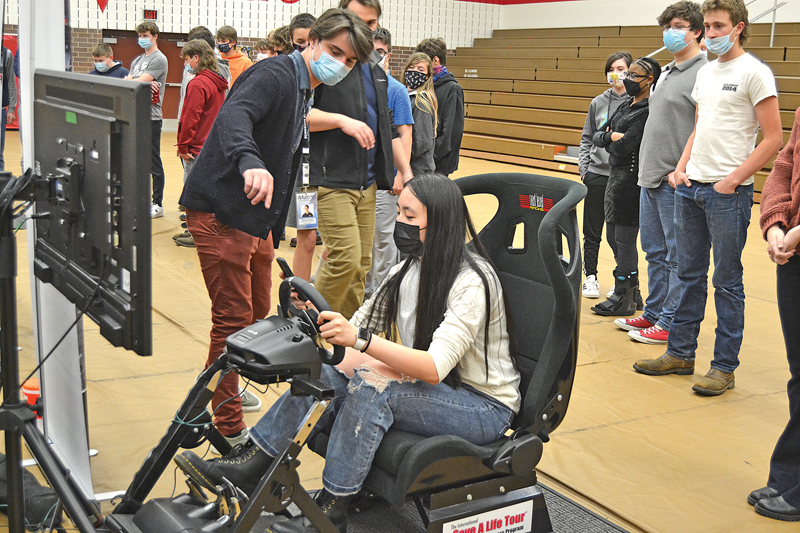
DISTRACT DRIVING — Colfax High School senior Katie Riley takes a turn at the distracted driving simulator that was part of the International Save a Life Tour at Colfax High School April 13. Students were given a cell phone and asked a series of questions to which they were to reply by text message while trying to drive the simulator. Students could also try their hand at impaired driving, wearing a pair of virtual reality goggles. —photo by LeAnn R. Ralph
By LeAnn R. Ralph
COLFAX — There was lots of laughing.
But mixed in with the laughter was a certain amount of consternation, chagrin and disgust with themselves at how quickly they became distracted drivers while trying to send a text message — and ended up, after only a few seconds, driving onto the sidewalk, running off the road, striking a sign post or light pole, or crashing into another car or a building.
The driving simulation with text messages, along with a simulation of being an impaired driver under the influence of drugs or alcohol, was part of a day-long event at Colfax High School April 13 put on by the International Save a Life Tour.
According to the organization’s news release, “The Save A Life Tour is a comprehensive high impact safe driving awareness program that informs, educates, and demonstrates the potentially deadly consequences resulting from poor choices and decisions made by the operator of a motor vehicle. The program specifically places emphasis on the following driving situations: Distracted Driving, Impaired Driving, Driver Experience, Improper Driver Behavior and Seat Belt Usage. The Save A Life Tour (uses) several methods for educating, including video presentation, speaking presentation, interactive demonstration with simulators, pre and post surveys and take-a-ways including a pledge card and a wristband.”
English class
Under normal circumstances, all of the high school students would have come into the gymnasium as one big group to watch the videos about distracted driving and to take part in the simulations, said John Dachel, principal at Colfax High School.
Because of the COVID-19 pandemic and the requirement for physical distancing, students watched the videos in their English classes the day before, and then by English class, were released to come down to the gym to try out the driving simulators, he said.
By using the English classes, Dachel said, every student at Colfax High School was given a chance to watch the videos and to try the simulators.
While the students drove the simulator, they were given a cell phone that asked them to respond to a set of questions while they were attempting to drive.
Students at the impaired driving simulator were given a pair of virtual reality goggles to wear.
With all of their classmates standing around directly them, students volunteered to try texting or impaired driving.
When all of the students had an opportunity to try their hand at distracted or impaired driving, they could take another turn on the simulators to see if they could improve their time.
Distracted
From all appearances, most of them did not do any better the second time around — but that was not from a lack of helpful comments by their classmates throughout both their initial and subsequent attempts:
“You just ran a red light!”
“Look out for the school bus!”
“You’re on the sidewalk!”
“You just went in the ditch!”
“You broke off that sign!”
“Look out for the car!”
“You’re in the wrong lane!”
“You almost hit that pedestrian!”
“You crossed over the centerline!”
Most of the students crashed after only a few seconds although one or two were able to go closer to 30 seconds.
Prior to the event, many students had expressed to Dachel they were confident they would ace the simulators because — after all — they send text messages while driving all the time.
Some of them also play lots of video games and were convinced that would improve their time with the driving simulator as well.
Dachel said he was grateful none of them had expressed confidence about being able to ace the impaired driving simulator under the influence of drugs or alcohol.
Texting, no matter whether they are driving, is something they all do, he said.
The simulators were set up on city streets with traffic, stop lights and pedestrians, but many of the students at Colfax High School do much of their driving in small towns or on country roads, Dachel said.
“It would be much different if they were trying to text and drive in the Twin Cities. This gives them an opportunity to see what that would be like,” he said.