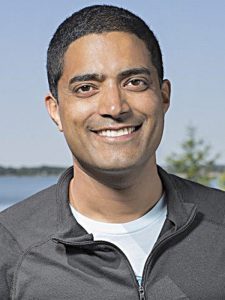
Raj Shukla
By Amber Hayden
MENOMONIE — During the 2020 Red Cedar Watershed Conference on March 12, Raj Shukla gave a presentation on a few of the things that are having a harmful effect on the lakes, rivers, and streams throughout Wisconsin.
Shukla has been the executive director with River Alliance of Wisconsin for the last four years, and has worked for over a decade in program design, development, and management to tackle pressing social and environmental needs.
Most recently Shukla was the director of programs with the non-profit Cool Choices, in which he led public engagement and energy efficiency programs in businesses, schools, and government agencies across the United States.
He also helped develop youth education programs for former Vice President Al Gore’s Climate Reality Project, and volunteered with the Red Cross during the time of Hurricane Katrina.
He currently serves as Chair of the Sustainable Madison committee, which is a city advisory committee of mayoral appointees who work to realize the community’s social and environmental aspirations.
River Alliance
River Alliance began 27 years ago by a group of paddling enthusiasts who also happened to be steeped in the science of eco-systems, and saw the need to restore the lakes, rivers, streams, and groundwater that connect all of Wisconsin.
River Alliance’s mission is to empower people to protect and restore water, all the while thriving as a community, economy, and habitat through access to clean, abundant water.
“Almost four years ago, I joined River Alliance as its new executive director,” Shukla explained. “To continue a long history of advocacy and action to protect and restore water.”
His role is to make sure people across the state of Wisconsin hear about the issues they are helping with, and get others engaged in River Alliance’s work.
“All of us at River Alliance work really hard and we have a lot of fun,” he stated. “And a big part of that is knowing that we are a part of a long history of principle accomplishment in Wisconsin.”
River Alliance has been involved in the removal of 60 dams across the state, and working to develop hydro projects to be more in tune with the natural environment.
“We have worked in other ways to help improve how we treat our natural resources,” said Shukla.
Recent Works
In Marinette, River Alliance worked with local government and businesses at every level to allow for the Lake Michigan sturgeon fish passage to spawn in water up the Menominee river.
“Two dams at the mouth of the river are equipped with fish elevators and water slides that help sturgeon move where their instincts take them,” he stated.
This process has allowed scientists to track and monitor the health and the numbers. This is done in case the sturgeon population needs to be replenished that has been decimated by pollution and over fishing.
River Alliance also works with local organizations to protect waterways from invasive species, by organizing a state wide Snapchat day to identify hot spots that result in training on how to remove invasive aquatic species.
The non-profit has also worked with local leaders about the dangers of mining.
River Alliance has focused in recent months on the proposed Aquila Resource’s Back 40 sulfide mine, reef deposit, and bend deposit in Michigan and Wisconsin.
Despite the Back 40 mine project not being in Wisconsin, it would affect the Menominee River in the long run that is the native homeland to the Menominee Tribe of Wisconsin.
River Alliance became involved to help people understand why the Back 40 sulfide mine should be stopped.
They explained it would cause an influx of cyanide, used to extract gold, and produces sulfuric acid, it is unsafe as the Menominee River is not built to withstand flooding, it would be harmful to the drinking water supply and aquatic life, it desecrates the sacred Menominee Tribe cultural sites, and it would benefit a Canadian corporation which harms the local economy.
“Two years ago we trained and supported local leaders to win a county referendum to oppose mining speculators determined to jeopardize health in the Willow flowage in Oneida County,” said Shukla.
River Alliance has begun to help farmers and food processors to become better stewards through a science based certification that was created in partnerships between corporations, non-profit advocates, and researchers from around the world.
“Our goal with the program is to reshape how agriculture is done in Wisconsin and across the country,” explained Shukla. “With water stewardship at the very center of how we feed ourselves.”
Working Together
Shukla and others at River Alliance know that big changes cannot happen without good policies, and that doesn’t happen without savvy committees that are guided by science.
Groundwater events have become more prominent in Wisconsin, with things like lead pipes, cancer causing chemicals, nitrates from fertilizers, and also floods.
Shukla stated that elected officials have heard the outpouring of responses, and Governor Tony Evers even declared 2019 the year of clean water.
The state assembly gathered task forces to get to the root of the issues and to develop solutions to the water quality concerns.
The task force held a dozen hearings to discover concerns and hear suggestions for clean and healthy water. In the report that the task force gave to the assembly, there were 13 pieces of legislation introduced, such as package assistance for farmers.
“This is important assistance that will help farmers transition to different forms of agriculture,” he said. “This would keep runoff on fields and out of rivers and streams.”
The 13 pieces of legislation that were presented to the assembly only covered four of the 15 priorities that were expressed at the hearings by Wisconsinites.
River Alliance feels that politicians and the public don’t know what to do about the challenges that are interconnected, according to Shukla.
“There are between 80,000 and 100,000 chemicals used in commerce in the United States,” he commented. “And their only standards are on a few hundred of those chemicals.”
Shukla urged those in attendance of the 2020 Red Cedar Watershed Conference to take the initiative to imagine a better way, and build the people power needed to make sure that elected officials take real meaningful action.
“We need a road map to guide decision makers and the general public as we recreate a system to protect and restore clean water for all of us,” stated Shukla. “River Alliance is taking the lead.”


