
Truth Be Told … Ken Neuburg — “Remember your first pack of baseball cards?”
PROTECTED CONTENT
If you’re a current subscriber, log in below. If you would like to subscribe, please click the subscribe tab above.
Username and Password Help
Please enter your email and we will send you a password reset link.


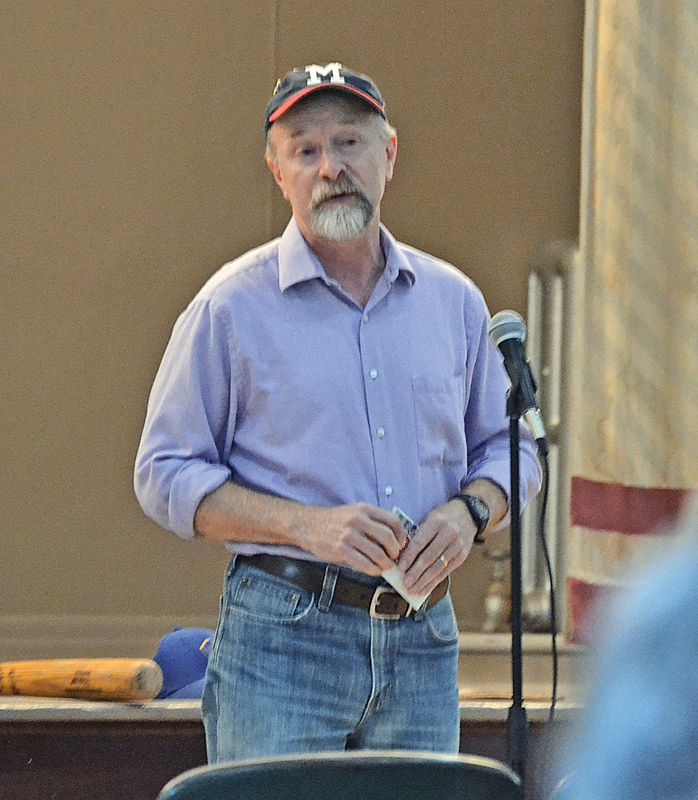
BASEBALL — Ken Neuburg was one of the storytellers at the Truth Be Told “Firsts” Edition at the Colfax Municipal Building’s Cozy Theater September 8. Neuburg, who is originally from Milwaukee, talked about his first pack of baseball cards from the first season the Milwaukee Brewers played in Milwaukee in 1972. —photo by LeAnn R. Ralph
By LeAnn R. Ralph
COLFAX — The Truth Be Told “Firsts” Edition at the Colfax Municipal Building’s Cozy Theater on Sunday, September 8, featured stories of “firsts.”
Storytellers included Ken Neuburg (First Pack of Baseball Cards), Randy Simpson (First Car), Jane Sonnentag (First Day of School) and Derek Westholm (First Date).
The Truth Be Told editions are hosted by Steve Russell and Kobi Shaw, who thought of the idea of local storytellers as a way to draw audiences to the renovated auditorium and to highlight the next project for the building: constructing an addition for an elevator and handicapped accessible bathrooms on all three floors.
Watch the Colfax Messenger in the following weeks for the other stories of “firsts.”
Ken Neuburg is from Milwaukee and grew up not far from Milwaukee County Stadium — 2.1 miles.
He is a packaging engineer for Hewlett Packard and has been a lifelong baseball fan.
Today, Ken lives in Running Valley, and the distance from his house to the Colfax Municipal Building is 3.1 miles.
“When I was a kid, County Stadium seemed so much farther away,” he said.
Here is Ken Neuburg’s story.
Ways to play
Baseball in Milwaukee was a big deal. It was by far the biggest sport when I was growing up.
There were four ways to play baseball in Milwaukee. You could go to St. Sebastian’s playground, and there were enough guys and brothers that you had a nine on nine full squad. If you got picked, you got to play … that’s how you developed your baseball skill.
And if you didn’t get picked, you watched.
You could also play Stickball on 54th Street. Home plate and second base were sewer hole covers. Power poles were first and third. And I’m not making this up. We played with tennis balls and a broom handle stick.
After a while we started getting paraphernalia from County Stadium. We started getting freebies from players. It would be a bat or a ball or a batting glove … if you played on 54th Street, a narrow street, with a real bat and a real ball, somebody’s window would get broken.
I will never forget the day somebody put a ball through the picture window of somebody’s house. We just (scattered).
And yes, they found out who we were.
With Stickball, you could play Strikeout. It was one batter against one pitcher, and you basically needed a wall. You would draw the strike zone on the wall with chalk.
My opponent, if I was batting, the pitcher was typically my younger brother. And you would bat and get three outs, strike balls, single, double, triple home run past your opponent.
You could get it past him on the ground, you could bounce it to the fence, you could hit the fence, you could hit it over the fence. We played that with a tennis ball.
Or you could play at Wick Field. Big giant netting. You were trying to hit the ball over the net.
Elmer’s
I still remember my first pack of cards. It was 1968. When you bought cards, you went to Elmer’s.
In Milwaukee in the neighborhood where I grew up, there were corner grocery stores. Elmer’s was a mom-and-pop shop. They had the store downstairs, and they lived upstairs.
I can still see myself opening this 1968 pack of baseball cards. The only problem in Milwaukee at this time was the Braves decided to leave us for Atlanta.
Many don’t realize this, but in 1968 and ‘69 we did have the Chicago White Sox. They played home games in Milwaukee County Stadium against each team once.
I think it was the 1968 season, they outdrew the entire attendance for Chicago at home that year. There was a lot of talk that 69-70, we would become the Milwaukee White Sox. That never happened.
Seattle Pilots
A cool thing happened in 1970. The Seattle Pilots became the Milwaukee Brewers.
I was on Cloud 9. I lived 2.1 miles from County Stadium. Baseball is my life. Baseball is my brother’s life. We got loads and loads of cards.
I’ve been a newspaper carrier now for two years. The Milwaukee Sentinel, the early morning route. You had to do your route before school. Sunday you had to go down to the shop and get all the special insert sections. I had some really good tipping customers.
My brother and me were really good at finding empty bottles.
In Milwaukee, in 1970, 16 ounce empty Coke bottles were two cents. A 32-ounce, if you could find a Fanta bottle, a 32-ounce glass bottle was a worth a nickel.
If I got a nickel and I got maybe three 16 ounce bottles, I got enough to buy a pack of cards at Elmer’s. And of course, Elmer’s would take the bottles and reimburse you for the coinage. That was kind of a big deal. Between my paper route and the bottles, I did pretty good at collecting cards.
1970 goes by. 1971 goes by.
My brother and I had gone to a few games. I went with my dad to one game. I went with my mom and dad to a game. I remember going with my uncle to bat day. We were in right field right behind Reggie Jackson. Absolutely awesome.
1972
But 1972 was when my brother and I decided there must be something more to this.
These players must be coming from somewhere. They must have a car. They must have to park their cars at the stadium.
If we could figure this out, we could probably get all of our cards signed, we could get autographs.
And after we got all of our cards signed, maybe we could ask these guys for free tickets.
What we came to find out, for a Milwaukee Brewers night game that starts at 7:30, the entire team had to be there by 5 p.m. at the stadium.
The manager was Del Crandall at the time, a former Milwaukee Brave. Coaches and managers got there at 2 or 2:30, and then players would start arriving.
The other thing we came to find out is the visiting team had to get to the stadium somehow.
Anytime a Yellow cab came down the hill at 2 or 3 in the afternoon, you ran to that cab, because it was going to be a player for the other team.
Between 5 and 5:30 for a 7:30 game, this big city bus would come down.
Imagine this, 20 plus Major League baseball players. They don’t have hats on. They don’t have uniforms with their name and number, and you’ve got these two packs of cards. Your alphabetized Milwaukee Brewers and your alphabetized whatever your other team — Chicago White Sox, Minnesota Twins, Kansas City Royals, whoever.
This bus comes out of nowhere, and you run to this bus, and you’re trying to figure out who is who, and you get your card, get your pen, get your autographs.
I think I learned a lot about organization, about never giving up.
With that as a little bit of a backdrop, I’d like to share with you my first pack of cards.
Billy Champion
My first pack of cards was 1968, but this was 1972 for the Milwaukee Brewers. At that time, the Brewers pretty much just had an M on their caps.
First card is Billy Champion. He is a pitcher we got from the Philadelphia Phillies. The trade actually happened after the 1972 season.
The reason I am showing you this card is I learned to golf at County Stadium because of Billy Champion.
After day after day of the summer, asking this guy to sign my cards, sign my empty three-by-five sheets of paper, one day, he got up and left.
We ran after him to his car.
He said, “Hey. Have you ever golfed?”
I’m 12 years old. “Uh-nope.”
He goes to the trunk of his car and pulls out two drivers and hands me one. I’m in the parking lot. At County Stadium. The next thing I know, he puts a golfing glove on.
Talk about your firsts. I’m looking at him. And I’m looking at this empty parking lot.
I hit the golf ball. I won’t say it went very far.
The coolest thing was that he was hitting that golf ball. He was a golfer. And he takes this golf ball and hits it across the parking lot at County Stadium. I’ll never forget that.
I’ll never forget golfing with Billy Champion.
Bell
1972. I happened to have a girl in my class who was named Gerrilyn Bell. Gerrilyn with a G. And the coolest thing was in 1972 the Milwaukee Brewers had a pitcher by the name of Jerry Bell.
And after being there all summer, day after day after day, I said, “You know, Gerrilyn, you really should meet this guy. How cool would it be to tell him you’ve got the same name.”
So, believe it or not, she gets on her bike with me and goes to the stadium.
That was day I got Jerry Bell the pitcher to sign an autograph card to my classmate. To Jerry Bell, from Jerry Bell.
She thought that was really cool.
Wright
Clyde Wright. Pitcher. California Angels.
In the early 70s, he was one of the better pitchers in baseball. He was the first guy I got a baseball from. Thank you Clyde Wright.
This guy got traded to the Milwaukee Brewers a couple of years later and proceeded to lose 20 games.
McNally
Dave McNally, pitcher for the Baltimore Orioles. 1972. He was a left-hander. He points to me. He is going to throw me this ball.
This guy had just won 20 games four years in a row. He still has the Major League baseball record. The only pitcher to hit a Grand Slam in the World Series.
This guy proceeds to throw me this perfect left-handed curve.
It was the first ball I dropped.
What you learned was, if you dropped the ball, you could never get down fast enough, and somebody else picked it up.
And my brother still reminds me — “Remember the day Dave McNally threw you that ball, and you dropped it?”
McDowell
Sam McDowell. Some of you might remember that he pitched most of his career with the Cleveland Indians, got traded to the Giants and then subsequently to the Yankees.
I don’t know if you realize this, but when you’re a kid in 1972 and ‘73, you know every aspect of County Stadium.
When you came out of the bleachers, behind the bleachers were open concessions stands. And if you went down the right bleacher exit, you were right past the visiting team’s dugout, the bull pen.
This day, Sam McDowell was in there, kind of in the back.
It was obvious Sam wasn’t going to get in the game.
He passes a dollar bill through the fence, and he says, “Hey, get me a hotdog.”
I went to the concessions stand, bought a hotdog and brought it back to Sam McDowell.
How many kids can say they bought a hotdog for Sam McDowell during a baseball game.
Uecker
Bob Uecker. Everybody knows Bob Uecker.
Did you know he went to my grade school? Did you know he grew up in my neighborhood? I didn’t find any of that out until I went to get an autograph from him.
He went to the same high school. Milwaukee Trade and Technical High School. We should have figured that out.
You look at the back of Bob Uecker’s card. He’s from Milwaukee, Wisconsin.
Bob Uecker is the first guy to give my brother and me free tickets to a Brewers baseball game.
Allen
Dick Allen. First baseman. Chicago White Sox. My all-time favorite baseball player. Two reasons.
You can imagine a 12 or 13 year old kid getting all of these autographs.
This is the only man that would not sign my baseball card. The only one.
He would talk to you. He’d be happy to tell you about his race horses. He’d tell you about a fire and some of his horses died. This is a really great guy.
He would never sign my card.
You know what this guy does one day? He proceeds to ask me for a three-by-five card. I pull it out. After you got all your cards done, you’d use these three-by-five cards.
He said, “Put your name on that card.” So I put “Ken Neuburg.”
And he says, “After 5:30, you go to Gate X, you and your brother, free tickets on me tonight.”
And you know what? We got to sit right behind the third base dugout. The Chicago White Sox dugout. The first guy from a visiting team to give my brother and me free tickets.
Killebrew
Harmon Killebrew. Everybody remembers Harmon Killebrew.
It’s one thing to hawk a foul ball. How about a home-run ball?
You’re in the left field bleachers. The other guys get a home run, you don’t really care.
Harmon Killebrew, our first game ball.
I say “our” because I didn’t catch it.
My brother caught it.
Right next to me.
In the left field bleachers.
And after he reminds me about Dave McNally and how I dropped that ball, he always reminds me he caught the Harmon Killebrew home run ball.
Rodriguez
Ellie Rodriguez. Catcher. Milwaukee Brewers. My first cracked bat.
Back in the day, when the guy was at the plate and you knew he had cracked a bat, did you ever see the ants come running down to the dugout?
I was one of those ants. And you had to be fast.
You had to be faster than the bat boy who was running it back to the dugout to get another bat for this guy.
And all had you had to do was ask, and they’d give you the bat. How cool is that?
That’s the other thing. As fast as you went to the dugout, you had to haul tail out of there because all of the ushers knew you didn’t have seats down there.
McNertney
Jerry McNertney. He wasn’t a Brewer in 1972. But I remember Jerry McNertney because I went to Bat Day.
In 1971 you either got a Danny Walton bat or you got a Jerry McNertney bat.
And I got a Jerry McNertney bat.
The bleachers in County Stadium were all made of wood. The staircases. Everything was wood.
You haven’t lived until you’ve heard about 10,000 kids banging their Jerry McNertney bats.
Awesome memories
That was my first summer with the Milwaukee Brewers.
I have some awesome memories from those days.
I am most grateful to my mom because Milwaukee gets a bad rap. I love Milwaukee. My mom always felt we were safe enough. We could ride our bikes to the stadium to go to a game. How cool is that?
I miss that. I miss those days.
I will tell you, sadly, the corner grocery stores, like Elmer’s, they’re no longer there.
If you drive on Lloyd Street, between 54th and 55th, and you’re looking for Elmer’s, you’re going to see somebody’s home. That whole mystique of having a corner grocery store is gone.
I think another sad thing, if you go to St. Sebastian’s they actually have signs — No Strikeouts Allowed.
They’re plastered on the wall of the school. How sad is that? This was our life as kids. Now you can’t hit the ball because you might hit somebody’s car or somebody’s house.
But we were just kids. And it was a lot of fun.
My brother got a baseball scholarship. I know it was because we played Strikeout.
Mike played with me and older kids. He was two years younger than me.
You know you’re in trouble in a pickup game when your brother is getting picked before you. You know he’s got some talent. You know when you start playing Strikeout and you start losing to your younger brother.
Most importantly, though, there’s a woman sitting over there who is my wife.
In my bio it says I have been married for over 35 years.
If you were going to guess where I asked her to marry me, where do you think it would have been?
County Stadium?
You would be right.