
Remembrances of Christmas Past: Diane Ternes: “We decorated our Christmas tree with Tabasco bottles and Chiclets.”
PROTECTED CONTENT
If you’re a current subscriber, log in below. If you would like to subscribe, please click the subscribe tab above.
Username and Password Help
Please enter your email and we will send you a password reset link.


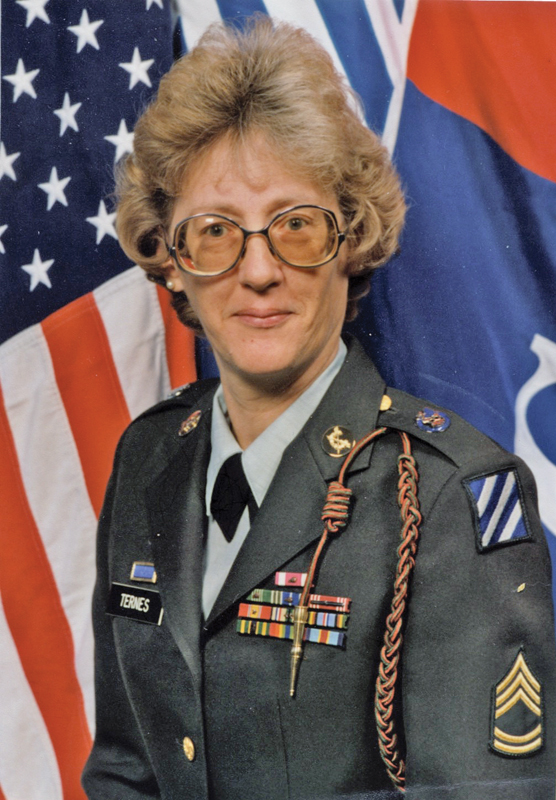
Diane Ternes
By LeAnn R. Ralph
COLFAX — Diane Ternes lives in Knapp, with her husband, Lee Ternes.
Diane is the daughter of the late Chuck (Charles) and Elda Marvin.
Longtime residents of the area may remember the marvelous Christmas (and other holiday light) displays at the Marvins’ home just west of the Hay River/Tainter Lake bridge on county Highway D.
Diane grew up in a family with eight children. She was the oldest, with four younger sisters and three younger brothers.
Diane is a member at Norton Lutheran Church west of Colfax. Chuck and Elda were members at Norton as well.
The Marvin family started out in Marshfield, then moved to Milwaukee when Chuck was in school where he attended the Milwaukee School of Engineering and graduated with an associate degree and a First Class license in radio broadcasting.
Eventually, the Marvin family ended up in Neillsville.
“Dad took over the radio station there. He helped build it from scratch. It was an AM station first. WCCN with Howie Sturtz. We stayed there until I graduated from high school and everyone else graduated from high school, except the last two boys, and they graduated from Boyceville,” Diane said.
Howie Sturtz was known for his five-man orchestra that played at ballrooms all across Wisconsin and in Minnesota. Sturtz also later owned WCCN’s FM station, broadcasting 100,000 watts, which was the maximum allowed by the Federal Communications Commission.
“Dad worked for the TV/radio station outside of Wheeler. He was an engineer at Stout for the radio station there. He worked for WEAU TV when they first came up here. He was back and forth and back and forth. Mom got sick of the back and forth. So we moved them out by Tainter Lake,” Diane said.
Chuck Marvin was the Chief Engineer at WHWC, the PBS station near Wheeler.
“We moved up here in 1980 when I left for Germany the first time. We moved them in June. I was on vacation for 30 days when we started, then I left for Germany, and they finished moving,” Diane said.
JAG
Diane Ternes served in the United States Army from 1973 until 1995. She started her Army career in Korea and became a legal clerk for the 38th Air Defense Artillery Brigade.
She was the chief legal clerk for the 11th Air Defense Signal Battalion in Darmstadt, Germany, and was a non-commissioned officer in charge of claims.
Diane was then assigned to the U.S. Army Claims Service of the Judge Advocate General in Fort Meade, Maryland, from 1983 to 1988.
She then transferred to Germany as a brigade legal non-commissioned officer and served in Operation Desert Storm for six months.
Ternes returned to the United States in 1991 and was stationed at the Criminal Law Division in Fort Knox, Kentucky, as part of the U.S. Army Judge Advocate General’s Corps until she retired in 1995 as a Sergeant First Class.
Chuck Marvin also served in the military. He enlisted in the United States Army Air Force and served January of 1944 until May of 1946. He received electronics and radar training in the military.
Christmas Wonderland
Anyone who had the opportunity to see Chuck and Elda Marvin’s displays of Christmas lights knows that the display occupied the entire front yard.
“Dad loved decorating,” Diane said with a laugh. “Both of them did, actually.”
“We tried carrying on that tradition for several years [after Chuck Marvin died], but it got harder and harder,” she said.
Chuck passed away in March of 2005.
“He turned on (the Christmas lights) December 4, and then it didn’t go off until February 6,” Diane said.
“He did other holidays, too. Thanksgiving. Halloween. Easter. He had a good time doing it. He designed most of it. For the carousel, he had it drawn up and the directions. The rope that went around so you could measure everything. Where to put it in the yard,” she recalled.
“He was pretty upset when he couldn’t do it anymore. He’d stand in the window and look outside. He’d say, ‘I don’t like being in the house,’” Diane said.
Large families
Diane is accustomed to holidays with large families. In addition to the Marvin family with eight siblings, her mother grew up in a large family, too.
“Mom came from a family of nine kids. Dad was only one of three. Two sisters and him. The cousins are all over. From Texas to up here to Alaska and Arizona. We’re spread around,” Diane said.
When Diane’s mom and dad were still alive, they would have Christmas gatherings at the house on Highway D.
“Sometimes we had 63 people in the house. And that was just the immediate family. Daughters-in-law and sons-in-law and their kids and grandkids,” she said.
Chuck would have been 99 years old this year. Elda lived to be 96.
Elda Marvin passed away in July of 2023.
Chuck and Elda also had two great-great-grandchildren, and Elda was able to see the two great-greats, Diane noted.
Christmas far away
While Diane was in the military, her first Christmas away from home was in Korea.
Christmas in Korea was not particularly memorable.
“Korea, [Christmas was] not so much. In Germany, it was all Christmas. Christmas Kringle. Christmas marts. Christmas festivals. Nutcrackers. Shops. Every weekend. And all week long. But especially the weekends. Beautiful lights. Whole towns lit up. Lights everywhere. The weather is just the same as it is here in Wisconsin with a lot of snow,” Diane said.
“The Kris Kringle marts in Germany were really fun. There was a nutcracker that was 22 feet tall. It goes up the middle of the building, so you can walk up the stairs on the platforms and balconies to look at it,” she said.
“I was in Germany twice. And I was stationed here at Fort Stewart, Georgia. Fort Benjamin Harrison in Indiana. Fort Meade, Maryland. I was usually most places for five years because of the position I had in the JAG office. I was mostly at the division level and battalion level. I didn’t have to change every couple of years. I could stay in one place,” Diane said.
“I met Lee in Germany the first time I was there. He was in the same unit I was in. We lived in the same barracks. Males on one floor. Females on another,” she said.
Tabasco
While Christmas in Germany was beautiful, “the Gulf War was a different story. I left for there two weeks before Christmas in 1990. We had Christmas. We had a little, tiny, miniature Christmas tree we decorated. Somebody sent it to us,” Diane said.
“In our Meals-Ready-to-Eat, our MREs, we got one-and-half-inch bottles of Tabasco sauce to put on our food. And a little two-packet of Chiclets. And that’s what we used to decorate our tree. Little Tabasco bottles and little Chiclets,” she said.
“We had a good time with that. Little lights on it. Somebody found some lights. Whatever we could find. Little trinkets. But the Tabasco bottles and the Chiclets were the main part,” Diane said.
“We decorated outside, too. We found a horny toad, wandering around out in the desert. We picked him up and brought him home. We put him in a little fenced in area, and we’d feed him bugs. We even decorated his little sanctuary. We had a good time,” she said.
While Diane and her colleagues in the military made the most they could out of Christmas, other experiences were not so great.
“The only bad thing was, with the food, when the women went through the line, the men would not serve us. They backed away from the table, and they said, ‘Take your own.’ But when the guys came through, they all got served,” Diane said.
Women were not allowed to be behind the wheel, either, and they were not allowed in the front of a bus.
“We were not supposed to drive vehicles. We had to keep our sleeves down and our arms covered. Taking the bus, we had to stay in a section closed off for women only. It was their women and us. The women had to sit in the back,” Diane said.
“They wouldn’t move the bus if you weren’t back there. They’d get off, the drivers even, if you were sitting up front. It was a very interesting tour. Six months. In March, it started getting hot over there, but then it was time for me to leave,” she said.
“I enjoyed most of my tours. There were places I didn’t enjoy being, of course. I enjoyed Korea, too. I was there for 18 months. Most people stayed for one year. I extended my tour, just to see something different,” Diane said.
Unfortunate tree
Since Diane was the oldest child in the family when she was growing up, she had certain Christmas duties.
“They were all younger than me, so I was in charge of giving out gifts,” Diane said.
“One year, we’d gotten a Christmas tree. We went to pick it up, and on the way back, the Christmas tree blew off the car. Somebody behind us sheared it from the top to the bottom. We went back to get it, hoping it had (fallen) on the side of the road,” she said.
But no.
Of course the tree had not fallen safely on the side of the road.
“Then we had to try to get another Christmas tree. This was in Neillsville. The only one we could find was at the liquor store. It was outside, covered in snow and ice. They said, ‘Take it, it’s yours.’ We brought it home and stuck it in the living room, in the tree stand,” Diane said.
“We’re waiting for it to thaw before we decorated it. All of a sudden, you could hear, ‘plop, plop, plop.’ It was the snow dropping on the sheet underneath it. The kids [younger siblings] said, ‘What is that noise?’ I said, ‘It’s Santa! He’s outside the window. The reindeer are on the roof.’ They went flying upstairs,” she said.
Diane’s brothers and sisters knew, after all, that if they saw Santa Claus, he would not leave them any gifts.
“We fell asleep on the couch, waiting for the tree to thaw. The kids came downstairs about 6 o’clock. ‘Santa was here, and there’s no presents under the tree!’ they said. Mom had hidden them in her bedroom upstairs. Some had even been put out at the radio station transmitter. We had to drive out there and get them,” Diane said.
“The kids ran back upstairs again and fell asleep. We were running around, getting the tree decorated, and Mom is handing me stuff. She was behind me, and I’m throwing stuff under the tree, so the kids wouldn’t see us doing it. They thought Santa had already been there, and they were not getting anything because they were still awake,” she said.
Memorable toys
“One year — you know those rocking clowns, you’d punch it, and it would rock back and forth— my brother got one of those from Grandma, Dad’s mother,” Diane recalled.
“He came downstairs and almost ran into it when we were trying to blow it up. He didn’t see it, luckily. We were standing in front of it,” she said.
“Mom’s Dad used to carve us wooden pull toys. Wheels on ‘em and everything. Pull ‘em around the yard. We had ducks and rabbits and a dog. We could pull them around with all wooden wheels. We’ve got pictures of them with us kids, sitting in front of us. The three girls. There were three of us then,” Diane said.”
“He made me a cradle for my first doll and put a button on the end of it. He always put a button on the girls’ cradles. I never understood why. Nobody could tell me why. There was aways a baby button on the cradle. I still have that cradle,” she said.
When she was growing up, the Marvin family visited other family members at Christmas, too.
“We didn’t get a lot of presents because there were so many of us. Mom was working full-time at that point and so was Dad. Every year was different. Every year was interesting,” she said.
Taffy
One Christmas tradition for the Marvin family was making homemade saltwater taffy.
“That was the best thing we did. Everybody had blistered hands. We used butter on our hands. We didn’t know you weren’t supposed to use butter. We’d pull taffy with buttered hands, and we’d get blisters. I still love to do it,” Diane said.
“We’d roll it in powered sugar after it was cut. Dad wanted to buy the saltwater taffy machine from the fair, but they sold it to someone else. So we made it by hand. We did it in one night,” she said.
“We never put the tree up until Christmas Eve. That was our tradition. We never had any special meals. But we did do some cookies. Spritz. Haystacks. I call them haystacks. Chow mein noodles with chocolate. Not the coconut,” Diane said.
“My mom’s sister made toffee all the time, and we learned how to do it, too. That was her pride and joy. She’d had polio. She used to make it all the time. She would drive to work at the insurance company,” she said.
“There was not a lot of money to go around, but we had a good time. Puzzles. We spent a lot of time with those. The one next to me is 18 months younger. Then there are three that are a year apart. 1956, ’57 and ’58,” Diane said.
“There are four cousins on my dad’s side. Then us. We’re the biggest family. He wanted a boy. He waited five girls first. Then he got his first boy. Then he said he wanted another girl. I said, ‘You waited all this time for a boy, and now you want another girl?’”she said.
With eight children in the family and a mother who worked full-time, you can’t help but think Elda and Chuck must have been incredibly organized.
“We all had our jobs to do. If you didn’t do your job, you didn’t get that quarter to go to the movie house. No allowance. Dishes. Especially the oldest ones. I played in band in school. Pep band. Football games. All kinds of other things. Concerts to prepare for. And the choir. We were in choir in church all of the time. All of us were,” Diane said, adding that her dad played the saxophone when he was younger.
“There were not that many musicians in his family, but we must have gotten the musical talent from somewhere. He played in the city band. It was like the Ludington Guard band. He was doing plays at the city theater, too,” she said.
“There were four of us in band and choir. And four of us went into the military,” Diane said.
Diane said she served in the military the longest, although one of her brothers was on active duty for six years and then served in the Navy Reserves.