
GC school district residents disgusted with Board of Education regarding handling of fraud allegations
PROTECTED CONTENT
If you’re a current subscriber, log in below. If you would like to subscribe, please click the subscribe tab above.
Username and Password Help
Please enter your email and we will send you a password reset link.



GLENWOOD CITY School District resident Amy Dopkins addressed the school board during the open forum held Wednesday, September 25 in the school commons as part of the presentation by Intellex Forensics on the alleged fraud perpetrated by former superintendent Tim Johnson. Dopkins, along with Nicole Miller, originally brought concerns of Tim Johnson’s compensation to the board nearly two years ago. Dopkins told the board that those concerns were repeatedly ignored by the district’s governing body and that she, Miller, and their families were ridiculed and their livelihoods threatened. —photo by Shawn DeWitt
By LeAnn R. Ralph
GLENWOOD CITY — Glenwood City school district residents who spoke during the public comments portion of a two-hour meeting to present forensic audit results regarding alleged fraud by the former superintendent expressed disappointment in the actions of the school board.
All together, about 100 people attended the meeting held with the Glenwood City Board of Education and representatives of Intellex Forensics on September 25.
About 30 people attended the meeting by listening on-line to the live feed while another 70 were present in person at the Glenwood City High School commons.
The forensic audit reviewed salary, bonuses, performance stipends and reimbursements to former superintendent Tim Johnson from 2013 to 2023, said Dan Pruett of Intellex Forensics.
The audit revealed $125,000 in stipends and $75,515 in reimbursements for classes that Johnson said he had taken at Viterbo University in LaCrosse that were never actually completed, he said.
All together, there were 41 classes that Johnson submitted to the school district for reimbursement that were not on the official transcript from Viterbo, Pruett said.
In addition, Johnson received $52,000 in payments for alternate benefits intended to pay for insurance benefits he never received but that were not included in any of his employment contracts, Pruett said.
Johnson also paid himself $38,460 for duties as the special education director in the Glenwood City school district, although Johnson was not issued, and never held, a special education administrator’s license from the Wisconsin Department of Public Instruction, he said.
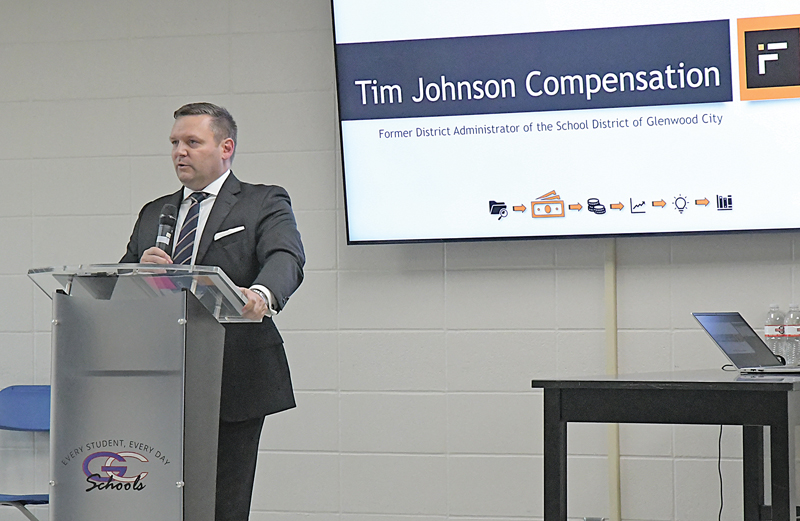
JAXON HUGHES of the audit firm Intellex Forensics explains the results of the forensic audit done for the Glenwood City school district at a special school board work session held last week. About a hundred district residents attended the meeting and asked questions of the school board about the lost of school funds. —photo by Shawn DeWitt
Ron Johnson, the Glenwood City school district’s accountant, also received payments of $17,500 for performance stipends that were not included in his contracts, Pruett said.
During the public comments given toward the end of the meeting, several school district residents defended Ron Johnson and said he was only doing what was he was told by Tim Johnson, while other residents said that Ron Johnson, as the school district accountant, should have known about generally accepted accounting principles.
The audit report also revealed a mismanagement of school district funds by transferring $349,680 to Packerland Brokerage Services, Pruett said.
School district money invested by Packerland did not comply with state statutes regarding permissible stocks and mutual funds for school districts, he said.
Questions
Following the presentation from Intellex, members of the Board of Education were allowed to ask questions.
One question focused on the Health Reimbursement Account (HRA).
An HRA is defined as an employer-funded health plan that reimburses employees for qualified medical expenses.
Tim Johnson notified school district employees that the HRA was going to be cancelled and then issued a payment to himself, Pruett said.
That is not how an HRA works. Employees do not contribute money to the HRA and only receive reimbursements for medical expenses, he said.
According to the forensic audit report, in June of 2015, Tim Johnson issued a memorandum to employees participating in the school district’s Health Reimbursement Account Plan (HRA) notifying employees that the plan was being terminated effective July 1, 2015.
Tim Johnson issued a memorandum to himself on June 15, 2015, stating he was eligible for a one-time Performance Stipend as result of his assignment as the Special Education Director/Public Services Director, and on July 6, he submitted an expense voucher in the amount of $44,020 for a performance stipend.
On August 4, 2015, Tim Johnson included a handwritten note explaining that the “performance pay” was to “clear out” the funds in his HRA account that had accumulated over the last five to seven years.
Documentation
Another question from the Board of Education focused on Skyward and documentation for the reimbursements Tim Johnson received.
Skyward is an enterprise software package for K-12 school districts and municipalities.
The documentation in Skyward was not accurate, Pruett said.
Were any other staff members paid for the discontinued HRA? asked another board member.
All staff members were reimbursed properly. Money in the cash fund was folded into the 403(b) accounts for school district staff, except for Tim Johnson, who wrote out a check to himself, said Patrick Olson, Glenwood City school district administrator.
Regarding the over payment of performance stipends for Ron Johnson, multiple signed contracts, each with different language, were discovered, Olson said.
Over payment to Ron Johnson came from those contracts, he said.
Other documents were also discovered that were not documented in Skyward regarding insurance and insurance benefits, Olson said.
The reimbursements in lieu of insurance benefits did not match the school district’s policy, he said.
“Alternative benefits” were paid to Tim Johnson in lieu of insurance benefits he supposedly no longer received, Olson said.
Performance stipends
Ron Johnson received extra performance stipends. Were the contracts changed? asked one school board member.
In the personnel files, there were multiple signed contracts, and it was impossible to tell which contract was the accurate contract for the particular period in question, Olson said.
Was the initial contract wrong and then changed? It was hard say what happened since all of the versions of the contracts were signed by Tim Johnson and Ron Johnson and the Glenwood City school board, Olson said.
Tim Johnson had written memorandums on Ron Johnson’s stipends and bonuses, said another school board member.
They were one-line items in the regular contracts. The performance stipends were buried in the contract. There was no criteria for paying the stipends and bonuses, and no corresponding information, Olson said.
The stipends were always different. Some were paid quarterly, but some were paid in a lump sum, he said.
When you see some of the differences, then you start to question those differences, Olson said.
The Glenwood City Board of Education approved $10,000 for staff performance stipends, he said.
“I do not believe in performance stipends,” Olson said.
Paying performance stipends puts administrators in an uncomfortable position. All staff members work very hard, and paying performance stipends comes down to a matter of “picking and choosing” among staff, he said.
There were handwritten notes and a few typed notes about who Tim Johnson thought should receive performance stipends, Olson said, noting that the practice of paying performance stipends was discontinued last year.
There was no system process for issuing the stipends. No reasoning was used for issuing the stipends, Olson said.
There were many inconsistencies regarding contracts and stipends, and “we are still finding inconsistencies,” he said.
403(b)
On almost every submission for the 403(b) benefits there were manual changes of the amounts deducted from the checks, Pruett told the Board of Education.
According to the audit report, during the review of the 403(b) contributions, Intellex “observed extensive manual adjustments to monthly contribution ledgers. Any review of these manual entries was not in the scope of this engagement; however, we recommend a comprehensive analysis be performed of the 403(b) plan and related contributions. Our review, however, did not reveal that payment for these components exceeded contractual amounts.”
There was no reason for the tremendous number of manual over-rides in the system. Some of those changes were not reflected on the pay stubs, although most were, Pruett said.
One school board member asked who had made the manual changes in the Skyward system.
When Intellex asked who was in charge of the benefits payments, the answer was Ron Johnson, Pruett said.
There are two versions of Skyward. One is a desktop version of the accounting system, and one is a web-based log-in version that is available on one computer, and that assumes Tim Johnson had access, Olson said.
Beginning or end?
Were the manual changes for the 403(b) contributions done throughout the year or at the beginning and the end of the school year? asked another school board member.
An analysis conducted of the changes revealed that the changes were intermittent throughout the school year, Pruett said.
Changes in deductions for retirement requested by employees would not be unusual, noted one school board member.
There is room on the forms for one or two changes per year, which would be typical, but these changes were made throughout the entire school year, Pruett said.
The changes seemed as if the person making the changes was trying to figure out the right amount, he said.
There was no paper trail in the records for changes, and no notations, said Eric Stevens of Intellex Forensics.
When employees want to make a change on 401(k) deductions, they go Human Resources and submit a form for changes, and Human Resources signs the form indicating the changes have been received, he said.
21st Century
Another odd aspect of the situation was the amount of information that was handwritten, Pruett said.
This is the 21st Century, and everything is accounted for in the Skyward system and not by handwritten notes, he said.
The appropriate processes were not followed, Pruett said.
Did the 403(b) contributions and Skyward match? asked one school board member.
The audit referenced pay stubs compared to what was in the contract and what was supposed to be paid, Pruett said.
Were any other employees affected by the changes made? asked another school board member.
The lack of records made it impossible to know if other employees were impacted, Pruett said.
If someone was affected, there was a lack of proper documentation, Olson said.
Some of the employees could be identified from the handwritten notes but others could not, he said.
Transcripts
One school board member asked about the transcripts and reimbursements for classes at Viterbo.
A form was submitted for reimbursement with a list of classes, but none of those classes appeared on the transcripts from Viterbo, Pruett said.
So the conclusion was that the forms were false? asked another school board member.
“Yes,” Pruett replied.
How would Intellex classify the fraud for an organization of this size? asked one school board member.
Stevens noted that Intellex conducts forensic audits for a range of clients, from very large corporations down to private individuals.
“It was so straight forward how blatant the fraud was,” Stevens said.
The fraud was “enormous” for a school district of this size from one person. The fiduciary relationship between Ron Johnson and Tim Johnson was “crossing the lines,” he said.
Could it have been figured out without documentation from Viterbo? Would the transcripts have made it easier? asked another school board member.
When the information is examined regarding who made and received the payment, both sides have to match, Pruett said.
Tim Johnson was claiming reimbursement for classes taken at Viterbo, but there were no transcripts from Viterbo, he said.
Legal?
Can a school board legally require transcripts? asked another school board member.
During the course of inquiries by district residents who had suspected several years ago that Tim Johnson had received reimbursement for classes he had never taken, and who had asked Tim Johnson to authorize release of his transcripts, Johnson had adamantly refused to authorize the release.
The usual policy of school districts is if district employees want reimbursement for classes taken, then the employees must provide the transcripts, Olson said, noting that there are differences in whether the transcripts required are official or unofficial transcripts from the educational institution.
Requiring a transcript for reimbursement is a sound practice, he said.
In this case, there were no transcripts and there were invoices that were falsified, Olson said.
How could this have been avoided? asked another board member.
Pruett noted that the questions he had asked regarding the invoices Tim Johnson submitted for reimbursement for classes taken at Viterbo could not be answered by Ron Johnson.
Since Ron Johnson was the school district’s accountant, it would be standard practice for one person to submit invoices and another person to pay those invoices, not for the person submitting the invoice to pay himself.
The forensic audit noted that there were a number of times when Tim Johnson authorized a payment to himself and then signed the check he had written out to himself.
“It was pretty blatant that it was false,” Pruett said.
The question is — what does an official invoice for payment for classes from Viterbo look like and what does a transcript from Viterbo look like? he said.
Checks and balances
One board member asked about checks and balances.
A good policy to adopt would involve a school board member reviewing the stack of payments against the stack of invoices before the regular school board meeting starts, Olson said.
The school board member can then asked the accountant to see the transaction paperwork for any transactions for which the school board member has questions, he said.
Two signatures on transactions would be good, but three would be better, Olson said.
Precautions are best practice, he said.
Did the school district’s regular audit firm indicate that the auditor did not see enough signatures? asked one school board member.
There are 426 school districts in the state. Bauman Associates and Clifton Larson Allen are two auditing firms that both have different perspectives. Auditors will remark on certain things they find in the audit, but to get to this level requires a forensic audit, Olson said.
A forensic audit is an audit “on steroids,” Stevens said.
A regular audit is not designed to detect fraud but rather to make sure that all of the money coming and going out is accounted for.
Tim Johnson’s efforts to manipulate the transcripts “was very poor.” The letterhead that was supposed to be from Viterbo did not match. The font did not match. A regular audit looks at the sources and uses of funds, Stevens said.
Super sleuths
School board members are not “super sleuths.” Would this have been obvious to a lay person? asked one school board member.
“You should be able to trust someone in that position,” Stevens said, adding that he commended the person who had first noticed the discrepancies.
“It was obvious to us,” he said.
Olson gave Intellex the information that was needed. A regular school board member would not have seen or looked for that type of information, Stevens said.
Glenwood City school district resident Amy Dopkins had first noticed the discrepancies. Dopkins and school board member Nicole Miller had attempted, over a several year period, to convince the Glenwood City Board of Education to take a closer look at the discrepancies, but the school board refused to take them seriously.
Risk mitigation
The Glenwood City school board should adopt policies going forward for risk mitigation, Stevens said.
The school board should require the license number and the license certificate for the special education director, he said.
The Glenwood City school district did not have a special education director for two years as is required by law.
The fraud poses a tremendous risk to the school district’s special education program. This was not just malfeasance, but the fraud will have long-lasting repercussions on the school district’s special education funding, Stevens said.
Q&A
The public comments portion of the meeting will not allow any back and forth questions and answers between the public and the Board of Education, Olson told the audience.
The reason “back and forth” was not allowed is due to the state’s Open Meetings law and recommendations from the Wisconsin Attorney General for governing boards to listen to comments but to not participate in a discussion with the public during comments.
There are “many high emotions and rightly so,” Olson said.
The public has had a number of questions about the forensic audit, and Olson said he would put together a “Question and Answer” document of the most frequently asked questions including additional questions asked at the September 25 meeting.
There is one major goal, and that is “to build your trust through transparency,” Olson said, adding that it is important for the public to have the opportunity to ask questions.
Members of the Glenwood City Board of Education know they have not been doing a good job with policy, so the school board decided to contract with a company called Neola, he said.
Many school districts in the area contract with Neola for school district policies. The company sends out policy updates that include changes in state statutes and new policies in areas not previously covered, such as the use of social media by students and school district employees.
School board members in Colfax and Elk Mound, for example, have stated that without Neola’s services, they would spend hundreds of hours every year trying to keep up with the work of updating policies.
Comments
The first speaker during public comments was Derrick Oberle, who had a number of questions, such as were there any red flags apparent to the school board, were there patterns of neglect, what about internal controls, best practices, fiduciary responsibility and conflicts of interest? Did the Glenwood City Board of Education raise any questions before the audit?
Barb Standaert noted that the Intellex auditors had said it would be difficult for the school board to notice the fraud and yet members of the community had pointed out the discrepancies several times.
The school board should have looked more closely at the information brought to them by members of the community, she said.
“It angers me” that there were not more processes and procedures for the administration to follow. Why was this not looked into more closely? Standaert asked.
Forewarned
The forensic audit cost the school district $21,000 to tell the school board some of the same information “that Nicole and I asked about,” said Amy Dopkins.
Instead, Dopkins said, she and Miller were “laughed at” by the school board, and the information was thrown in the garbage.
Negative talk was spread around the community. “They trashed us,” Dopkins said, noting that Tim Johnson had threatened to file a lawsuit for defamation when she and Miller had questioned the reimbursements.
Lisa Kaiser [president of the Board of Education] “said we were losers,” Dopkins said.
If something does not look right, people should ask questions, she said, adding that she had asked for transcripts, but the school board refused to require transcripts.
All of the current school board members, except Tony Mielzarek, had a part in refusing to pay attention to the discrepancies, Dopkins said.
Mielzarek was appointed to the Board of Education this year.
One school board member, after Deputy Kaitie Leising had been murdered just outside of Glenwood City, said that Deputy Leising’s killer “had no integrity,” and that the people asking questions about the reimbursements to Tim Johnson had the same integrity as Deputy Leising’s killer, Dopkins said.
Dopkins said she was tired of the stigma she was facing in the community and tired of having her livelihood threatened.
“You did nothing. You should resign,” Dopkins said.
The audience at the meeting applauded Dopkins’ comments.
Investments
Mark Wink referenced the school district funds invested by Packerland Brokerage.
The school board approved moving funds from a low interest account to a high interest investments. The school board did not act fraudulently, and Ron Johnson did not act fraudulently and was only doing what the school board asked him to do, he said, describing the findings of fraud against Ron Johnson as “character assassination.”
Ron Johnson followed directions, but Tim Johnson conducted the fraud, Wink said.
Linda Main said she found all the finger-pointing to be “disheartening.”
The situation is having an impact on the children in the school district, she said, noteing that she has a child in special education.
You trust the people in charge, and they do not have a degree in forensic analysis, Main said.
“I wish people could stop pointing fingers,” she said.
The Intellex auditors said that the fraud could affect future special education fundings, and that will affect my child, Main said.
Kevin Fry echoed some of Main’s comments
Ron Johnson sacrificed his career. He went to school here. Tim Johnson is the problem. Ron Johnson was treated wrongly, Fry said.
Betrayed
Tammy Erickson said she had grown up in the community, and the situation has placed a “cloud” over the community, adding that she had trusted that the best interests of the community had been taken care of.
“I feel betrayed,” she said.
Children are asking why is this happening, and the answer is “I don’t know,” Erickson said.
Erickson said she had worked in the school building for 27 years and that the school board members needed to be better listeners and fact checkers rather than sweeping the situation “under the rug.”
The Board of Education should apologize. The bullying, intimidating and nastiness “needs to be apologized for,” Erickson said.
Terri Ross said no one should care that Packerland Brokerage invested the school district’s money because the money “was safe.”
Did the auditors talk to Ron Johnson? Ross asked.
Ron Johnson has never been talked to about the audit. Tim Johnson is the culprit, she said.
Benefits
Matthew Schutz noted that Tim Johnson was responsible for taking $300,000 from the school district.
In 2011, when Governor Scott Walker signed Act 10 into law, teachers and support staff lost benefits, he noted.
What does an administrator’s contract look like? Schutz asked.
“We lost a lot. They kept theirs,” he said.
Ralph Steger said the school district needs more transparency and mentioned Patrick Gretzlock, the former high school/middle school principal.
The “key” is to have transparency and answers to questions, he said.
“To help the community to heal, we need transparency,” Steger said.
Lisa Multhauf said she had moved to Downing in 2017 because “everything said” it was “a great community.”
But the community had a thief and a school board that swept it under the rug, she said.
“Many people do not trust you,” Multhauf said, adding that the school board had been told “multiple times” that there were discrepancies with reimbursements, and the school board responded that “everything is fine; it’s great.”
Ron Johnson, as an accountant, should know that he must double and triple check his work, she said.
On Day 1 in accounting school, it is stressed repeatedly that there should be multiple checks and balances, and yet there were no questions about Tim Johnson’s discrepancies, Multhauf said.
People make mistakes, and it is time for the school board to step down and let other people take over the job and “do good” for the Glenwood City school district, she said.
Olson
Cindi Krafve said she agreed with all of the previous comments.
Mr. Olson has been put through one and a half years of a “horrible workload,” she said.
Tim Johnson had a poor opinion of Patrick Olson, Krafve noted.
Krafve said she had written a letter to the editor about Tim Johnson’s salary and had gone to the DPI to check on his salary.
“He did not like that,” she said, adding that she had been glad to see Tim Johnson leave the school district and had been glad to see Patrick Olson had been hired.
Olson should be recognized for his efforts and appreciated and thanked, Krafve said.
The audience attending the meeting applauded Krafve’s comments.
Justice
Larry Nielsen asked if there had been any action taken by the authorities to bring Tim Johnson to justice.
Is there anything residents of the school district can do to put pressure on the district attorney? Nielsen asked, adding, “this should be clear cut.”
David Plank said he believed “the local swamp should be drained” and that the Glenwood City school board should resign.
Patrick Olson needs help — “please resign and let someone else take over,” Plank said.
Nathan Hoffman noted that it is the school board’s job to hold the superintendent accountable, and yet, when Tim Johnson was superintendent, Johnson would speak for the school board.
Hoffman said he commended the school board for hiring Patrick Olson.
The Glenwood City school district used to be a place where people wanted to be, Hoffman said.
Lisa Kaiser “you should flip over your name tag and leave. As board president, it is your responsibility to be a leader,” he said.
Someone must be held accountable, Hoffman said.
Board statement
Kaiser read a statement from the Board of Education.
The situation was challenging for board members to deal with, she said.
The forensic audit was necessary to understand the situation, and it was necessary to share it with the community, Kaiser said, noting that the school board was disheartened by the results.
The school board wants to apologize to the community. There are processes and procedures, new checks and balances and new polices for the Glenwood City school board, she said.
Kaiser said she “looks forward to working with the community to earn back trust.”
Earning trust takes a long time, and it only takes one incident to ruin that trust, she said.
Criminal proceedings
Olson told the audience that he would answer one question, and that it was a question he had been receiving frequently
Regarding the criminal aspect of the situation, many agencies were involved, including the Wisconsin Retirement System, the Federal Bureau of Investigation and the Wisconsin Department of Justice, he said.
A St. Croix County assistant district attorney had been tasked with charging the case, but the assistant district attorney resigned, Olson said.
The case was referred to the DOJ, but the department declined the case, he said.
The St. Croix County district attorney has said he is working diligently on the case and will have a charging decision soon, Olson said.
If people have more questions, they should be sure to ask them, he said.
The goal is transparency, and the school district is here “for the kids,” Olson said.
Glenwood City is “a great community” and the community “needs to come together,” he said.
Glenwood City focuses on Every Student Every Day,” and “we need your help,” Olson said.
People should ask questions, and they should come to the school board meetings and ask questions, he said.
The community must move forward and heal, Olson said.
People should contact the Board of Education with questions and should contact the administrators, Kaiser said.
“We are happy to answer questions,” she said.


