
Boyceville Cucumber Festival grand marshals: Boyceville Community Ambulance Association
PROTECTED CONTENT
If you’re a current subscriber, log in below. If you would like to subscribe, please click the subscribe tab above.
Username and Password Help
Please enter your email and we will send you a password reset link.


THE BOYCEVILLE Community Ambulance Service, which is celebrating 50 years of service to Boyceville and surrounding communities this year, has been selected to serve as the grand marshal for the annual Cucumber Festival which will be held this Friday through Sunday, August 16-18. The current crew of Emergency Medical Technicians (EMTs), pictured above, will lead the grand parade this Sunday. Front row (L to R): Finley O’Dell, Madison Azevado, Makiah Cleland and Jasmine Peterson. Back row (L to R): Rachael Montgomery, Andrea Jensen, Charles Wold, Desirae Laursen, Wayne Dow and Paul Hedlund. —photo by Shawn DeWitt
by LeAnn R. Ralph
BOYCEVILLE — In honor of the 50th anniversary of the Boyceville ambulance service, members of the Boyceville Community Ambulance Service Association are the grand marshals for the Boyceville Cucumber Festival’s grand parade.
“I would love to see some of our old EMTs come back to participate (in the parade) but I do not have a complete list,” said Wayne Dow, director of the Boyceville ambulance service.
“I did ask a couple of our older former members if they wanted to be part of the parade, and they said, ‘no, thanks, that’s okay,’ which is typical of EMTs, too,” he said.
People do not serve as EMTs for the glory — they serve to help their community.
“We have always been there to help our people. In my case I am starting to see the grandchildren of people I have treated,” Dow said.
In a rural small-town area, you tend to know a lot of the people, he said.
“We have all taken care of our family members and our neighbors,” Dow said.
“We are honored to be grand marshals. We are here for the community. Always have been. That’s why I have always been happy we have kept ‘community’ in the name of the service,” he said.
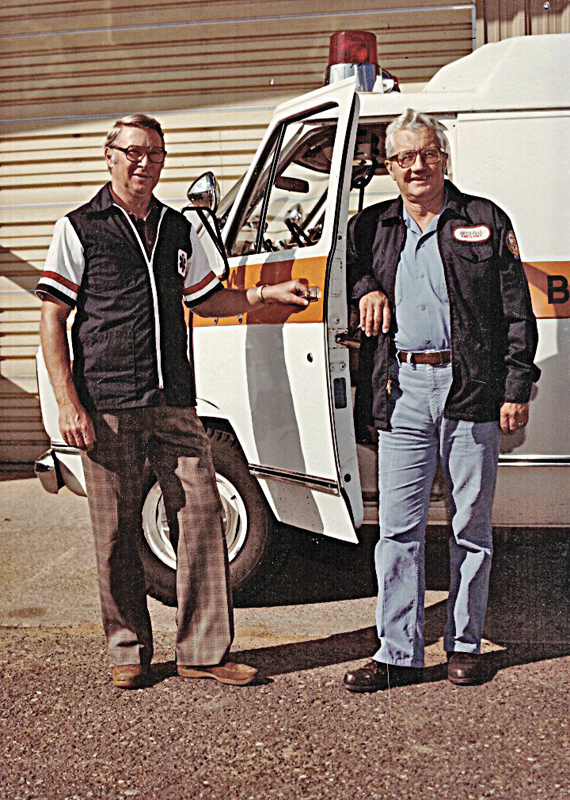
BOYCEVILLE’S FIRST TWO EMTS — Charles Bartlett (left) and Herb Dow were the first two certified Emergency Medical Technicians (EMTs) in Boyceville. This photograph is on display at the Boyceville ambulance station on Race Street. The Boyceville Community Ambulance is celebrating 50 years of service this year and has been selected as the 2024 Boyceville Cucumber Festival’s grand marshal. —photo submitted.
Parades
The early policy of the Boyceville ambulance service was not to participate in parades..
“I know that policy has been broken a few times over the years,” Dow said with a laugh.
The original policy, though, was that Boyceville would not send the ambulance out of town for a parade because Boyceville only had one ambulance at that time. Boyceville has participated in parades in Glenwood City, but the policy now is that someone remains at the ambulance station in Boyceville in case an ambulance is needed, he said.
In researching information for the 50th anniversary of the Boyceville ambulance service, Dow has found a number of documents from the early 1970s.
The first ambulance was purchased for $15,000. The second brand new ambulance, a 1985 model, was purchased for $48,000. The next ambulance was $81,000, Dow said.
Nowadays, new ambulances cost about $350,000.
Among the papers Dow found was the original application with the state of. Wisconsin, the Division of Highway Safety Coordination, application for a highway safety grant in the amount of $17,200 to purchase an ambulance.
The application, dated September 12, 1973, is signed by Herb Dow (Wayne’s father) who was fire chief at the time; Ed Evenson, village president; and Stanley Mickelson, the local highway safety coordinator.
The Problem
The application for a Highway Safety Grant for an ambulance contained a narrative section titled, “The Problem.”
At the time, the problem was that an ambulance had to come from the hospital in Menomonie and go through two stops lights and a two-lane bridge, which delayed response time, Dow said.
According to narrative included with the grant application:
“The community of Boyceville approached the Dunn County Highway Safety Commission expressing concern over the response time of the present ambulance service and requested funds for the establishment of an ambulance service based in their community, the Village of Boyceville. In checking their situation, we find that the response of the present ambulance service, Memorial Hospital ambulance service, Menomonie, Wisconsin, is excessive because of the location of the hospital.
“Memorial Hospital is located in the south east corner of the city, necessitating driving through the entire city, including the business district, through two traffic lights and over the two lane bridge. Response time from the hospital to the north city limits is approximately eight minutes … The proposed area to be covered by the proposed Boyceville ambulance service is quite large and is well removed from Menomonie …
“The attached map also shows areas covered presently by the other ambulance services in the county. Three state highways, STH 64, 79 and 170, are located in this area. STH 79 and 170 intersect in the Village of Boyceville.
“During the period from January 1, 1973, through July 31, 1973, 51 motor vehicle accidents were reported in this area, including 13 involving personal injuries to 19 people and two fatalities. The Boyceville community feels that the need is urgent enough that they will provide the local funds for this proposed service.”
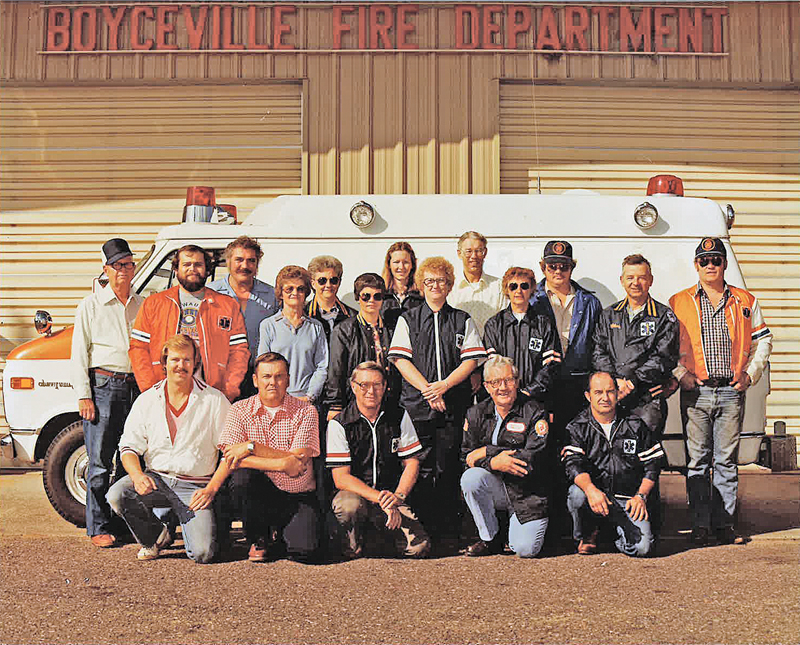
1983 BOYCEVILLE AMBULANCE CREW — Members of the Boycveille Ambulance Service are pictured in this photograph taken in September of 1983. Front row (L to R): Pete Hybben, Duane Kostman, Charles Bartlett, Herb Dow and Maurice Evenson. Middle row (L to R): Bob Marlette, Ardy Labree, Mary Lagerstom, Kendra Kostman, and Marge Bartlett. Back row (L to R): Gale Spielman, Eldie Sutliff, Annabelle Yamriska, Kristy Hetzel, Lyle Hight, Doug Hellendrung, John Yamriska, and Dale Mounce. —photo submitted
Fire phones
The application for funds for an ambulance in 1973 includes five new fire phones, Dow said.
Before all of the technological advances that give us the communication system used today by emergency services, fire departments used fire phones that rang at a number of houses.
John Yamriska had one of the new fire phones. Annabelle Yamriska was key to dispatching ambulance service in those years, Dow said.
The Yamriksas were not part of the fire department. People who were deemed “worthy” of a fire phone were people who were around most of the time and were not afraid to talk on it, he said.
“You have to remember that when people picked up that phone, you had 20 or 25 other people on there with you,” Dow said.
In addition to Charlie Bartlett, Herb Dow and John Yamriska, early EMTs included Clarence Tape, Eldie Sutliff, Jack Harvey, Merle Robinson, Bobbie Marlette, and Morris and Sharon Evenson.
Original rates
Among the papers kept by the ambulance service were the minutes from the March 11, 1974, meeting of the Boyceville Community Ambulance with 21 members present.
The meeting was called to order by Chuck Bartlett.
During the meeting, members decided on what the ambulance service would charge.
For one hour, with two men responding, the charge would be $7.50 for each person for a total of $15.
The second hour and any time after that would be charged at $4 per hour or $8 for two people.
Supplies would cost $5, and if oxygen was needed, the cost would be an extra $5.
The vehicle cost would be 25 cents per mile up to $10.
The basic two-hour charge in the fire and ambulance district area would be $50 for the first 50 miles, and each additional mile would be charged at the rate of 50 cents per mile.
The basic two-hour charge outside of the fire and ambulance area would be $60 for the first 50 miles, and each additional mile would be at the rate of 50 cents per mile.
False alarms would be charged the labor rate for one hour of $15 and a mileage charge of 25 cents per mile that would be charged back to the municipality.
Boyceville received $1,000 from Dunn County in 1974 to help with funding the ambulance service and received $1,500 in 1975, Dow noted.
Dow recalls many of the people who were early transports for the Boyceville ambulance service, although he is puzzled by one listed as Hedlund Manufacturing — no name of anyone at the business, just the business itself.
He also is fascinated by the early expenses of the ambulance service, such as $2.39 spent at the Gambles store in Boyceville.
The service was doing its own billing back then, too, he said.
July 31, 1973
The first minutes from the ambulance committee are dated July 31, 1973.
The meeting was called to order by Gale Spielman, “who was immediately elected chairman of the committee.”
Lyle Hight Jr. was elected as secretary for the committee.
The discussion was on “what to do next.”
“The first step is to contact Stanley Mickelson, the Highway Safety Coordinator. This to make application for funds for the purchase of an ambulance.”
The secretary was then directed to contact Mickelson to set up a meeting for August 8 at the Boyceville fire hall to talk about the application.
August 8, 1973
The August 8 meeting of the ambulance committee included Gale Spielman, representing Boyceville; Rhinhart Wyss, Stanton; Malcolm Goodell, Wheeler; and Herb Lake, Hay River.
Stan Mickelson discussed the funds available and said he would assist in preparing the application for funds by conducting a survey of the traffic accidents in the area.
According to the minutes, “The township of Sherman reported they had 342 persons to be served by this ambulance service, while New Haven had 408 and the Village of Wheeler reported 212. An estimate was taken of the other townships and the Village of Boyceville, and it was decided this service would serve approximately 2900 persons.
“ In order to run an excellent ambulance service, personnel must be trained, and the E.M.S. course is to start at Chippewa Falls in October. Personnel who are enrolling in the course should register as early as possible by contacting Jean M. Schlieve, Area Coordinator.”
As a side note, to show the ripple effects of what can result in positive changes for other communities, Herb Dow had put up a flyer that year at the Boyceville Cucumber festival, looking for people who wanted to attend the E.M.S. course.
Paula DeWitt, co-owner of the Tribune Press Reporter, had always wanted to be a nurse. She had gone to enroll in nursing school after she had graduated from high school and was told she could not attend because she had recently become engaged and it would just be a waste of the school’s time to have her enrolled.
Paula was devastated, of course.
But years later, when Paula saw Herb Dow’s flyer, she jumped at the chance to finally be able to help people in the way she had always wanted to — and became Glenwood City’s very first EMT.
50 years
“We have been helping our community for 50 years now. It’s interesting to see how we have grown. And I have gotten to see almost all of it,” Dow said.
“I see how much the medical aspect has changed, how there is much more medical direction. I could not tell you who our early medical director was. We just went by what the book told us in the 70s and 80s. Then as we got more advanced with defibrillators … (and other medical equipment) we needed more medical direction,” Dow said.
The Boyceville ambulance service’s new medical director, incidentally, is Dr. Chris Kapsner, who lives north of Boyceville.
Readers will recall that Dr. Kapsner ran for representative of the 67th Assembly District in 2020 and for the 23rd Senate District in 2018.
Dr. Kapsner’s speciality is emergency medicine, and he practices at Abbot Northwestern Hospital in Minneapolis.
“He is excited to help us out and help the community. He lives here in the community,” Dow said.
“I am very happy that he is on board,” he said.
Dow’s first ambulance call was in August of 1987, and coincidentally, it was Pickle Fest.
“Medicine has changed. Dispatch has changed. Equipment has changed,” Dow said.
One of the paramedic students serving with the Boyceville ambulance service was starting to learn the 12-lead electrocardiogram (ECG) placements recently that help pinpoint where a heart attack is occurring in the heart.
Dow noted he had told the student they did not have any of that kind of equipment years ago.
“We transmit (the 12-lead) to the hospital. Sometimes the hospital calls for a helicopter to take that person as soon as we get there,” Dow said.
“When I started in Appleton, we had one ambulance that could transmit a 3-lead,” he said.
“I would encourage everyone to learn First Aid and CPR. We are always looking for more people to join the ambulance service, too” Dow said.
The roster is currently up to 22 EMTs, although three of them are inactive, including several students who are attending college in another state, he said.
Some of the Boyceville EMTs are cross-credentialed with the Colfax ambulance service and vice versa, Dow said.
Ambulance services in both rural and urban areas all around the country are experiencing difficulties in finding EMTs, and cross-credentialing with other services has been helpful in managing the shortage, he said.
Boyceville and Colfax cover a substantial portion of Dunn County: four of the seven villages, (Boyceville, Wheeler, Colfax and Elk Mound) and 12 of the 22 townships.
The Boyceville Community Ambulance District includes the Village of Boyceville and the Towns of Hay River, New Haven, Sherman, Sheridan, Stanton and Tiffany.


