
REMEMBRANCES OF CHRISTMASES PAST: Gust Fehr: “We were never bored at Christmastime. There was always something to do.”
PROTECTED CONTENT
If you’re a current subscriber, log in below. If you would like to subscribe, please click the subscribe tab above.
Username and Password Help
Please enter your email and we will send you a password reset link.


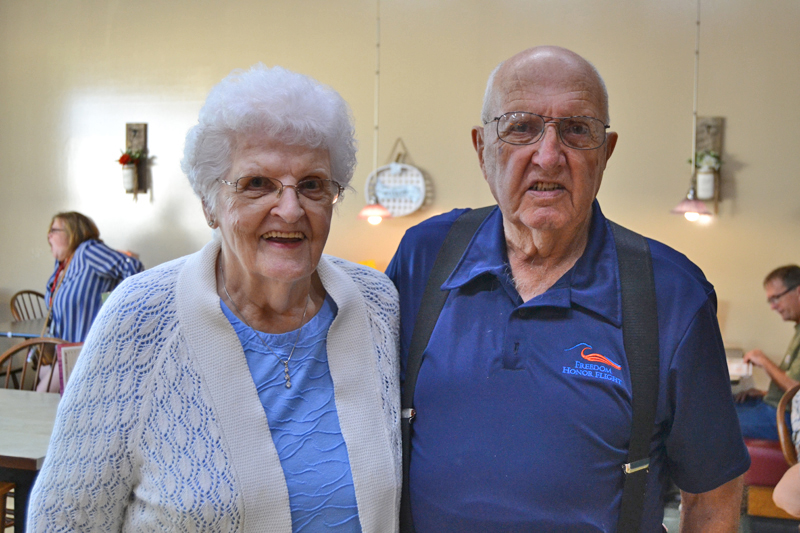
TWINS — Twin brother and sister, Glenice Kressin and Gust Fehr, attended the reunion for their graduating Class of 1949 at Mom’s Restaurant Saturday, September 18, 2021. — Photo by LeAnn R. Ralph
By LeAnn R. Ralph
COLFAX — Colfax resident Gust Fehr grew up in the Towns of Auburn and Cooks Valley north of Colfax in Chippewa County during the years of the Great Depression and World War II.
While the Fehr family may not have had much money, as was true of many families at the time, they always had good food to eat and plenty of fun.
“Our land was split. We had two farms, and some of the land was in each [township],” Gust said.
Gust’s father, unfortunately, lost his entire savings when the bank crashed during the Great Depression.
“That was a disaster. We were hard up, like a lot of people. There was five of us kids. Two sets of twins. A brother that was a twin with a twin sister, and I had a twin sister. So I always told everybody I had two twin sisters,” Gust said with a mischievous smile.
“We always ate pretty good because we lived on the farm. We had to walk to school about two and a half miles,” he said.
“At Christmastime, we never got much for presents. It was hand-me-down stuff. I can remember my two older sisters got a doll for Christmas, and those dolls had hair on their heads. But my little sister got a doll that didn’t have hair on her head, and she was so upset, she threw it across the floor,” Gust said.
“We always got a Christmas present, but it wasn’t very much. Maybe a pair of socks or a pair of gloves. Something to wear generally,” he said.
In those days, people would cut whatever evergreen trees they could find to use for a Christmas tree.
“At Christmas, Dad would go up in the woods and cut a jack pine Christmas tree, like many people did back then. A couple of days before Christmas, we would decorate it. We would take a long thread and string popcorn and put that on the Christmas tree. And we’d always have popcorn balls,” Gust said.
“On the Christmas tree we had nice tinsel and angel hair, too. We had candles, candleholders. We’d get to light the candles on the tree Christmas Eve, but you had to watch it so you didn’t burn the house down,” he said.
“They never had Christmas trees like there is today [sheared and shaped natural trees or artificial trees]. You can’t even hang decorations on them now, the way they are,” he said.
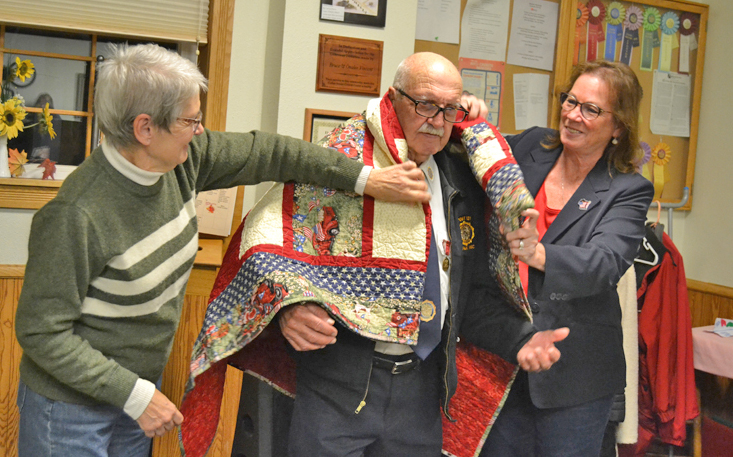
KOREAN CONFLICT — Colfax resident Gust Fehr, a veteran of the Korean Conflict, was the recipient of a Quilt of Valor during a ceremony at the Grapevine Senior Center following the American Legion Auxiliary of Russell-Toycen Post 131 of Colfax’s annual Veterans Day Supper November 11, 2022. On the left is Gust’s daughter, Pam Moen, and on the right is Wisconsin Northwoods Quilts of Valor member Nancy Hainstock. — Photo by LeAnn R. Ralph
Millionaire
Even though Gust’s dad usually cut the Christmas tree and brought it home, there was the time Gust and his cousin cut two Christmas trees, and Gust received an unexpected windfall.
“My uncle had a 40-acre woods, and one year, they let us cut a Christmas tree, my cousin and I. We cut two. I don’t remember why,” he said.
“Dad put them on the car, and when we got to Bloomer, we stopped at the store to get some groceries,” Gust said.
“Walter Scheidecker was there, and he saw those Christmas trees, and he said, ‘I’ll buy one of those trees.’ And Dad said, ‘They belong to Gust.’ [Walter] said to me, ‘I’ll give you six bits.’”
Gust paused.
“Now, I didn’t know how much six bits meant — it was 75 cents. Man, I thought I had a million dollars!” he said.
Family traditions
During the Great Depression and the years of World War II, when no one had any money, or not very much money, new toys were not an expectation.
But Gust and the other children in the family did enjoy going window shopping.
“We got to go to town to look at the toys in the Farmers’ Store. We couldn’t buy one, though,” he said, adding “Now-a-days, kids got more things than Carter’s has pills.”
Getting ready for Christmas also meant baking.
“We always made angel food candy at Christmastime. And we always helped our mother make cookies. We didn’t have to, but if we were there, we could maybe eat some of the dough,” he said.
“All kinds of cookies. All kinds of Christmas cookies. My grandma was Norwegian, and she’d make this braided bread,” Gust said.
Gust also remembers his grandmother would sing “O Christmas Tree” in German as well.
“She’d always sing that. I learned it at one time. I can’t sing it in German now,” he said, demonstrating the few words of the song he does remember — “O Tannenbaum, O Tannenbaum,
wie treu sind deine Blätter! Du grünst nicht nur zur Sommerzeit, nein auch im Winter, wenn es schneit, O Tannenbaum, O Tannenbaum, wie treu sind deine Blätter!”
“We made sure to hang our stocking, too. We didn’t get much in it, maybe an apple or an orange. Then we sang Christmas carols on Christmas Eve,” Gust said.
“We’d have some candy, not very much. Filberts. And those big nuts that were hard to crack [Brazil nuts],” he said.
“I knew it was a lie, but my dad said the cows would talk on Christmas Eve. He never would take us to the barn to let us hear them talk, though” Gust said.
Then there was the neighbor that Gust would help out from time to time.
“One year, he gave me a pair of fleece-lined mittens for a Christmas present. That was something, I tell you,” he said.
And Gust’s aunt would send Christmas presents in the mail.
“It wasn’t much, but it was a present. A little more than what we got at home. And we got something in the mail!” he said.
Christmas Day
“On Christmas Day, we’d go to one aunt’s or another. We’d always have a good time. My Aunt Rosie and Uncle Louie, he was good to us, would give us an apple or something,” Gust recalled.
“Then there’d be cherries on a piece of wire that hung on the Christmas tree. We got to eat one of the cherries. They really decorated trees back then. The icicles had to be hung just perfect,” he said.
Christmas also involved many hours outside, playing in the snow with siblings and cousins.
“When we’d go to one of the aunts or grandma’s for Christmas, the adults would play cards, and us kids would go outside to play. We’d played a lot outside. We’d make angels in the snow. Lay on our back in the snow,” Gust said.
At Christmas, visiting the neighbors was something to look forward to as well.
“We’d go to the neighbors’ at Christmas, back and forth. We’d probably go to four or five houses. The kids would play outside, and the folks would play cards. Then we’d have a good lunch afterwards,” Gust said.
“We never were bored at Christmas because we always had something to do. We’d go to all the neighbors to see their Christmas tree, and they’d come to our place to see our Christmas tree. The neighbors tried to out-do one another decorating their Christmas trees,” he said.
Singing Christmas carols also was part of the neighborhood tradition.
“We’d start out singing Christmas carols at one place. Then we’d go to another place, and they’d join in. Then you’d go to another place and sing Christmas carols. Christmas was really a big thing back then,” Gust said.
Stage fright
Getting ready for Christmas also meant practicing for the Christmas program at school.
There’s that old saying about “practice makes perfect,” but unfortunately for Gust, that was not the case.
“I can remember my mother would teach me and teach me to say my piece. I’d get up there [for the school Christmas program] and — I could’t say nothing,” Gust said.
“In grade school, the teacher would get so mad at me. I knew the answers. I knew my piece. My mother taught it to me well. But I absolutely could not say a word. I could not recite it to save my neck,” he said.
“Now today, I’m quite a talker. Nothing really bothers me. Now I can talk in front of anybody,” Gust said.
“If you put it in the newspaper that I don’t like to talk, they’ll say I’m a liar!” he said with a laugh.
Gust was not the only family member afflicted with stage fright.
“I remember my sister had to sing a solo one year. She was about scared to death. I don’t think she sang it all the way through before she started crying,” he said.
“Us kids would always trim the Christmas tree at school. That was a big thing, to have your Christmas program,” Gust said.
Getting to school
Being prepared for the Christmas program was one thing, but then there was winter weather to deal with, too.
“You wondered if you were going to get there, because there was always snow, and there were not any snowplows back then or not many,” Gust said.
“You’d probably get snowed in for a week at a time. But us kids always had to trudge through the snow to get to school. A snowplow might come through once a week, if you were lucky,” he said.
“In school, the teacher had us doing everything. We’d help carry in wood to light the wood stove. And all we had was a kerosene lamp on the wall,” Gust said.
“I remember my cousin Vern was older than I was, and I would get everything that he grew out of. That’s what I dressed in. If you had a hole in your pants, you didn’t want to go to school. You’d cry because you had a hole in your pants. Now they run around with [many holes in their pants,]” he said.
During World War II, kerosene was a precious commodity.
“The guy who drove the grader [to plow snow] needed kerosene. Everything was rationed back then. You got stamps to buy kerosene and gasoline. He would plow our driveway, and Dad would give him some stamps for kerosene. It was kind of illegal for him to plow us out. But he needed those stamps to heat his house. I suppose he didn’t want to cut wood,” Gust said.
Foolin’ the neighbors
One activity at Christmas for Gust and his family, friends and neighbors revolved around an old Norwegian tradition when people would dress in disguise and try to fool their neighbors.
The Norwegian word for it is “jule bokk.”
“There was always the Christmas Foolers coming around. They’d dress pretty wild. That was really a lot of fun,” Gust said.
“Even when I moved to Colfax. Carl Hainstock and Ole Repaal. I went Christmas Foolin’ with them. We’d just have a ball. Nobody ever got mad,” he said.
“You’d just knock on their door and walk right in. We had a good time. Then they’d make coffee or give you a glass of water. We didn’t have soda like we have now. But they’d give you something,” Gust said.
“I can remember those Christmas Foolers would be dressed so you didn’t know who they were. Then you’d find out after you started talking to them,” he said.
Good eats
During the 1930s and 1940s, people made the best of everything and did not let anything go to waste.
“My mother was a good cook. You’d get a can of sour milk back [from the creamery], and Ma would cook it down and make cottage cheese. Take the whole can. Ten gallons. She had one of those boilers, and she’d put it on the stove and let it simmer all day, and she’d strain it, and you’d have good cottage cheese. It was the best cottage cheese,” he said.
“We’d burn a lot of wood. I don’t know how the women did it back then. They’d make some of the best bread you could ever eat. They’d have a pot of soup on the stove for a week at a time, and you could always get a bowl of soup. The older it got, the better it got,” Gust said.
“We made our own sausage and hams and bacon. That’s when you had good bacon. Now, I think they don’t smoke their bacon and hams long enough to get a smoke in them,” he said.
“I can remember our old smokehouse. Grandpa always went out there to put more wood chips on it to make more coals,” Gust said.
“We raised potatoes, too. I can remember my cousins coming over, and my mother would make a bowl of potatoes, and those kids would just heap their plates up with potatoes and gravy and chicken. They lived in the country. They didn’t have much either. Ma would butcher chickens. And we had all the eggs we needed and potatoes. We ate really good,” he said.
“We always had some kind of dessert, too. Pie or cake,” Gust said.
While Gust’s mother was a fabulous cook, there was one memorable time, however, when she made a mistake.
“If you could get a piece of custard pie, that was something,” Gust said.
“I remember one time, Ma sent custard pie to school with us. We tasted it, and — she had used salt instead of sugar! She didn’t do it on purpose. Our pie we looked forward to eating was no good!” he exclaimed.
“Times were tough back then. But we never starved,” Gust noted.
“We always had to get up in the morning and milk our cows. We each had to milk three cows by hand. There were no showers back then. All of the kids probably smelled the same. You’d take a bath on Saturday night. My mother could milk cows. She could probably milk three cows to my one. Then we got a milking machine. And that was quite a thing,” he said.
Winter days
When there was snow on the ground, and snow removal from the roads was sporadic, people were good at making their own entertainment.
“The kids would come out from town, and my dad would pull a sled behind the big sled [with the horses]. And if you fell off the sled, those horses knew it. They’d take off, and you couldn’t catch up to them,” Gust said.
“We used to have a lot of fun. On Sunday, Dad would hook the team up, and all these people would come from town, kids and parents, and he’d take them for a sleigh ride. He’d probably go a couple of hours,” he said.
“And Ma would make hot chocolate for everybody. They called it hot cocoa then. We always had lots of company,” Gust said.
The work horses were crucial in other ways, too, during the winter.
“You never had a car that would start in the winter. Most of the time you had to pull it with the horses to get it started. If you did get it started, you wondered if you had tires enough to get to where you were going. We’d always carry a tire pump and patches. And we had a tire iron that you could take your tire apart and patch the tube,” Gust said.
“I remember we had a ’35 Ford, and you’d have to hook the horses up. My sister got married, and her husband worked in a sawmill. I’d have to get up at 6 o’clock in the morning to harness the horses and pull his car a half a mile to where it would start,” he said.
Drought
During the dry years of the Great Depression, the lack of rain caused quite a disruption in farming operations.
“In the ‘30s it was so dry, people had to take their cows up to Mud Brook in the swamps. They made stanchions out there and milked their cows there,” Gust said.
“We had two farms, but there were swamps, and the cows did pretty well. They didn’t really like that swamp grass, but they ate it because they didn’t have anything else,” he said.
Insects caused problems as well.
“The grasshoppers were so bad back then. They’d come in, and in one night, they’d have a hay field stripped,” Gust said.
“A neighbor built a bucket for the front of his Model A Ford, and he’d drive up and down the field, and he’d get two or three sacks of grasshoppers at a time. They were thick. They’d move in and strip the leaves off of everything,” he said.
Crops also suffered from the drought.
“The corn would get about three feet high. They’d cut it with a grain binder, it was so short,” Gust said.
After the drought, then there was enough snow during the winter to cause problems in the spring.
“I remember we’d go to town and get stuck in the mud. You’d go to a neighbors, and he’d have to get the horses to pull us out. We had a bad spot by our place too. People would get stuck in the mud, and Dad would get up in the middle of the night and pull them out. I don’t think he ever charged anybody a dime,” Gust said.
“I can remember when they blacktopped (state Highway) 64. It was all gravel roads, all mud roads. When we went to high school, we’d get stuck in the mud by Alvin Berge’s. I can remember to this day, we were supposed to get out and push,” he said.
“And some kid on the bus, older than I was, there was a Caterpillar sitting there, and he went and got it and pulled the bus out. I don’t know if he knew how to drive it, but it worked. The county was working on the road,” Gust said.
“Us little kids were never going to push the bus out. Alvin Berge was driving the bus. His brother was in high school, and he drove a bus, too. The seniors drove the buses,” he said.
“Colfax had the first bus service in the state of Wisconsin. We road the bus, and each kid had to pay a quarter,” Gust said.
“Three of us went to high school, and it was 60 bucks [all together for the bus and some other fees]. Then the school said that Ma didn’t pay,” he said.
Gust’s mother knew what she had to do.
“She took the check down there to school and showed them where the school had cashed it — $60 was a lot of money back then,” he said.