
Wallace Nelson remembers serving during World War II in the U.S. Navy aboard the Landing Craft Tank 1241
PROTECTED CONTENT
If you’re a current subscriber, log in below. If you would like to subscribe, please click the subscribe tab above.
Username and Password Help
Please enter your email and we will send you a password reset link.

WALLACE NELSON
By Missy Klatt
Wallace “Wally” Nelson and his wife, Rose, are both 97 years old and both currently reside at Glenhaven. Nelson grew up in Siren, WI and graduated from Siren High School in 1943. He then enlisted in the United States Navy at the age of 17.
“At 17 you could choose your service.” commented Nelson about enlisting in the Navy. When asked why he chose the Navy, he replied “I just liked it.”
Nelson served for three years and eight months which he referred to as a minority hitch. He explains, that a majority hitch was four years but if you chose the Navy you could just serve three years and eight months.
Nelson did his basic training at Farragut Naval Training Station, in Idaho. They then sent him to school to be an electrician also at Farragut. Nelson eventually made his way to the Pacific where he served on a ship, the LCT 1241 (Landing Craft Tank). There he served as an electrician and worked where ever they told him to. “You don’t have much choice” stated Nelson.
As with most ships that were in the Pacific, Nelson’s was attacked by the Japanese at some point. “It was a long time ago, I’ve forgot a lot” remarked Nelson when talking about the war and his service. However he does remember being at Iwo Jima and Okinawa.
The internet describes LCTs as the Navy’s all-purpose general duty vessel. Besides carrying tanks ashore they were used for many different purposes. It goes on to say, LCTs are specially designed ships used for hauling cargo, trucks, containers, building materials, cars and passengers. On Navsource.gov I discovered some specifics about the LCT-1241. The ship was involved in the Okinawa Gunto operation which was the assault and occupation of Okinawa Gunto, from May 18 to June 30, 1945.
Navsource.gov also lists the following Awards, Citations and Campaign Ribbons associated with the ship: American Campaign Medal, Asiatic-Pacific Campaign Medal, World War II Victory Medal, Navy Occupation Service Medal (with Asia clasp), Philippines Liberation Medal.
When asked about the worst days in the service, Nelson replied we don’t talk about the worst days. Some of the best days were being on a ship. “A lot of navy people never see it.” Being on a ship that is. In total Wally spent one year and nine months aboard the ship with the rest of his service on shore.
Wally had three sisters, so he was the only one in his family to serve in the war.
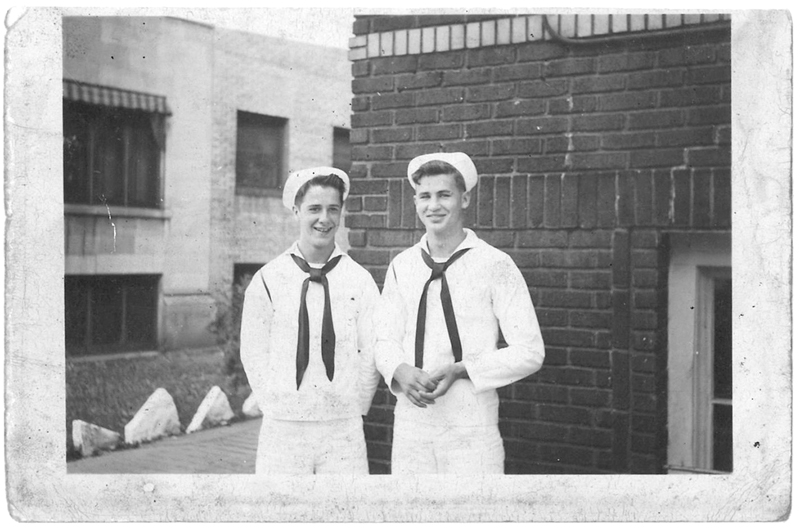
Wally Nelson on the right, during his early days in the U.S. Navy.
After the Navy, Wally continued on as an electrician stating that the Navy taught him pretty well. He was happy that it was a career he could use on the outside. He worked for many years at the University of Minnesota. He also said that he and his dad bought a garage and worked on cars at some point after he got out of the Navy.
Wally enjoyed being in the navy and made a lot of good friends in his years there.
Wally is a member of the VFW and Legion.
Doing some additional research on the internet I came across an August 2001 newsletter entry written by Ensign Richard Baruth, Officer-in-Charge LCT-1241, that lists Nelson as part of the crew, that article is below.
“My crew was very resourceful since they were able to obtain beer, a Jeep, a small power boat, and a vicious little spider monkey. All of these things made life a little easier. Generally speaking, duty was boring and routine around Okinawa.”
September 1944—Crew #5834 begins amphibious training at ATB Solomons, Maryland.
Personnel aboard:
Acuna, Frank – S 1/c
Baruth, Richard – Ensign
Elkins, Burman – F 1/c
Hayes – RM 3/c
Kinney, Alfred – MoMM 3/c
Lesser, Ted – MoMM
Marshall, Duke – SC 3/c
McManus, William – S 3/c
Nelson, Wallace – EM 3/c
Rusiewski, Mike – S 1/c
Simpson, Leonard – GM 3/c
Swanson, Warren – QM 3/c
Thompson, Bob – F 1/c
Zimmerman, Roy – BM 3/c
Training began on Chesapeake Bay. Training consisted of becoming familiar with amphibious warfare invasion techniques. Crew rapidly progressed through beachings, landing personnel, and unloading cargo on enemy beaches.
Crew #5834 excelled in basic training and landings. They were selected to navigate approximately 120 miles of the Chesapeake from ATB Solomons to the Yorktown Mine Warfare Arsenal, Yorktown, VA. Our job was to deliver a tank deck of shells to the arsenal for reworking. We navigated through the Chesapeake traffic of ships, ferries, and fishing craft without problems. On return, encountered a hurricane blowing up the East coast and forced to refuge in Norfolk. We just managed to enter Hampton Roads ahead of nightly closing of the anti-submarine nets. Road out storm tied up to a coal loading dock.
On 26 October 1944, we were detached from ATB Solomons with orders for sea duty. Left Washington D.C. as part of a 144-man rail troop movement for New Orleans. We were assigned to various landing craft headed for the Pacific.
October 1944, reported to the naval station, New Orleans. We were assigned the landing craft LCT-1241 for duty. LCT-1241 was lashed to the launching ways on the deck of LST-643. We were to remain piggy-back until launched at a future invasion sight. (Okinawa)
LCT-1241 was built by Manitowoc Shipbuilding, Manitowoc, Wisconsin, brought down Lake Michigan, through the Illinois River, and down the Mississippi to New Orleans. She was to be our sea going home for almost 2 years.
Late October aboard the LST we departed New Orleans for Biloxi, Mississippi, where the LST loaded a tank deck of ammunitions for the Pacific Theater (PTO). We went through the Panama Canal spending 3 days between the Atlantic and Pacific ports. Minimal shore leave was granted.
Left Panama and sailed up the west coast of Central America. During this trip friction between skippers of LST and LCT began over LST’s attempts to steal (via transfer) competent LCT crewmen and swapping for LST misfits.
Arrived at ATB Coronado, California (San Diego) where personnel problems were attempted to be resolved through the commander of the ATB. LST told to leave LCT crew as assigned. Many personality problems arose during our tour on LST-643.
Left San Diego in convoy of LST’s for Pearl Harbor. It was 7 days of very rough seas between U.S. and Pearl. Left Pearl after Thanksgiving. Our departure was probably applauded by the nested LSTs where 643 was assigned to tie up. The lousy ship handling by LST skipper was evident every time we were given a new nesting site. He had no ability to come along side without ramming neighboring ships. This was just one example of his poor ship handling.
After leaving Pearl, heading west, a crew picture was taken on the deck of LCT-1241 somewhere between Pearl Harbor and our next landfall.
We arrived at Eniwetok Atoll in the Marshall Island group. Several hours of R. and R. involving games of softball and beer drinking and on the return to the LST, LCT-1241 had a casualty. We lost Kinney who suffered a crushed foot between LST anchor housing and the gunwale of the small boat. He was reaching for a line when the sea swell rode the small boat up under the ship. He had to be returned to the States.
Next was Saipan in the Marianas island group to embark 1st Marine Division personnel, their water buffalo tanks, and ammo for Iwo Jima.
19 February 1945, we were part of the D-Day invading force at Iwo Jima. We disembarked Marine personnel and their amphibious tanks while standing off the beach. We did not beach until D plus 3 days. Since no anchoring positions off Iwo were available, we would steam at night in convoy. While awaiting beaching orders we saw our first Jap action when shells from Mt. Suribachi dropped around us. There were no casualties of either the LCT or LST crews. We left the Iwo Jima area 5 days after D-Day.
From Iwo to Leyte, in the Philippines we picked up small cargo and then went to Ulithi (approximate position 10 degrees N – 160 degrees E) to load men and equipment of the 3 Marine Div. Our LST skipper had orders along with other LST’s to round the island and beach to pick up Marine amphibious tanks directly off the beach. Our LST skipper decided he had a better idea and would take on the tanks while standing off shore and then beat the other LST’s back to port for the best movie selection. His idea was to lower the bow ramp into the water and signal the Marines to come out in the surf and board via the lowered ramp. He failed to count on the tremendous ground swell that picked up the bow of the ship forcing the ramp under the bow and slamming as the wave broke. Result was neither the ramp nor bow doors would be closed, 6 feet of water on the tank deck, flooded food and munitions and broken welds on the LCT. He was forced to back down in reverse to the port for 3 miles!
We backed into the harbor and blinker signals from the port commander demanded the captain report ASAP to the port commander. Entire crew thought we would finally lose him and he’d be relieved of duty. No such luck! He came back. We spent about 3 days in dry dock getting the LST and LCT repaired. Headed north.
1 April 1945, Launched and operating on D-Day at Okinawa. We, as an operating unit of the invasion force, took on our first tank of aviation gasoline and landed it at Red Beach north of Naha City.
During the battle for Okinawa LCT1241 operated in and around the Ryukyu Islands. Our duties were to bring in men, munitions, vehicles, gasoline, and anything necessary to support the troops. We were fortunate to have no casualties from Japanese fire. We were under many Kamikaze attacks. We went through many storms of the China Sea typhoon season with no major problems. They did serve to break up our routine of unloading ships.
My crew was very resourceful since they were able to obtain beer, a Jeep, a small power boat, and a vicious little spider monkey. All of these things made life a little easier. Generally speaking, duty was boring and routine around Okinawa. We did receive orders to complete evacuation of the US Navy from a small island north of Okinawa. This was le Jima. This is where Ernie Pyle, the famous war correspondent, was killed.
6 August 1945, we were happy to hear of the ”A” bomb on Hiroshima. Our LCT flotilla was scheduled to be part of ”Operation Olympus” the code name for the invasion of the Japanese home islands. August 9, 1945 Nagasaki was bombed.
August 14, 1945 was VJ Day–the end of the war. Much crazy shooting and celebration. We immediately began to rotate married members of the crew home.
LCT-1241 remained in Okinawa until March of 1946. It was then loaded onto LST-728 for return to the States. Aboard LST-728 from 9 March until May 1946.
5 May 1946, lifted off LST-728 at Mare Island, San Francisco. Stayed in port until we sailed into LSD (landing ship deck) #07 for the trip to Swan Island, Portland, Oregon.
As the skipper, I left the crew. Only 2 of the original men were left – Nelson and Swanson. Final fate of LCT-1241 is vague. References in Jane’s Fighting Ships (1975-76 edition) indicated the designation was changed from LCT to LSU-1241 and assigned further duties. Nothing further.