
Remembrances of Christmas Past: Pastor Les Walck: Christmas in the tropics of Papua New Guinea
PROTECTED CONTENT
If you’re a current subscriber, log in below. If you would like to subscribe, please click the subscribe tab above.
Username and Password Help
Please enter your email and we will send you a password reset link.


BROTHERS — My brother and I (Les Walck) by a Christmas tree. —photo submitted
Editor’s Note: The Rev. Dr. Leslie Walck has served as pastor at Colfax Lutheran Church for the past 25 years.
By Rev. Dr. Leslie Walck
COLFAX — Childhood memories of Christmas for me are Christmas celebrations in the tropics of Papua New Guinea (PNG), where my parents were missionaries, 1946 to 1972.
All children are eager for Christmas to come, and we were too. Being in the tropics, where there is no fall or winter, we didn’t have the advantage of thinking of the first snowfall as a prelude to Christmas.
For me, the sign of Christmas drawing near was the arrival of packages from uncles and aunts in the United States. Those boxes, wrapped in brown paper, and loaded with U.S. stamps, arrived in late November. Back in July or August, they had been shipped by “surface mail,” which meant they had come by ship across the Pacific Ocean.
Those kind relatives had done their Christmas shopping early in the summer. We, however, were not allowed to open them until Christmas Eve.
The next sign that Christmas was near was when students from the school went to an offshore island, where they gathered branches from the casurina trees. PNG did not have any Christmas tree farms, nor even any pine trees in our region.
Instead, the Americans chose to use casurina branches, which had long, soft needle-like leaves. Branches of the casurina trees 12 and 24 inches long were cut, enough to share amongst the missionary families on the Baitabag station.
My dad had already prepared a stalk of a banana tree, by stripping it of its leaves and the outer layers of the stalk. Gleaming white, it naturally contained a lot of water. About four feet tall, it was set upright in the living room in a bucket with stones in it to stabilize it.
Then we had the pleasure, under my dad’s direction, of creating a perfectly shaped Christmas tree. Longer casurina branches were stuck into the banana stalk at the bottom, shorter ones up top, and medium ones in between. My dad made sure the branches were evenly spaced and securely stuck into the moisture-laden banana tree stalk. It was always a work of art.
Then came the decorating. My mom had brought some 1940s era Christmas decorations from the U.S., and we carefully placed them on the tree, along with some homemade ones. She had brought — and each year saved — bright, silvery tinsel, which we draped all over the tree. After Christmas, the tinsel would be re-packed in tissue paper so it could be used the next year.
We even had real candles on the tree, and carefully lit them only for a short time of Christmas Eve. Then the brightly wrapped gifts that had been shipped all the way across the ocean were spread out under the tree.
Christmas Eve
Finally Christmas Eve arrived. After sharing in a Christmas Eve service with the students and faculty at the boarding school, we had our own family Christmas.
The Christmas story was read. We sang some Christmas carols, including ones that referred to the deep snows of winter, as well as “Jingle Bells,” though we had no idea what a sleigh was.
Prayers were shared asking God’s blessings on all our loved ones back in the U.S., and finally we were allowed to open the gifts. We received toys, games and clothes, and truly were appreciative of having those thoughtful relatives. But we also had to carefully re-fold the wrapping paper to be used again the next year.
We also enjoyed homemade Christmas cookies and bars.
The next day, we had a picnic at the beach. Although there were no snow or sleigh bells, we thoroughly enjoyed Christmas in the tropics.
First Christmas
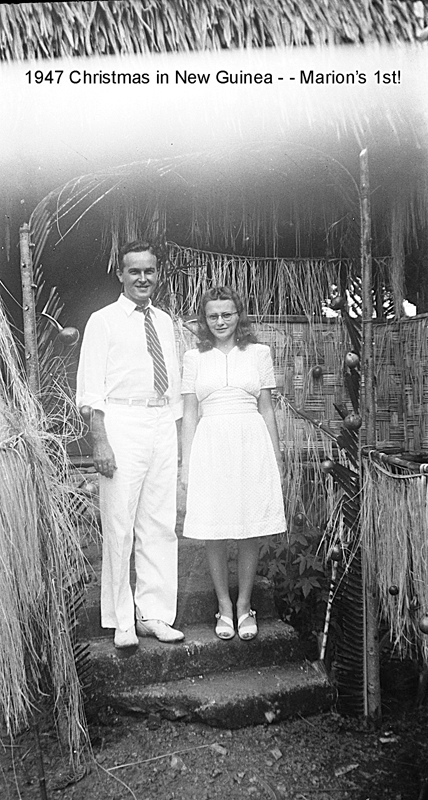
TROPICS — Pastor Les Walck’s folks, Christmas 1947, in front of the “Bush House” that they lived in while they were missionaries.
—photo submitted
I also want to share the truly amazing experiences of my mom’s first Christmases away from her state-side family. She has recently been sharing some of those memories about a non-Christmas in 1946 and then her first Christmas in PNG in 1947.
My dad had preceded her to PNG early in 1946, as part of the first group of new and returning missionaries after World War II had ended.
My mom then followed in December of 1946 as his fiancée, traveling by ship with a group of missionaries, some of whom were wives and children of those already in PNG.
Just being on that ship from San Francisco to Sydney, Australia, was truly amazing for a farm girl from southern Minnesota. It would be her first Christmas away from home — and then it turned out to be a non-Christmas!
How did that happen?
Well, the ship crossed the International Dateline right at Christmas, so they lost a day. They went from December 24 directly to December 26. Everyone aboard had no Christmas that year.
After disembarking, she spent about a month in Sydney as the guest of an Australian pastor and his family, before finally obtaining a visa to proceed to PNG.
She arrived in Lae, PNG, for her wedding on February 6, 1947. Their honeymoon started with a moonlit boat ride up the coast toward Madang. They travelled by boat, truck and eventually on foot up to the mountaintop mission station of Nobonob.
She was most eager to arrive at her new home, with her new husband. The new home was a “bush house,” made by hand out of local jungle materials.
Ironically, she realized, her forebears, when they first arrived in Wisconsin, near Milwaukee, from Germany 200 years before, also had built their homes by hand out of local materials. As they had lived in “bush houses” in Wisconsin, so now she was living in a bush house in PNG.
That first year on the mission field was a trying and challenging year. My dad had 18 villages in his circuit he had to visit regularly, and so he was gone part of the time.
Fortunately, an older New Guinean woman offered to be my mom’s “New Guinea mama,” who would help her to adjust to the tremendous changes required to live in PNG.
That was challenging in itself, but another challenge existed as well.
A local cult, the Cargo Cult, led by a charismatic leader, was challenging the Christian faith. Even though many of the people had been baptized Christians before the war, now they were led astray by dreams of quick and easy wealth. Eventually, however, the appeal of that cult died down.
“Hepi Krismas”
During that first year, another New Guinean, a teacher from a coastal village, along with his family, was transferred up to Nobonob to start a school. He taught them reading, writing and arithmetic, as well as Bible stories and songs. As Christmas approached, he asked if the school children could come and sing their Christmas songs.
My folks jumped at the chance, and made some cookies and lemonade, and had gifts of pencils, rulers and notebooks for each child.
The day finally arrived. The children were excited as they walked down the jungle path to my parent’s bush house.
The Christmas story was read by two of the elders. The children sang their Christmas songs. Treats and gifts were shared. It was a delightful Christmas celebration. My mom’s first in this country.
And then it was time for the children to return to the village. By this time the sun had set.
In the tropics, there is no winter; the days are all 12 hours long, with about 15 minutes of dawn and dusk; and temperatures rise into the 80s or 90s every day, even Christmas day.
So, since the sun had set, the children, their teachers and the other adults lit torches that were made out of palm tree fronds. The children skipped their way up the darkened path, carrying their torches, and shouting joyfully and excitedly, “Hepi Krismas! Hepi Krismas!”
My mom has reflected on that first Christmas in PNG. She and my dad realized that the Christmas songs, the shouts of “Hepi Krismas!” and the view of the torches heading up the hill had truly buoyed their spirits. These eager children were the future of the church, the weight of the challenges lifted, and it was all turning out to be worthwhile.