
Christmases Past – Mary Kiekhafer: “We always had our program at church, Beyer Settlement, on Christmas Eve.”
PROTECTED CONTENT
If you’re a current subscriber, log in below. If you would like to subscribe, please click the subscribe tab above.
Username and Password Help
Please enter your email and we will send you a password reset link.


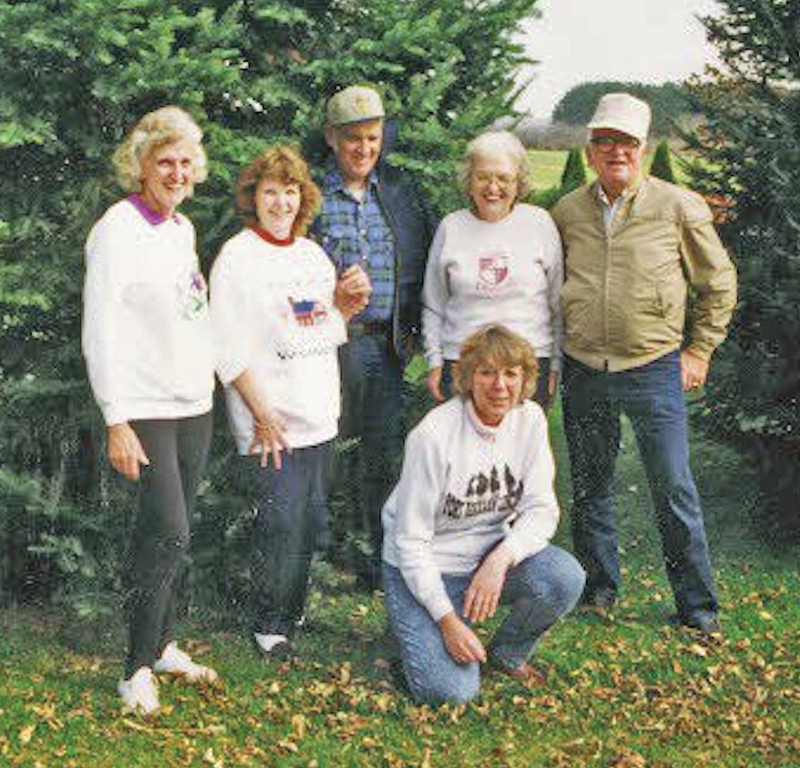
ROSE SIBLINGS — Mary Kiekhafer and her siblings. From left: Mary Kiekhafer, Carol Haff, Norman Rose, Sherley McKelvey, Dick Rose Jr. Kneeling in front, Janet Rose. —photo submitted
By LeAnn R. Ralph
COLFAX — Colfax resident Mary Kiekhafer grew up on a farm southwest of Colfax in Beyer Settlement. She went to school in the one-room Pleasant Valley School.
Mary, whose maiden name was Rose, had two older brothers, two older sisters and one younger sister.
In later years, Mary, along with Margaret Christianson, became the first two “women bus drivers” in the Colfax school district.
Here is Mary’s story:
On Christmas Eve, Santa Claus got his chores done. We always had the Christmas program at our church, Beyer Settlement, on Christmas Eve.
When we came home, for some reason or another, we all went in the house, but Dad didn’t.
And then there was noise in what we would call the front room. Someone else would call it a living room, but we called it the front room.
And Dad would go in the north door into the front room, and he would make a lot of commotion and then he’d come back out and put the car away.
We knew it couldn’t have been him in the front room making a commotion, because — he was in the garage. He had to put the Graham-Paige away.
People have to be back in years to know what a Graham-Paige is, because that was a car that my dad drove. He had two of them before he finally graduated to a Dodge.
We’d wait until everything got quiet and Dad came in, and then we would open up presents.
Some of the presents were there under the tree before we went to the Christmas program, but there were parts of them missing.
The boys would get sleds. I had two brothers. And they would get sleds and skis. One year, the oldest boy even got a bicycle out of the deal.
Of course, we were all a little upset about that, but then we all shared the bicycle.
I would get dolls and clothes.
Aunt Alma and Uncle Rob, my dad’s sister and brother-in-law, would bring oranges or apples for us every year. We always got a fruit bag from them.
That was a big deal because we didn’t get fruit very often.
Christmas farm
One year for Christmas, I got a farm set. It had to have been during (World War II) because the animals were made of pressed wood. The cutout was made of pressed wood, and then the picture was pasted onto the animal. So I had a farm.
My dad made sure I had some kind of a barn to put them in, a cardboard box or whatever it was, and unbeknownst to Mum, I would go into her clothespin bag and get the old straight clothespins, with the criss-crosses, and make fences.
That never went over big. She was not a person to like things like that, but she would tolerate it.
I had my farm, and I was happier than a clam.
Other than dolls and the farm and clothes, somewhere along the line, I’m sure I must have gotten a sled because my brother and I each had a sled.
I can’t think what else we might have had, other than the basic Christmas trimmings. We didn’t lack. We didn’t have a lot of money, but we didn’t lack.
At the Christmas program, we always got a bag of the old-fashioned curly ribbon candy. Good candy. And an apple or an orange. And one year we got a big Tootsie Roll. They didn’t make Tootsie Rolls in tiny pieces. They were big Tootsie Rolls.
Dad liked the old-fashioned grape wine at Christmas, too. We always had it for Christmas. Mogen David. Dad would always buy it.
Dad would go out and cut the Christmas tree from the swamp, and then we would sit around in the afternoon and string popcorn to decorate it.
We also had the colored paper chains we put on the tree. We’d make them at school, and then we’d divide them up and take them home for the Christmas tree.
Those Christmas trees from the swamp probably weren’t what people would like to have for a Christmas tree today, but we thought they were just fine.
Jim
For Christmas Day, my oldest brother and I, we had a horse named Jim, and he was a gentle creature.
We had an old cutter. We would get Jim squeezed in between the thills and hook him up, and then my brother Dick and I would take Jim and go for a ride. That worked fine. We got along well together. We always had a lot of fun.
But then, one year, Jim got to the point where he didn’t want to crawl between those thills anymore.
And we didn’t have another horse that would fit. Well they would fit, but they would not handle it. So we kind of had to give up on the cutter.
Jim had gotten older and a little on the cranky order. He was a good horse. He was solid brown.
We had a mare we drove with him who was real flighty. He would hold her down. Dad used to hook another brown colt he’d got with Jim, too.
This horse’s name was Pete. Dad got his hands on him somewhere along the line, in a trade or something, because Dad’s brother was kind of a jockey.
Pete was a good horse. He was a good lead horse, because he was always right straight ahead. But you had to have blinders on him, because if you didn’t have blinders, he would spook.
Dad would hook Pete and Jim together on the wagon, loaded with grain, and we would go to Rusk with those two horses. And everything was fine until we had to go across the railroad track where E, this was the old E, and Pete would get to that railroad track, and he would stop right there because he could not stand the sound of that wood on his feet.
Dad would hook Jim with him, and Jim would take the wagon and Pete and us, and we’d go across the railroad track.
One time someone came to hunt who liked horses, and Dad told him, “You can ride Pete. You’ll have to ride him bareback, but you have to be careful how you handle him, because when he takes off, he takes off.”
The guy said, “Oh, yes, I can handle him.”
This guy gets on him, and he went down the driveway all well and good, but he took him on the county road, and that horse took off.
This guy hung on for dear life. Until Pete decided he had gone far enough, and then he turned around and came back. There were shotgun shells strewn all the way along the road. Dad went down and picked up the shotgun shells and put them away.
That was the last time anybody ever rode Pete, and then Dad traded him off. He was not a horse to have around kids. My uncle lived with us, and he was my dad’s brother, and he was a little slow, and Dad was afraid would Pete would trample him or that he would hurt somebody else.
We farmed with nothing but horses. Dad didn’t get a tractor until I’d been married maybe four or five years. He and my brother worked together. Norman had a farm just up the road from him, but then Dad got to the point where he couldn’t anymore. He had an auction and got rid of it all.
I was a Rose. Phillip was a very close cousin of mine. He would come to our house on Sunday, and we kids just loved it when he came to visit.
At school
I have to tell you about the school Christmas programs. We always had two weeks off for Christmas, so the program would be the Friday before the first week off.
We had 20 kids in a one-room school. We went to Pleasant Valley, and of course, we had the big old iron stove in the corner.
You know, I laid in bed the other night and thought about it, and I was trying to figure out what we sat people on. There was only one door to get into that school house. But the stage was right at the front where you came in.
The people must have come in and sat at the desks or we must have had benches for them to sit on.
If you were the older kid, you got to pull the curtain, and you got to get the little kids lined up and you had to make sure they knew their parts, and if they didn’t, you had to stand behind the curtain and say the words, and then the little one would repeat it. They probably only had a line.
Right up until the very end, the eighth grade, I was kind of like the mother and combed their hair and made sure to tell them not to twist their skirts when they were standing on the stage.
They still do it, you know, at the Christmas programs at school. They still stand up there and twist their skirts.
The other night when I was laying there thinking about it, you know, Don Scharlau, from the tree farm [Pleasant Valley Tree Farm], Don and I were in school together. We grew up together. They lived back over on the tree farm, but we lived right out at the end of the road on a big farm.
Don was my age. We went through school together, and I thought, you know, I could call Don and find out what we sat on!
Janet
I had two older sisters, and then the two boys, and then me, and then nine years later, my younger sister came. She was an “oops.”
I was the youngest for nine years. I was a brat. I was spoiled. Not to the point where the boys couldn’t get me straightened out, but I was a little on the spoiled order.
Then of course, when Janet was born, that took care of that. Then all of the attention was given to her.
At that age, you don’t look at your mother to see if her tummy is bigger. And she was a big woman. She was always built big. I never knew what was going on. Aunt Alma and Uncle Rob came to visit and brought Mom a package.
She took that package and stuck it in the closet and didn’t open it.
I could never understand why Ma didn’t open that package — until Janet was born. It was a baby blanket in the package.
Jan was nine years younger than I am, and she passed away from a form of leukemia.
Christmas was always a wonderful time. We always had a lot of fun. My sisters were older, so they always got big girls stuff, and the boys got skis and sleds and the stuff boys are supposed to have.
But I got the farm!
I was married and gone from home when my sister Janet bought me the first doll that came out that was lifelike baby doll. She bought me one of those for Christmas one year.
I had that thing until it started to peel. The outside started to crack. That took care of my baby doll. I didn’t have her much longer after that.
One year, because my sister was so much younger, we liked to do things for her because she was the baby. Jan was probably 18 or 19 years old or maybe older and had gone to the Cities by that time. She came home, and I couldn’t find anything else to buy for her, so I got her a beanie with the propeller on it.
She hung onto that darn thing, and it was still in her stuff when we went through it (after Janet passed away).
Sugar cookies
When my mother baked, she made cookies. She had Norwegian blood in her, but she didn’t go to all that work to make the Norwegian things. Grandma Lunn did that.
My mother would make white sugar cookies that would melt in your mouth. When my mother baked — “you kids are nowhere near the kitchen.”
She would take a white dishtowel, the white flour sack dishtowels, and she would take one of those and tie it around her head because you did not get hair in the cookies, and — “You kids stay out of here!”
We’d wait until it got time to bake them. Then we could get the pieces that were left over and curled up.
We thought we had the world by the tail because we couldn’t have the sugar cookies but we could have the leftover pieces.
That was the limit of Mom’s Christmas baking. She had Norwegian blood. Her mother was Norwegian, but she didn’t make fattigman or sandbakels or krumkake. Grandma Lunn used to do all that.
[Mary’s first husband, Erling Lunn, died in the June 4, 1958, tornado.]
Grandma Lunn taught Danny how to eat lutefisk. He had never tasted it before that. She told us we always had to come over for supper before Christmas, and she’d make lutefisk. We all liked it. It was fish with butter on it!
Danny had never eaten it. She dished him up some, and boy, after that, you couldn’t get it away from him at Christmas when Grandma Lunn made her lutefisk.
We had one meal at Christmas at Grandma’s, and Danny had to have his lutefisk. [Dan Kiekhafer died in 1994.]
Oh, yes. We’ve always had a good Christmas.