
Colfax Advanced Biology class takes field trip


submitted by Tate Russell
On Friday, May 5, the Colfax Advanced Biology classes went on a field trip. We traveled down to Alma WI, stopping along the way to casually observe the bird populations at each site, and to test the water quality of the Chippewa, Buffalo, Red Cedar and Mississippi Rivers. We wanted to see how certain qualities of the water (Temperature, Transparency, Dissolved Oxygen Levels, pH, Phosphorus Levels, Nitrate Levels, and Oxygen Demand) varied from river to river.
The day started at 5:30 a.m., when we boarded a school bus and drove to the Red Cedar River, located in Colfax, to do a series of water tests. We then drove for about half an hour, to the outskirts of Elk Mound, where we tested the Chippewa River. We arrived at 6:40, and had finished with our testing in about 20 minutes. Our next stop was at the Buffalo River in Alma at 8:20 a.m. After this round of testing, the group headed to our final water testing spot, the Mississippi River. When the classes were finished with these tests, we went fishing on the Great Alma Fish Float, then ate lunch atop the bluffs at Buena Vista park, and finished off the day by visiting Nelson Creamery for ice cream.
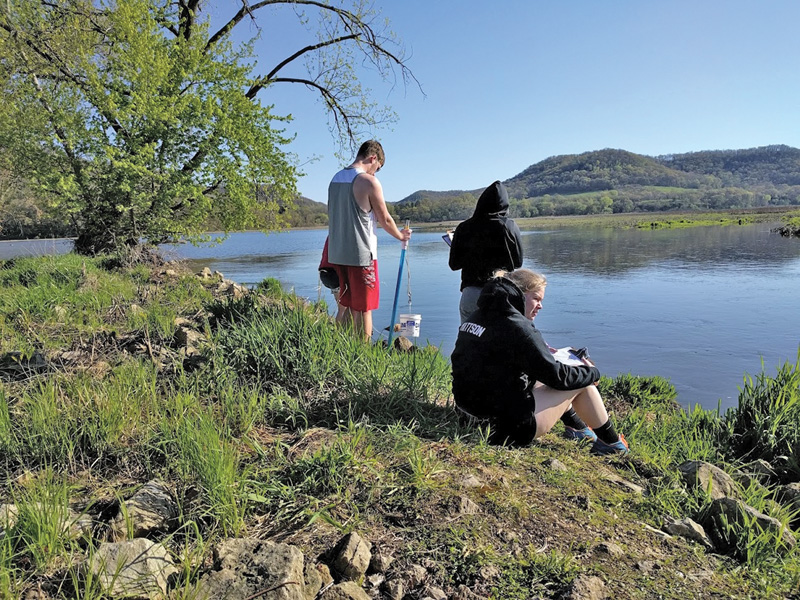 FIELD TRIP — Colfax High School students in Mark Mosey’s Advanced Biology class went on a field trip May 5 to Alma, and along the way, they stopped to test water quality in the Red Cedar River, Chippewa River, Buffalo River and Mississippi River. —photo submitted
As for our results? In our tests, we found the transparency of the Red Cedar and Mississippi Rivers were the best, meaning these rivers had the least amount of particles and sediment in the water. The Dissolved Oxygen test revealed the Chippewa River had the highest levels, with 11 parts per million (ppm), followed by the Mississippi with 9, the Buffalo with 7, and the Red Cedar with 6. Dissolved oxygen is what fish use as their oxygen source, and higher levels usually are better for the fish populations in the river. The pH, or acidity test yielded results in the 8.0-8.5 area (The pH for water is usually around 7.0). Our tests told us that the water we tested is less of an acid, but more of a base, which neutralizes acids. The next tests we did were the Phosphorus and Nitrate tests. In the Phosphorus test, we found the highest levels in the Buffalo River, with 0.83 parts per million, which is far over the healthy limit. The only other high measurement we found was in the Red Cedar, with 0.33 ppm. Both the Mississippi and Chippewa Rivers displayed normal levels of Phosphorus. As for the Nitrate test, we found none in any of the rivers except for the Mississippi River, with 0.2 ppm. The final water test we did was the Biological Oxygen Demand test. This tells us how many microorganisms are living in the water, because of the oxygen they take up from the samples we collected. We found no change in our oxygen readings, except the Chippewa River, which showed a demand of 2 parts per million of oxygen. This means there are some organisms in the water that are using up the oxygen.
In talking to my fellow students, I felt that we mostly enjoyed the trip (although waking up at 5 a.m. was a challenge for some!). We were able to gain an appreciation for the rivers around us and find out how these rivers are doing. The tests revealed nothing too much out of the ordinary, which is good because we can say that we are doing a good job of protecting our rivers! There isn’t a huge problem with pollution, and the characteristics of the water all seem to be how they should be. The ecosystem is doing well and we should keep it that way!