
Remembrances of Christmas Past: Yvette Viets Flaten: Memories of Christmas past … travelling around the world
PROTECTED CONTENT
If you’re a current subscriber, log in below. If you would like to subscribe, please click the subscribe tab above.
Username and Password Help
Please enter your email and we will send you a password reset link.


ANNIE’S CHRISTMAS CAKE — Yvette Viets Flaten (on left) pictured with her mother, Joyce Ette Viets, with the 2011 version of “Annie’s Christmas Cake.” —photo submitted
Editor’s Note: Although Yvette Viets Flaten did not grow up in Colfax, she spent furloughs in Colfax when her father, Colfax native Wayne Viets, was on furlough from the United States Air Force. She and her mother, Joyce, lived in Colfax for a year when Yvette was in high school, and her father was stationed in Thailand. Her mother and father retired to Colfax when her father retired from the Air Force in 1974. Yvette also married a young man from Colfax — Daniel Flaten. They were married at Colfax Lutheran. Yvette is a graduate of UW-Eau Claire.
By Yvette Viets Flaten
COLFAX — Memories of Christmases past are a great comfort to me.
As the holidays approach, I find I spend a great deal of time in the past, reminiscing about family and friends, as I sort through old recipes and make a list of all the ingredients I’ll need for baking.
As the decorations come out, each ornament reminds me of someone or some place special in our family’s history.
Treasured among the ornaments on our tree are a handful from my grandparents, and from my mother and father’s first Christmas tree. From my grandparents, I have three small Victorian glass ornaments: a ball, a walnut, and a pinecone that were passed down. And I have a delicate blue teapot that my father bought my mother in 1947, in symbolic recognition of her British heritage. It is a unique ornament. I’ve never found another teapot ornament.
Christmas 1947 was not the first Christmas my parents spent together, however.
My father, Wayne Viets, was stationed in England at Chelveston Air Station, with the U.S. Army Air Corps, beginning in October 1942. He had been trained stateside as an engine mechanic on B-17s and was posted to the 305th Bomb Group (Heavy) at an airbase that had been created in the midst of farm fields in Northamptonshire, in England’s midlands.
On Saint Patrick’s Day in 1944, while on a pass in the town of Northampton, he met my mom, Joyce Ette. She wasn’t too sure about accepting a “Yank’s” offer for a date to the “pictures” (movies) but agreed to meet him in the town’s market square and see how it went from there.
Evidently, it went well enough that she agreed to see him again, and over the next few months, he would ride the liberty trucks the 10 miles in from Chelveston to town whenever he could get a pass.
Invitation
As December approached, my mother’s parents, Arthur and Annie Ette, invited Wayne to “come for Christmas.”
My mother’s eldest brother, Leslie, was away, serving in North Africa with the British Army. Another brother, Alan, was in the hospital in Yorkshire, recovering from severe wounds received in Normandy in the first weeks after the D-Day invasion. My mom’s younger sister, Gwen, was sixteen.
It was a cold and austere Christmas that year. Food was rationed and Annie’s Christmas cake was made with things like powdered eggs and prunes substituting for fresh eggs (rationed at one per person per week) and raisins and candied peel.
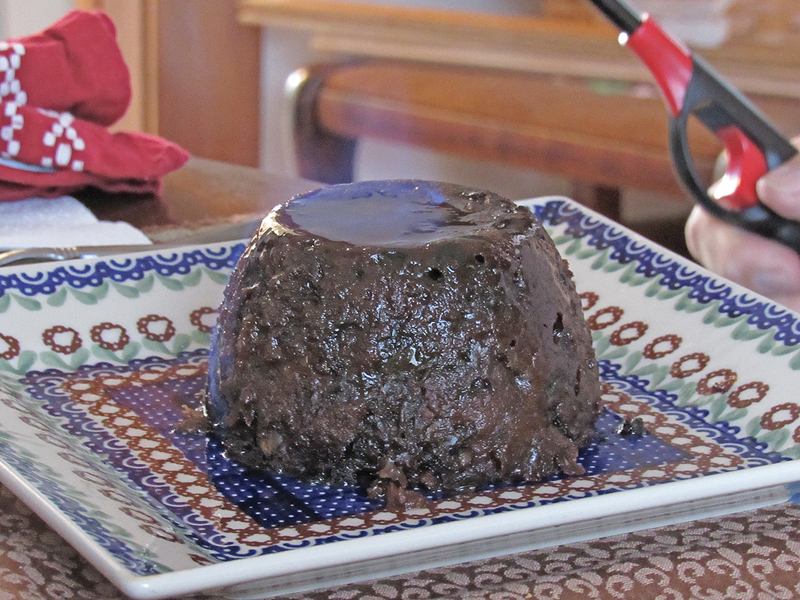
PLUM PUDDING — English plum pudding has been part of the Christmas tradition for Yvette Viets Flaten for as long as she can remember. The tradition also would not be complete without the “thimble of brandy” poured on top of the pudding and then set alight. —photo submitted
The house, like most English homes until the 1960s, was heated with coal in a fireplace, and that was severely rationed. Still, the family did have a traditional roast goose for the Christmas dinner, Christmas crackers to pull, and a Christmas tree, but not a cut one.
The tree lived at the far end of the garden and was dug up and potted in an old clothes copper and brought in year after year. It was at most, three feet tall, and sat on a small table before the front windows, decorated with ornaments and tinsel.
Christmas dinner was the highlight of the day, culminating with the serving of Annie’s plum pudding, complete with a sprig of holly stuck on top. Just before serving, the lights were shut off and a thimble of brandy poured over the pudding and then set alight.
In the darkened room, the lovely blue flame glowed and added a bit more flavor as it burned off. Then the Christmas pudding was cut and served, and someone at the table would find the good-luck silver coin that was baked inside.
In 1944, it would have been a three-penny coin, called a ‘thrupenny bit,’ long out of circulation. (Today, I use an old sixpence coin, also retired.)
I don’t know who got the lucky coin in 1944, but the tradition of that plum pudding, the coin, and the fun of seeing the blue flame lit became a tradition that my mother brought with her when she came to the U.S. and married my father.
Throughout the years that followed, no matter where we lived, our family continued that tradition on Christmas Day.
I had the good fortune to experience a number of English Christmases as I was growing up. My father, after five years as a civilian mechanic, working for Frontier and United Airlines, re-enlisted in the now-named U.S. Air Force in 1950. He was stationed in Denver, where I was born in 1952, and then at Nellis AFB in Las Vegas, Nevada.
In 1956, orders came for a relocation that made my mother ecstatic. We were ordered to England. She was going home!
We were posted to RAF Manston, on the southeastern coast of Kent. We lived in the town of Birchington, right on the sea, and my first memories of Christmas are from our house there, and being at my grandparents’ in Northampton.
As I grew up, I came to realize that I had had the chance to experience very traditional, and very Dickensian, Christmases in those early years, straight out of “A Christmas Carol.”
Another move
The year 1959 gave me a new experience of Christmas.
We were now stationed at Grand Forks, North Dakota, and found ourselves living in the small town of Larimore. Prior to this, we had lived in the desert Southwest and in the temperate English climate where winters might be wet and gray and frosty but certainly never BELOW ZERO!
Now, my mother ordered me snow pants and a parka from the Sears catalog, and I learned all about ice and snow and blizzards during our two years stationed there.
We didn’t have goose those years, but I recall roast turkey and Scandinavian baking and treats from our neighbor, Ingeborg. She was older and taught my mom to make lefse, which my dad loved, being from Colfax originally and half Norwegian.
Although it may not be an exact Christmas memory, I recall the night, well after ten o’clock, when Ingeborg’s husband, Bud, came hammering at our kitchen door.
“Come out, come out,” he called when my dad cracked the door. “Bundle up and come out! Hurry!”
We bundled up and stepped out into one of the coldest nights I can ever recall.
In silence, our jaws dropped.
The Northern Lights filled the entire sky. I have never since experienced anything like that night. The colors were brilliant. Reds, then greens, then faint blues and golds shimmered and danced overhead and repeated their play, over and over.
For a while, the lights were like a fountain pouring down out of the top of the world; then they became columns that rotated and swirled and pulsed like huge search lights.
We stood in awe.
But it was bitingly cold, and we soon went back inside to warm up, before going out again.
My father said it was thirty below zero that night. I believe it. Both the northern lights and cold took my breath away, and left me with a love of astronomy and a deep respect for winter weather.
France
In August 1961, a new set of orders stated that we would be going to France, to be stationed at Châteauroux AFB, a large NATO base in the center of France, near the famous valley of the chateaux on the Loire River.
Once there, I entered the fourth grade, and like all American students in Department of Defense schools, we had French lessons twice a week, to help us appreciate the country that was now home.
I loved it and soon became able to understand and speak to our French neighbors and translate for my parents when we shopped and travelled. We made friendships in France that have lasted a lifetime.
I became friends with Marguerite Lefour, who lived across the street, and we exchanged gifts at Christmas. Her parents invited us to celebrate “Le Jour de Rois,” or Three Kings’ Day, on January 6, which is also Epiphany.
At their home we got to taste the rich “galette de rois,” a tart of puff pastry with an almond cream filling called frangipane. Not unlike the good luck coin in the English Christmas pudding, the galette also has something hidden inside it that brings good luck: A fève, or fava bean, or a small trinket.
Somehow, Marguerite’s mother, Germaine, managed to cut the galette and make sure I ended up with the slice with the charm — in my case, it was a small plastic crescent moon — which I still treasure to this day. And the finder gets to wear a gold crown that comes with the cake, in honor of the journey of the Three Kings.
Another family with whom we became friends, Yves and Jeanne Stéphan, and their four daughters, invited us to join them on Christmas Eve in 1963 for what the French call La Réveillon, a celebration dinner.
We arrived at 6 p.m., not really knowing what to expect, but two things soon became apparent: The French, as a rule, spare nothing as hosts, and that Madame Stéphan was an excellent cook.
We began in the salon, with aperitifs for the adults, and a huge tray of the most scrumptious hors d’oeuvres that included small tidbits of sausages, shrimp, cold meats and pickle on small diamond-shaped pieces of fine bread. Exquisite!
After an hour or so of conversation, we proceeded to the dining room. We began with a simple consumé, which was followed by a pâté, (rabbit, I think it was), then classic escargots (snails) in butter sauce, followed by the highlight of the dinner, pigeonneau berrichones, pigeon cooked in the style of Berry, the region in which we lived. They were halved, stuffed with a giblet and mushroom mixture and served on toast points, covered with a delectable sauce. With them, Madame Stéphan chose to serve tiny peas in individual pastry shells, so elegant and delicate.
The meal ended with cheeses and pastries, and finally coffee and liquors for the adults.
At some point near midnight, Monsieur Stéphan excused himself from the company and after a little while there was a knocking at the front door and Père Noël appeared, in his red hood and cape, carrying a sack on his shoulder. He delivered gifts for the children, me included, and then laughing and calling “Joyeux Noël,” he went out again.
The older girls, Yveline and Nadine, knew it was their father, but the two youngest, Joceline and Isabelle, were wide-eyed and astonished true believers.
After we said our thanks and goodbyes, we began our drive back to Chateauroux, arriving home about 2:30 in the morning. I had never been up so late, and we had never eaten such an elaborate dinner, an entrée to true haute cuisine. It left a huge impression on us.
Over the years my mom would recreate one or another of the dishes, the petits pois in pastry, or the escargots. When I had my own kitchen, I experimented with the main dish, substituting Cornish game hens for the pigeons. It’s a close substitute that I’ve served at Thanksgiving and Easter dinners.
I have never forgotten the lessons of good food and good hospitality that I learned from our French friends, and when Christmas comes, I think of the holiday celebrations we shared with a special fondness.
Colfax
The year 1968 was momentous for our family. At the time, we were stationed at Paine Field AFB in Everett, Washington, when my father received orders for Ubon, Thailand.
This was during the height of the Vietnam War, and there was no possible way that my mother and I could accompany him overseas on that tour. And as Paine Field was also being decommissioned at the same time, we decided that we would spend the year of separation in my dad’s hometown, literally the only place in the United States where we had any family at all.
At the beginning of November, we packed up and moved to our new home — Colfax.
I was familiar with the village. We had always visited here during our furloughs, and when we had been traveling to or from our latest stateside or overseas assignments.
My grandfather, Ralph Viets, had been a barber and his barbershop had been located behind the old Farmers Store. The Viets House once stood at 509 Pine Street, the site now occupied by part of the CTL building. (The Viets House was moved from its original location in the 1990s and now stands at 811 E. Railroad Avenue.)
In 1968, my aunt Vivian Grimsrud and her daughter, Lucy Pat Glasier and her family lived in the old house, which had been the village’s original Hotel Royal.
When we arrived from Washington, we stayed there as we looked for a home to rent and waited for our household goods to arrive.
I was a junior in high school that year and on the first day of school in Colfax, as I walked toward the north side, it began to snow. And snow and snow.
My dad left for the jungle heat of Thailand just before Thanksgiving, and we, who had not lived in a cold climate since North Dakota, had to relearn winter skills all over again.
It didn’t take long. That winter was very snowy. I remember the joy of several “snow days,” even though it meant I had to shovel the driveway.
Christmas without my father could have been a somber affair but my mom and I made the best of it. We put up a Christmas tree, which took some doing without my dad’s expertise in cutting the trunk level so it stood straight.
We spent Christmas Eve with my aunt and family and enjoyed an old Viets tradition of fried oysters for supper before going to evening services at the Methodist church.
The tradition of fried oysters came from the Hotel Royal days at the turn of the century, when the family would have a barrel of oysters shipped from back east to the Colfax depot.
Christmas morning was bright and sunny but cold. We went to the Viets House for a traditional Christmas turkey dinner. And that year, my cousin Pat, another great cook, made the family’s old Yankee ‘steamed pudding,’ for dessert, which is the American version of English Christmas pudding, cooked in a double boiler, the basic recipe nearly identical.
That year was also the Year of the Pies. We had apple, and pumpkin, and my mom’s mince pie.
When we asked Aunt Vivian which she wanted, she replied: “A piece of each!”
Sounded like a good idea to the rest of us, too.
Next …
As I entered my senior year of high school, I knew we would soon be learning where our next station would be, and my mom and I eagerly awaited the letter with that news.
It seems odd now, but in 1969, there was no email, and a telephone call to my father in Thailand was out of the question, both in cost and logistics.

SPANISH CHRISTMAS TREE — Yvette Viets Flaten’s mother, Joyce Ette Viets, pictured in 1970 with the potted Christmas tree they had while stationed in Spain. In the lower left corner is the Feliz Navidad ornament Yvette and Joyce purchased on Christmas Eve. —photo submitted
So, when the letter arrived, my mom opened it and read out my dad’s opening line — “Sí, sí, señoritas! We’re going to Spain!”
We had been posted to Torrejón AFB, just outside of Madrid. I was thrilled. I had been studying Spanish for two years, to go along with my French, and now here was a chance to travel again, and learn more of the language … but…
But.
I had met someone in school, and we had gone on one or two dates, to movies in Eau Claire … I liked him … But now, another move was imminent.
When we left for Spain in January 1970, I was truly torn between wanting to stay and wanting to go. The day we left Colfax, January 3, it was a cold, below zero morning, snow banks lining Main Street, the fields white as far as the eye could see. We flew out of McGuire AFB in New Jersey and arrived at Torrejón on the night of 6 January.
It was raining lightly and the temperature was 60 degrees. It was a huge shock to my mom and me, who still had on our Wisconsin coats and boots and scarves and gloves. We were so overdressed!
And the day of our arrival, on Epiphany, was Spain’s biggest Christmas celebration — Día de los Trés Reyes — Three Kings’ Day.
The stores in Madrid were decorated with lights and Three Kings figures everywhere, completely different from our depictions of Santa Claus.
Sort of like Dorothy, I knew I wasn’t in Wisconsin anymore.
Spain is a Mediterranean country with a dry climate that produces great crops of wheat, olives, and grapes, but does not grow Christmas trees. Spaniards do not decorate trees as northern Europeans or Americans do; instead their holiday decorations center on a central nativity scene and ornaments and candles.
On Christmas Eve, the figures of the Three Kings are placed somewhere across the room from the stable. Each day, starting on Christmas Eve, the figures are moved a little closer to the Christ child, until on January 6, they arrive at the stable. That’s the day when Spanish children receive their presents, in commemoration of their arrival.
Our first Christmas in Spain we did manage to have a tree, however. Our Spanish neighbor, Juanita, told us that a garden nursery in our town of Alcalá de Henares had some and said she would call for one for us. She did.
That night two men arrived at our second floor apartment, toting a huge ceramic pot with a living tree in it! Shades of my mom’s childhood in England!
We were taken aback, but paid the hefty price, and happily decorated it. We had it up until long after the 6th and eventually gave the tree to our landlord who planted it in the garden of a church convent.
Christmas surprise
That first Christmas in Spain gave us another surprise.
After supper on Christmas Eve, my mom and I decided to go out for one last look around the stores, which in Spain were open until 8 p.m.
I suppose we were both expecting to step out into a muffled and reverent Wisconsin Christmas Eve, with snow falling silently on quiet streets, and lights glowing from every home’s windows. A real Christmas card scene.
When we stepped out into our street, we were instantly struck by the noise and the press of the crowds passing. It was Fiesta! The day, which marks the beginning of the celebration of Navidad, The Nativity, is celebrated with merriment and joyful noise.
There were groups of students walking around the Plaza Mayor singing, playing guitars and shaking tambourines. Families were out, meeting in bars and restaurants for tapas. Everywhere, people were calling out and greeting one another.
On a street corner, we stopped and bought a little bag of roasted chestnuts from a woman who had a coal brazier set up there. It was a new experience that night, but over the next three years in Spain, I came to love the wintertime roasted chestnuts.
We bought an ornament that night, too, a big green ball with the words Feliz Navidad, picking it out from the stalls that were set up on the plaza.
People would stay out on Christmas Eve until they went to midnight mass.
Home again
When our tour of duty in Spain ended, we returned to Wisconsin. My father retired from the Air Force in April 1974, and my parents decided to live in Colfax.
In May of that year, I graduated from the University of Wisconsin — Eau Claire, with a degree in Spanish. While I was finishing my studies there, I met that boy again, the one I had dated back in my senior year in high school.
We went to the movies again, and found out that we still enjoyed each others’ company.
On November 23, 1974, Daniel Flaten and I were married at Colfax Lutheran Church.
Dan’s Norwegian and Swedish heritage enhanced our Christmas traditions.
As we began our own family, we celebrated with Dan’s parents, Reverend Irwin and Edith Flaten, in their family’s way, with a Christmas Eve meal that often included spare ribs or Swedish meatballs, lefse, kringle, and a host of other sweets.
After dinner was finished, we opened gifts, as opposed to the English tradition of opening them on Christmas morning.
This led, in fact, to our son and daughter having two Christmases. On our tree we now had straw stars and goats and Dala horses, as well as a couple very special bells from Dan’s mother’s family, authentic sleigh bells from the work horses’ harnesses. They jingle with such a deep and special tone that one might almost think that they are really his sleigh bells.
Over the ensuing years, the traditions of Dan’s family and my family blended together, creating our own particular Christmas celebration.
For example, we love Norwegian sandbakkels, fattigmann, and lefse as much as we love English Christmas cake and mince tarts. We have lutefisk and pickled herring as well as roast goose with sage dressing. And we always try to keep the English tradition of Boxing Day as a day of rest, staying home on December 26.
2020
This year, with the advent of the Covid-19 Pandemic, we are all facing unknown challenges, and this Christmas will undoubtedly be different from those in the past.
In fact, it reminds me very much of my youthful experiences, traveling and living abroad in new countries and experiencing their holidays in different ways.
It also reminds me of the two Christmases when my father was overseas, and my mom and I were stateside. Then, we resolved to make the best of the Christmas that we had. We kept the traditions that we could keep, but we were open to having the day be something new, something unique, and perhaps, something that we could add to our own family’s Christmas legacy.
Now, we have the opportunity to do the same, recognizing that this 2020 Christmas will be a singular and unique experience, albeit one, we hope, that will not soon repeat itself.