
Bob Fehr and the Atlantic Giant: growing “The Great Pumpkin”
PROTECTED CONTENT
If you’re a current subscriber, log in below. If you would like to subscribe, please click the subscribe tab above.
Username and Password Help
Please enter your email and we will send you a password reset link.


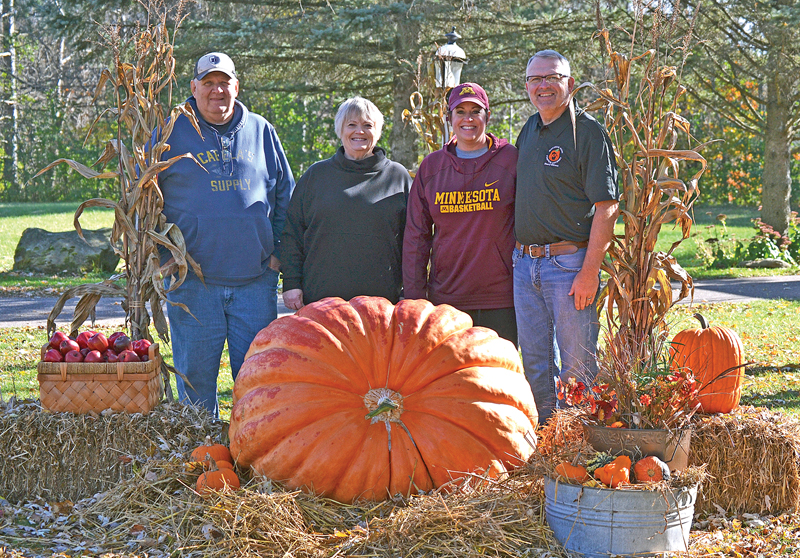
650 POUNDS — Bob Fehr of Colfax mentored his aunt and uncle, Mike and Carol Boyd, while the Boyds raised this 650 pound Atlantic Giant pumpkin this summer. The pumpkin is on display at the Boyd home on Iverson Road in Colfax, and trick-or-treaters are welcome to take a picture of their kiddos in costume with the pumpkin. In his own garden this year, Bob grew an Atlantic Giant that tipped the scales at 1,040 pounds. From left: Mike Boyd, Carol Boyd, Jan Fehr and Bob Fehr. —photo by LeAnn R. Ralph
By LeAnn R. Ralph
COLFAX — Colfax resident Bob Fehr set a goal for himself: to raise a pumpkin that weighed more than a thousand pounds.
And this year — he succeeded.
His aunt, Colfax resident Carol Boyd, also decided to try her hand at raising a giant pumpkin this year.
Carol’s pumpkin weighs an estimated 650 pounds.
“These pumpkins are like raising another child,” Carol said.
“Carol’s display for Halloween will be awesome. There will be a couple of hundred kids coming down through here for trick-or-treating, and they’ll be able to enjoy that and have a chance to take a picture with it,” Bob said.
Mike and Carol Boyd live at the end of Iverson Road in Colfax.
“They have a certain way they measure it to figure out the weight, but Bob’s was actually put on a scale. We were gone during the competition, so we didn’t take ours to be weighed,” Carol said.
Bob is a member of the Wisconsin Giant Pumpkin Growers Association. His pumpkin was weighed at the weigh-off in Altoona and came in at 1,040 pounds.
Bob’s pumpkin placed in the top 10 for weight and was second place for the prettiest pumpkin. He has earned “Heavy Hitters” designation because the pumpkin was over a thousand pounds.
After the weigh-in, the pumpkin then went on display at Valley Pasture Farm. Bob planned to harvest the seeds after Valley Pasture’s last weekend to be open for the season.
“That one has really good genetics, and (Carol’s) pumpkin has really good genetics,” he said.
Nerve wracking
Hauling a pumpkin that weighs more than a half a ton is a careful process requiring a special harness to pick it up off the ground.
“Then you need a skid steer or a tractor, and you can lift it up, and then we’ll slide a pallet underneath it, and then you can lift that with pallet forks,” Bob explained.
“A lot of people think you roll them (while they are growing) to keep them round, but you actually want that flat spot on the bottom for hauling so they won’t roll around,” he said.
“That’s a pretty nerve wracking job. Because you don’t turn them, you really don’t know what’s underneath. You could lift it up, and the whole thing could fall apart if you have rot on the bottom. You really don’t know until the end of the season if you’ve got a good pumpkin or not,” Bob said.
This was Bob’s fourth year of growing Atlantic Giant pumpkins. A friend of his from Menomonie, Shannon Engel, who is a professional grower and pumpkin carver, got him started.
“He said, ‘I heard you have a garden. Here put this in.’ And he handed me a little plant. I said, ‘What is it?’ He said, ‘It’s a giant pumpkin.’ I said, ‘What can I expect?’ He said, ‘Oh, you should get a couple hundred pound pumpkin.’ I was a little intrigued about that. I didn’t do anything to it, and I ended up with a pumpkin that weighed 320 pounds,” Bob said.
“So, I got to thinking — I wonder what would happen if I tried? Subsequently, I’ve been working on my soil. Soil is very important to growing giant pumpkins. Mine is all clay, and it’s getting to the point now where it’s decent, although it’s still not great,” he said.
The second year, Bob’s giant pumpkin weighed 600 pounds. Last year, the pumpkin he raised was a little over 700 pounds.
“My goal in this whole thing was to get one at a thousand pounds, and I reached that this year at 1,040 pounds,” he said.
No wet feet
Although Bob lives on the north side of Colfax in an area where the soil has more clay, at the Boyds’ house on Iverson Road near Eighteen Mile Creek, the soil is more sandy.
“He came up here, and he said, ‘Look at your soil! This is good for pumpkins!’” Carol said.
“Pumpkins like damp soil, but they don’t like wet feet. They want well-drained soil. My second year growing, if I turned the water on for 30 seconds, I had puddles. That’s how much clay there is. Now I can water for 20 minutes, and it will soak that up,” he said.
Fehr bought a timer this year and set it to water four times per day but only five minutes at a time. So, every six hours, the pumpkin plant was watered five minutes for a total of 20 minutes per day. All together, the pumpkin received about 500 gallons of water per week.
“I had a one-month stretch where my pumpkin averaged 24 pounds per day that it was putting on,” Bob said.
Instead of sitting and watching the pumpkin grow, it’s more a matter of getting up in the morning and seeing that your pumpkin has grown overnight.
“The pumpkin, the fruit, only grows at night. During the day the plant, the big leaves on the plant, will absorb energy from the sun, and the plant uses that to grab the nutrients from the soil, and then at night, the pumpkin grows,” Bob said.
“You have to cover it with a sheet at night and a blanket so they don’t get cooled down. It’s just like tucking a kid in at night,” Carol said.
“From the day the pumpkin is pollinated, and I self-pollinate, and that’s to keep the genetics intact. You don’t want the bees cross-pollinating. From the day the pumpkin is pollinated, you cover the fruit portion. You want to cover it from the sun because you don’t want the skin to dry out when it starts growing. You want the skin to be soft and supple so it doesn’t crack when it starts growing,” Bob said.
“When the night-time temperatures start to cool down, then you put a blanket on it because you want the night-time core temperature to stay warm. If it senses cold, it’s a signal to the fruit to stop growing and to shut down,” Bob said.
“You want to keep it warm all the way up until the day you pick it,” he said.
“What’s surprised me is how many days they will grow. I just thought they kept growing,” Carol said.
“The pumpkin will grow 100 days from pollination. My pumpkin was a 1,040 pounds, but it was actually only 80 days old,” said Bob, who starts his pumpkin plants indoors in April.
“I can’t bring the plant outside until the threat of frost is gone,” he said.
Fehr said Engel plants his pumpkin plants around May 10 but then has a little greenhouse he puts around the pumpkin plant.
“It will hold the plant for three weeks, and then the plant gets too big. But then he’s out of the woods as far as temperatures,” Bob said.
“I think I have a line on a small hoop house for next year,” he added.
“If they’re putting on 20 pounds per day or 30, and the really big ones will put on 40 or 50 pounds a day, but if you can get 20 extra days, and even if it was only doing 10 pounds a day, that’s 200 extra pounds,” Bob said.
“What you need to get a big one is good soil, good seeds with good genetics — and good luck,” Bob said.

WHOPPER — Bob Fehr of Colfax poses with his 1,040 pound pumpkin at the River Prairie Giant Pumpkin Festival weigh-in. If you look closely, you can see the digital scale readout in the upper right hand corner — 1,040 pounds. Bob has been raising Atlantic Giants for four years, and to date, this was his largest pumpkin. —photo submitted.
Genetics
There are two lines of genetics for the Atlantic Giant pumpkins.
Carol and Bob’s pumpkins both have a good shape and a nice, bright, orange color.
“The big ones, like the world records and the 2,000-pounders and the 1,700 pounders, they are a pale color. Like a cantaloupe with only a few wisps of orange in them,” Bob said.
“When I got into it, Shannon is big on shape and color. And I thought, if I’m going to grow one, I want it to look like a pumpkin. I don’t want people to walk up and say, ‘What’s that?’ I shouldn’t say never, because the genetics are improving every year, but the genetics I grow, if I could get one that’s 1,500 pounds, that would be pretty good for those genetics,” Bob said.
One pumpkin plant needs a minimum of 500 square feet. Bob has about 800 square feet in his garden and plans to expand it a bit for next year for two plants.
“Why I grow, I like to share the pumpkin with other people. The last two years, Missy Prince caught wind that I was growing one, so the last two years, we had the kindergarteners and the first graders come for field trips. That’s my favorite day of the year. Those little kids ask so many questions. Most of them are relevant to growing the pumpkins. They are very curious, and they come up with some very good questions. They haven’t stumped me yet, but they’ve come close,” he said.
If someone wants seeds, he or she can contact Bob Fehr, and he will be happy to share.
“Sometimes you only get 10, but usually you get a couple hundred. They can buy seeds from an organization. I’m not going to sell mine. I’ll give them away and let other people try it if they want to,” Bob said.
When he gives away seeds, he gives five or six so there is at least one seed that will grow.
Hazards
Several hazards can strike fear into the hearts of pumpkin growers.
Insects, for instance, such as squash bugs.
This was the first year Bob had squash bugs.
“I was able to get them out of the vine and applied insecticide and was able to get them stopped. It’s high risk. My second year, I had a nice one growing, it was about 450 pounds, and I ended up with a stem split on it,” Bob said.
The vine must be adjusted as it is growing to avoid ending up with a split stem.
“Before I could get to it, the stem split and went into the pumpkin, and I lost it,” Bob said.
“I showed Carol and Mike a picture (of the squash bugs), and I said, ‘if you see any of these, call me immediately.’ They start out as a little orange and black beetle, and then they lay eggs, and they look like those little waxies that you use for ice fishing,” he said.
“I can be a babysitter now. When they go away, I can go up and watch the pumpkins,” Carol noted.
Weather can also be a danger to the pumpkins.
“I would call Bob at work. ‘Bob, I think it’s supposed to hail today. What I am supposed to do?’” Carol said.
“I probably made four calls this year to Jan at the school, because I could see weather coming in. ‘Hey, could you run home?’ I’ve got wool blankets and Carol had wool blankets, just for hail damage,” Bob said.
Anyone who has, or has had, students at Colfax High School or Middle School, will know Jan Fehr. She is the office secretary who keeps the place functioning.
“Jan had a lot to do with it,” Carol said.
“Jan puts up with a lot. She puts up with eating dinner at 9 o’clock on summer nights. I come home, and I go straight to the pumpkin patch. We come in and have late dinners. That goes on for at least a month,” Bob said.
Soil compaction can be an issue, too.
“I’ve got walking boards and stepping stones in my garden. If you compact the soil, it inhibits root growth,” Bob said.
One morning, momentary panic set in for Carol after a deer had walked through their garden.
“I got up in the morning, and I said, ‘I know those are deer tracks inside the patch.’ The pumpkin was covered, so they didn’t get at it,” Carol said.
Whitetail deer love pumpkin.
“Especially if they can get into the shell. If they can get it broke open, then it’s all over,” Bob said.
Squirrels are not welcome, either.
“The first year I had squirrels that got after mine,” Bob said.
“I was chasing it with a broom,” Jan said.
“I got rid of those. I live trapped them. Took them across river. I said, ‘You’re going to have to swim if you want to come back,’” Bob said.
“Since then, knock on wood, I’ve not had any trouble with critters getting in there. I’ve been lucky that way,” he said.
One day Carol found a scratch on her pumpkin — and then found herself dabbing liquid bandage on the scratch.
“It’s the equivalent of peroxide for us or iodine. If you get them treated, they will scar right up, just like our human skin. There’s a lot of tricks. I’ll call Shannon, and he’ll answer his phone, ‘Pumpkin 911. What do you need?’” Bob said.
40 percent
When asked how Bob had managed to talk his aunt into growing a pumpkin, Carol said, “He just brought a plant up one day.”
“I think you mentioned that you would like to try it,” Bob said.
“Well, maybe I did. It was kind of a whim. It was fun. I learned a lot,” Carol said.
“Carol and Mike did a great job too. You don’t get something like that without spending time. I’ve given seeds to quite a few people, and they’ll call me, and they’ll say, ‘I’ve got nothing.’ I’ll go out, and the vines (are all over). There’s so much more than putting seeds in the ground,” Bob said.
“I still consider myself to be very much of a novice. I am far from professional. I have learned a lot. I have learned a lot from Shannon. But as I told Mike and Carol, I probably know about 40 percent of what I need to know,” Bob said.
In addition to the pumpkin at Valley Pasture and the one at Mike and Carol’s, the growing operation produced a third pumpkin that is in Pam Moen’s yard on University Avenue. Pam is Bob’s sister.
“You sang to yours,” Jan said.
“Yes, I said I think mine was growing really good because I’d sing to it. And weed,” Carol said.
“Bob got really nervous when I went up to look at his when they first started growing. I said, ‘That twerpy thing?’” she said.
“In the sandy soil, hers really took off right away, and I’m like, ‘great.’ Mine was a slow starter. Hers was like 200 pounds, and mine was like this big (the size of a basketball). And she said, ‘that little thing?’ I said, ‘Just wait.’ And it was about three weeks, and it passed this one up,” Bob said.
“Then I was jealous,” Carol said.
“One thing about Colfax, and this whole band through Wisconsin and Minnesota. If you look at where the growers are from who are bringing the big pumpkins to the contest, many of them are right on the 45th parallel. That’s supposedly the ideal climate for the pumpkins with the daytime temperatures not being too hot and the nighttime temperatures not being too cool,” he said.
Shannon “always says to me, ‘I’m sorry Jan. I’m sorry for getting him into this.’ But it’s a good hobby,” Jan said, noting she never has to wonder where Bob is.
“He’s always in the pumpkin patch,” Jan said.


